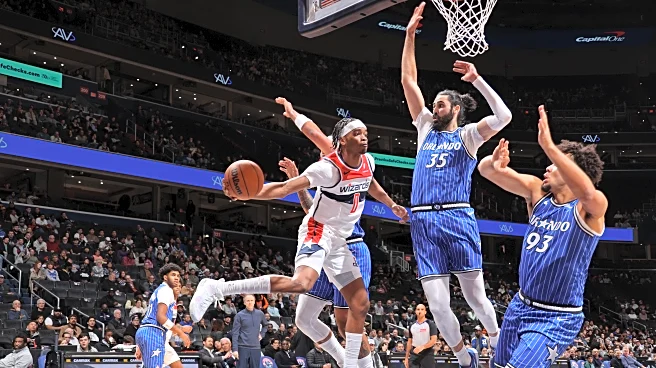

Halfway through the third quarter, it looked like the Wizards would coast to a blowout win over the Orlando Magic. They were up 26, the Magic kept bricking shots, fouling, and throwing the ball away, and the Wizards were fast-breaking
them into oblivion. Then Magic coach Jamahl Mosley benched his starters and the Orlando bench mob staged an epic — though ultimately futile — comeback.
Over about 12 minutes of game time (including portions of the third and fourth quarters), Orlando cut Washington’s 26-point advantage to just two. By then, Wizards coach Brian Keefe had reinserted starters to stem the tide.

Whether it was the starters — CJ McCollum hit several shots in the closing minutes to help secure the win — or just Orlando’s bench mob running out of gas, the comeback stopped there. The Wizards closed out their 10th victory of the season, 120-112.
Washington’s starters (plus Justin Champagnie) dominated the Magic. Alex Sarr led the way at both ends, scoring an efficient 23 points in 31 minutes and blocking five shots. He deterred several more attempts when Magic players cut short drives or passed rather than attempt a shot over the Wizards’ big man.
Bilal Coulibaly was a defensive wrecking ball. He harassed Orlando star Paolo Banchero into four turnovers and offensive rating of just 97 (league average is 115.8 so far this season).
McCollum continued what Magic broadcasters said was a career-long pattern of torching Orlando.He finished with 27 points on 19 shots to go with five assists and six rebounds.
Thoughts & Observations
- Coulibaly stripped Banchero on the game’s opening possession and took the ball the other way for an easy bucket. It was a pattern that repeated throughout the game. His hands on defense are excellent — he had at least three strips. Opponents think they have the ball secured only for him to reach around and punch it loose. His awareness is also superb — opponents cannot make crosscourt passes when he’s in the vicinity.
- One offensive improvement from Coulibaly: he’s gotten better at closing space when he has the ball and a defender sags off him to concede the three. Instead of just pulling the trigger on an iffy shot, he’s using that space to build momentum and drive by his man. This was a tactic Ben Simmons used back when he was good.
- For the game, the Wizards were (slightly) outshot, and out-rebounded. They won because Orlando (uncharacteristically) committed a bunch of turnovers and (characteristically) committed a load of fouls. The Wizards hit 31-33 from the free throw line while the Magic — typically good at getting to the line — made just 16-24.
- Two plays — one for each team — exemplify one of the problems with NBA officiating. It’s not an issue of consistency — the refs make the calls the same way game after game for stars and non-stars alike. Play One was around 1:06 in the first quarter: Marvin Bagley III drove. The defender stayed with him and was in good position. Bagley lowered his shoulder and plowed into him, knocking him back and creating space. Then he went up and scored. On Play Two (around 9:08 in the second quarter), Desmond Bane knocked Bub Carrington down with a lowered shoulder before rising up to hit a three. There was no call from the refs on either play. Both of them should have been whistled as offensive fouls, would have been in any other league or level of play — and would have been in any previous NBA era.
- The Wizards had some trouble defending a clever Orlando action. The Magic would send a big man to screen up top. It looked each time like the start of a typical pick-and-roll ball screen except the big would set the pick off ball and the guard would then cut into the lane. The Wizards typically don’t switch off-ball screens. The action produced several open cutters, as well wide-open looks from three-point range. With sloppy passing and poor shooting, the Magic largely failed to capitalize. One successful example came early in the first quarter — McCollum got back screened, Khris Middleton stepped into the lane to help, and Orlando’s da Silva hit the wide open corner three.
- Between Coulibaly and Sarr, the Wizards might have building blocks for a terrific defense in the future. Coulibaly has the agility and length to effectively defend everyone from skittery guards to tradition power forwards. His length and awareness make him a menace in passing lanes. His ability to guard up should improve as he gets stronger. With Sarr, the Wizards have a potentially elite rim protector, who can also competently defend on the perimeter when switched onto a smaller player.
- I continue to think the Wizards should promote Champagnie into the starting lineup — at least until Kyshawn George returns from his strained hip flexor.
- On the first night of a back-to-back, it looked like Keefe was trying to let the youngsters finish off this game. They couldn’t hold the lead, and he was forced to go back to the starters.
- Orlando’s Jase Richardson had a good score in YODA (my stat-driven draft prospect evaluation tool), and every time I see him play, I like what I see. He needs to get stronger (as is the norm for every young player), but he makes good decisions, has excellent skills, and plays with craft. He scored a career-high 20 points in just 26 minutes last night, and was a big reason the Magic mounted a comeback.
Four Factors
Below are the four factors that decide wins and losses in basketball — shooting (efg), rebounding (offensive rebounds), ball handling (turnovers), fouling (free throws made).
The four factors are measured by:
- eFG% (effective field goal percentage, which accounts for the three-point shot)
- OREB% (offensive rebound percentage)
- TOV% (turnover percentage — turnovers divided by possessions)
- FTM/FGA (free throws made divided by field goal attempts)
Stats & Metrics
PPA is my overall production metric, which credits players for things they do that help a team win (scoring, rebounding, playmaking, defending) and dings them for things that hurt (missed shots, turnovers, bad defense, fouls).
PPA is a per possession metric designed for larger data sets. In small sample sizes, the numbers can get weird. In PPA, 100 is average, higher is better and replacement level is 45. For a single game, replacement level isn’t much use, and I reiterate the caution about small samples sometimes producing weird results.
POSS is the number of possessions each player was on the floor in this game.
ORTG = offensive rating, which is points produced per individual possessions x 100. League average so far this season is 115.1. Points produced is not the same as points scored. It includes the value of assists and offensive rebounds, as well as sharing credit when receiving an assist.
USG = offensive usage rate. Average is 20%.
ORTG and USG are versions of stats created by former Wizards assistant coach Dean Oliver and modified by me. ORTG is an efficiency measure that accounts for the value of shooting, offensive rebounds, assists and turnovers. USG includes shooting from the floor and free throw line, offensive rebounds, assists and turnovers.
+PTS = “Plus Points” is a measure of the points gained or lost by each player based on their efficiency in this game compared to league average efficiency on the same number of possessions. A player with an offensive rating (points produced per possession x 100) of 100 who uses 20 possessions would produce 20 points. If the league average efficiency is 114, the league — on average — would produced 22.8 points in the same 20 possessions. So, the player in this hypothetical would have a +PTS score of -2.8.
Players are sorted by total production in the game.