

I’ve been thinking about this for a while now. Some people might call me crazy, but one question keeps coming back to me: could Phoenix actually have the best backcourt (PG/SG) in the league…in terms of depth? I’m sharing my thoughts here, hoping we can maybe reach a conclusion together.
Important clarification right away: Phoenix doesn’t necessarily have the best guard duo, nor the biggest star power. What they do have, though, is something extremely rare. A full-on army in the backcourt. That’s
exactly why I consider them one of the strongest guard groups in the league as a whole. So the real question remains: when we talk about depth, could they simply be the best?
A Backcourt Built on Completeness
We can already talk about Phoenix having the most complete backcourt in the league, thanks to a rare diversity of profiles. Seven players who are all technically different, and all playable on a team that expects to make the postseason. The Suns have a backcourt that can adapt to anything the NBA throws at them.
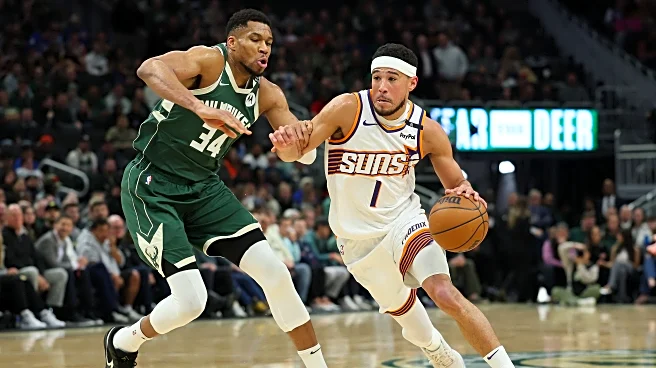
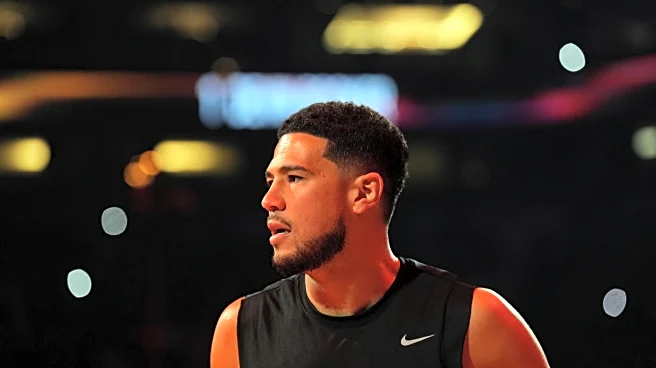
Devin Booker is the star, the leader of this seven‑headed hydra. Every year he gains maturity: his game is calmer, less one‑dimensional, more oriented toward creation. He’s no longer just a three‑level scoring threat. He’s a complete half‑court weapon, capable of creating for himself and for others, with efficiency and cleanliness that are more than respectable for his volume.
To complement this duo of offensive creators, the Suns have Collin Gillespie, who was in the 6MOY conversation before injuries and is now on track to finish high in the MIP race. He’s probably the best pure basketball player of the seven, the one who “respects the game” the most, the most pro. Strong in impact metrics (DPM, RAPM), clean and efficient (89th percentile in rTS%, 99th in 3‑point percentage, 84th in oTOV), he adapts to multiple systems, controls tempo, and reads the game at high speed thanks to elite IQ and execution.
Fire and Ice
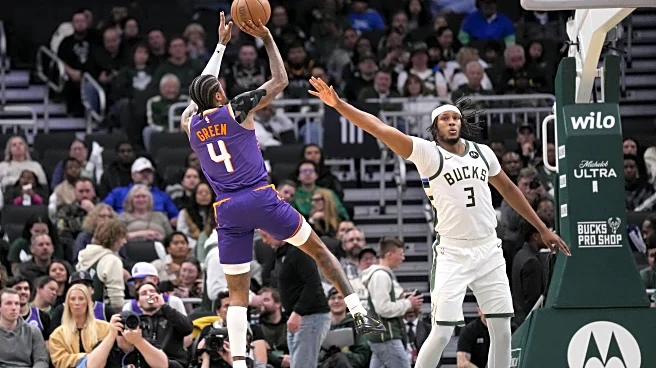
Behind the Booker – Gillespie duo, which brings stability and structure, Phoenix can shift into a much more aggressive mode with the Jalen Green – Grayson Allen tandem.
Green is pure athletic spark. This season he’s averaging 14.8 points, 3.2 rebounds and 2.2 assists in 22.8 minutes (including 25 points, 5 rebounds and 59 TS% over his last three games). He constantly pressures the rim and can flip the tempo of a game in just a few possessions. His inconsistency can be frustrating, but his impact is mostly about the offensive energy he injects into every game.
Allen, on the other hand, is the metronome. With 17.5 points, 3.0 rebounds and 4.2 assists in 30.1 minutes, he brings the outside volume and reliability Ott’s system needs, taking nearly 10 threes per game at 35.5%. His off‑ball movement, discipline (even if he still carries his “dirty” reputation), and 1.5 steals make him one of the most reliable guards in the league. Together, they’re the fire and ice of this team.
The Guard Dog
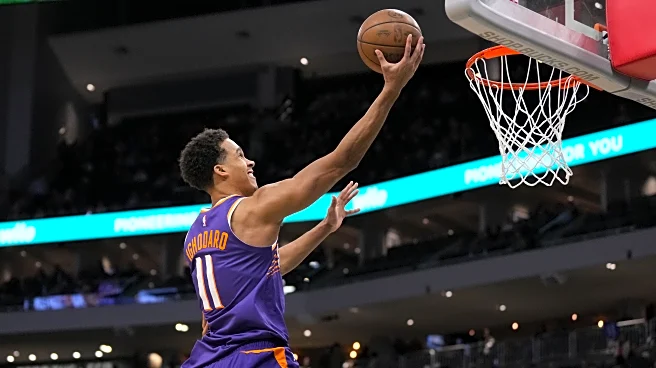
Then you have Jordan Goodwin, the guard dog, the catalyst, the low‑volume player with maximum impact. He’s one of the best players in the league in a very specific — and often overlooked — area: generating extra possessions through offensive rebounds and steals. Beyond that, Goodwin is an excellent on‑ball defender, capable of being a POA stopper or an elite disruptor in passing lanes. His lack of offensive efficiency (89 TS+) keeps him from having a bigger role in the team’s creation, but he remains one of the best role players in the league. And there’s no doubt Phoenix will have to fight to keep him.

The Finishing Pieces
Finally, Phoenix can rely on a nice duo to close stretches, absorb minutes, or step in when someone needs rest or gets injured: the surprisingly impactful Jamare Bouyea and rookie Koby Brea. Bouyea is more established, averaging 15 minutes per game and firmly in the rotation, while Brea represents the future — only five games played so far, but flashes of a future rotation‑level shooter.
A Backcourt That Can Become Anything
We’ve gone through the profiles one by one, and they’re all unique. That’s what allows Jordan Ott to deploy an extremely wide range of systems, lineups, and tactical approaches. Among the 12 lineups with 100+ possessions this season, seven feature a different backcourt — and with Green returning, that number will likely rise. Phoenix has seven playable guards, whether as starters or rotation pieces.

With this pool, Ott can shape his team based on context, opponent, or game momentum. He can go with a scoring‑heavy backcourt like Booker/Green (+13.9 net rating), which imposes pace and pressure. He can choose control and management with Booker/Gillespie (+7.5). For maximum spacing, Gillespie/Allen (+1.1) stretches the floor. For defensive impact, Goodwin/Gillespie (+11.9) brings aggression and discipline. For balance, Booker/Goodwin (+9.7) is a natural option. And for speed, small‑ball, and quickness, Bouyea/Gillespie (+2.3) offers a totally different dynamic.
These are just examples — there are more combinations — but very few teams can claim such richness in the backcourt, with six duos already capable of fulfilling a precise mission while being both reliable and effective.
Let’s go back to the initial question. Do the Suns have the best backcourt in the league? As we’ve seen, they don’t have the flashiest or most powerful guard group. But in terms of depth, variety, reliability, and adaptability…it’s hard to find anything better in today’s NBA. And in that specific category, Phoenix does have the best backcourt in the league in my eyes. OKC and the Spurs are strong contenders too — dangerous, well‑built — but are they as versatile? I don’t think so.
In the end, this is just one question among many that crossed my mind. And realistically, it’s not the sheer number that matters. It’s the versatility and depth across all tiers. Three, four, or five guys are enough to build an effective, reliable backcourt. What about you ? How do you see it?