
“It takes three years to grade a draft” and it’s been three years since Ryan Poles went into a draft with a 1st-round pick for the first time as a general manager for the Chicago Bears. Based on looking
at every draft from 2011-2020, we know what results “should” look like by league by team, and by position. It’s fair to assume that a typical draft class will contain 60-70 “reliable starters”, players who offer at least 40 starts over their first five years. That same class will contain a number of regular contributors who do not start as often but who still appear in at least 60 games.
Teams with earlier draft priority have a better chance of finding success at nearly every level, but at a minimum a team should find two starters and two reliable contributors. Chicago had also increased its draft power by various means, and it’s worth pointing out that draft picks earned by trading away Khalil Mack, Roquan Smith, and Robert Quinn needed to pay off as well–even if they were down a different pick from the Claypool trade. Simply to get an adequate return on investment then should require at least three starters and three role-players.
Note that this is not an exercise in evaluating Ryan Poles as general manager on the whole–for this exercise he is neither being credited for the Panthers trade nor penalized for the Claypool trade. Instead, the question is whether or not, with the picks he had, he made sound selections. As such, I will be evaluating each selection on both the process (was the player taken a good value for what the team needed at the time and was he a reasonable selection in that role given what was known at the time) and how it worked out on the field, giving each half equal weight.
DAY ONE
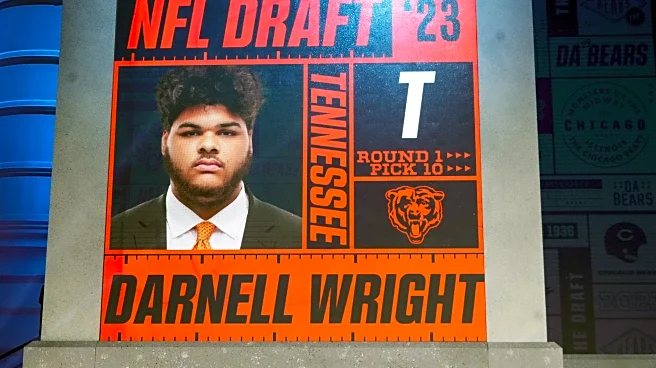
#10) Darnell Wright. Justin Fields had just been sacked on a league-worst 13% of his pass attempts, which was actually worse than the league-worst 9.67% of the prior year. Chicago needed to fix the offensive line before anything else, and using a top ten pick on a tackle was a smart move. Wright had been identified as the best offensive lineman that Will Anderson had faced, and while “draftniks” were slow to catch on, some of us spotted his talent right away. As far as process is concerned, this is easily an A.
Has it worked out? The second-team All-Pro has been an absolute anchor on the right side of the line, and most metrics agree that he has been an elite player at the position. He is one of the four best tackles in pass-blocking win rate per ESPN. Wright has played better than essentially every other tackle who would have been available to Chicago in that draft. The only caveat here is that while all of this is true, it is exactly what should be expected from a player taken with a top-ten pick. This is an A, but only because it’s unfair to penalize Poles for getting a pick right when he had to.
Summary: Poles nailed the decision he had to get right. A
DAY TWO
#53) Gervon Dexter. Chicago had depleted its defensive talent with trades, and it needed to regenerate some of its pass rush ability. To that end, a player like Dexter made sense, but there’s a caveat. Poles had just traded away off-ball linebacker Roquan Smith and edge defender Robert Quinn after trading away edge defender Khalil Mack. Instead of taking edge defender Tuli Tuipoluto (98 solo tackles and 26 sacks so far) or the more ready pass rusher Kobie Turner (88 solo tackles and 24 sacks to day), Poles selected an interior defender in Dexter who hasn’t been nearly as productive. Annoyingly, there were indications that Dexter lacked the high-end athleticism that Chicago had recently lost. Poles got cute and it cost the Bears. This is a D+, shaded up only because the general goal of reinforcing a depleted defense is sound.
By contrast, despite some flaws, Dexter has turned out to be a solid player on what is arguably a weaker defensive line than many of his draft peers. Comparing him to his truest peers, interior defensive linemen selected 43-63, his first five years should see 56 games (mean) or 66 (median) and 30 starts (mean) or 35 starts (median). Depending on the preferred measure of central tendency, he should have 6 defended passes and 7-9 sacks with 14-15 tackles for a loss. Dexter already has 49 games and 33 starts with 3 defended passes, 13.5 sacks, and 10 tackles for a loss.
If he maintains the rate of production he is currently providing, he would have 81 games, 55 starts, 5 PDs, 22.5 sacks, and 17 TFLs. That puts him nowhere near the average performance of a first-round interior defensive lineman but also comfortably in the top half of his peers and pushing into the top third. This should be a B, if I’m being fair. Why is Dexter so frustrating as a player at times then? Because even though he was a good find for his draft position, that means less because better talent was available at positions that were needed more at the time and Poles missed it.
Summary: Adding these grades together means Dexter is either a C or a C+, which feels too high based on what could have been and too low compared to his production in a vacuum, so it’s probably right.
#56) Tyrique Stevenson. A right tackle does not make a total overhaul of the offensive line, and with major needs up front on defense as well it seemed strange that Poles traded up to take a defensive back after already taking a corner and a safety with his highest two picks in the prior draft. On the other hand, Stevenson was graded by many as a player to be taken in the second half of the second round, and that’s where he was taken. His draft profile praised his motor but mentioned that he got handsy and lacked ability in run support, which seems fair? Instinctively this feels like a D, but there is an argument for a C, and so this will be a C-.
As for his on-field play, Stevenson has been a magnet for criticism due to some bad decisions made during his career, but he has also been productive compared to other second-round corners (he is ahead of every other DB in his class except Brian Branch in interceptions). The “average” second-round corner would play 53 games (35 starts) and generate 6 interceptions (31 PDs) with just over 5 sacks + tackles for a loss over his first five years–or one per year. In three years, Stevenson has played in 45 games (40 starts) with 7 interceptions (38 PDs) and 3 sacks + tackles for a loss–one per year. If Stevenson merely duplicated his worst year of performance to date, he would exceed all reasonable benchmarks a year early.
The case that he’s been a solid return on investment gets even easier if you compare Stevenson to the median instead of the mean. There, he should hit 58 games (38 starts) with 4 interceptions (29 PDs) and 4 sacks + tackles for a loss. Again, besides games played (which he is on the path to meeting), he is well ahead of all of those marks. Despite the way the coaching staff seems to have soured on him and some maturity issues at times, Stevenson himself is an excellent 2nd-round corner, and in fairness this has to be an A.
Summary: This is a good player taken at a questionable place who has turned out to be worth the investment. This averages out to a B.
#64) Zacch Pickens. Chicago double-dipped on the interior of the defensive line and ignored the interior of the offensive line. Worse, in taking Pickens, they reached. Pickens typically had a 4th-round or (at best) late 3rd-round grade on him, and he was ranked below other players who offered greater diversity compared to Dexter. However, this was not a total reach, merely a partial one. To be generous, I’ll place this as a D.
Because he was taken in the top of the third round, Pickens is sometimes classified as a second-round pick because of the number (64), but even comparing him to third-round picks is telling. The median 3rd-round pick would have 58 games and 18 starts after five years, recording a pair of pass deflections, 4 sacks, and 11 tackles for a loss; of note, that’s functionally the same median as 4th-round picks at the same position–give or take. Pickens? He’s just not there. He’s actually at 29 games and 3 starts, with 1 PD, 1.5 sacks, and 2 TFLs. In short, even if he were to duplicate his most productive year (2024) wherever he ends up for the next two years, he’d still be behind in games, in starts, in passes deflected, in sacks, and in tackles for a loss. His performance has been a total failure.
Summary: This is an F, because even though Pickens is still playing in the league, his selection was a failure for Chicago in every way.
DAY THREE
#115) Roschon Johnson. One of the things about the devaluation of running backs is that if those interested in “value above replacement” are going to invoke the availability of running backs in later rounds as a talking point, then it should be accepted that teams will take swings at the position in later rounds. So taking a running back in the fourth-round is reasonable, even if he had just signed D’Onta Foreman. Johnson himself frequently had a 3rd- or 4th-round grade on him, so taking him with a 4th-round pick seems likewise reasonable. It’s also worth pointing out that while he has been outperformed by a couple of running backs drafted after him, he has also outperformed a couple of those drafted before him as well. This is a B for the process if not the results.
However, Johnson has no starts and has taken only 4 offensive snaps this season, with most of his limited playing time coming on special teams. As a fourth-round running back he should hit 45 games (9 starts) and 1478 yards from scrimmage before his first five years in the league. If he simply wanted to be an above-median player, he would need at least 52 games 5 starts) and over 1140 yards from scrimmage. Even at this year’s rate of usage (whether it’s for Chicago or another team) he has a chance to make the games level. However, it’s unlikely he’ll record any starts unless something dire happens to his team’s depth chart. If he were to go to another team and serve as a rotational back, he might manage to accumulate enough yards to bring his total up to one of these two averages…but it’s not looking like he’ll hit any of these marks for Chicago. He has essentially been reduced to a rotational special teams player. As such, his on-field performance is more of a D or D-.
Summary: Drafting Johnson was a reasonable attempt at finding a decent return on investment in draft capital even if it didn’t work out. It happens. The process was more or less okay. This is probably a C-.
#133) Tyler Scott. While it’s hard to believe at the moment, many fans were elated with the selection of Tyler Scott. The Bears needed help at receiver, even over and above what the trade with the Panthers had brought in. As for the player? Scott had a third-round estimation on him in consensus, and he was a pick beloved by this site as well as fans. Everything looked like it should go well. Both of these two parts of the process have to be an A.
If only reality had rewarded this optimism. Scott is currently on the Rams’ practice squad, but while he was in Chicago he managed only 4 starts and 214 yards from scrimmage so far–never scoring a touchdown. If he doubles those numbers in his last two years somehow, his production would be below average (mean or median, take your choice) for a fourth-round receiver. Only his game appearance total (28) is in the range of the 32-34 games that should be expected from a player at his position taken in the fourth round. Bluntly, if it’s possible for a fourth-round pick to be a bust, that’s what Scott is. That’s an F.
Summary: This is the second player in a row where everything makes sense even if the individual player just never lived up to expectations, and in that sense while the grade is probably going to average out to another C-, it’s a C- that indicates something meaningful. It suggests that the issue with the drafting process of Ryan Poles’ early years is not with player scouting but rather player development.
#148) Noah Sewell. At this point in the draft, Chicago still needed an edge rusher and more help on the interior of the offensive line. Instead, Ryan Poles reached for an off-ball linebacker? That’s hard to justify, especially given the fact that he had already just signed TJ Edwards and Tremaine Edmunds to substantial contracts. At least Sewell was often considered a 3rd- or 4th-round pick at the time, so Poles was likely unable to resist the “value” presented by Sewell–and almost every linebacker drafted after him has performed slightly worse, so he wasn’t a terrible selection from that regard. This saves the process grade from being a D and bumps it up to a C-.
As for actual impact, though, Sewell needs to play in 44 games with at least 16 starts to match the average for his draft status, and he needs an interception, five defended passes, three sacks, and seven TFLs. he has 35 games with 9 starts, so those marks seem possible in the next two years His next defended pass or sack will be his first, and he could double his tackles for a loss (3) and still be short of the mark. As a player, he is underperforming even the modest expectations imposed on a player of his status. His special teams contributions are the only thing saving this from an F, but he’s still a firm D-.
Summary: That is now three players in a row who have underperformed compared to consensus expectations, and because this was a gamble in terms of position and need it brings the selection grade down to a D if not a D-.
#165) Terrell Smith. Chicago took another defensive back? Not an edge defender and not a center? It seemed ridiculous, but it was what it was, and what it was seemed at the time to be a sign of a problem. This was in fact the fifth defensive back Ryan Poles selected in his first two years at GM. Now, Smith really was a well-regarded corner by the standards of where he was drafted–and the later rounds are traditionally where teams do find successive depth at defensive back. The process grade is probably just a C, shaded down to a C- because of the redundancy when leaving other gaps.
As for performance, the interesting thing is that fifth-round corners actually seem to play. To be in the top half of his peers, Smith would need more than 33 games, at least 4 starts, an interception, and four total pass breakups–with a single TFL. Smith is short by a few games but has more than twice as many starts already, and he has defended ten passes and made 4 tackles for a loss (while still managing the interception). If he never recovers from his injury, he’ll already have outperformed his draft status. This is a solid B if not a B+.
Summary: the Smith draft is a C+ or the lowest possible B- from a teacher who curves.
The 7th-rounders. Any value acquired in the 7th round is simply a matter of prospecting for talent. It’s extra credit. Neither Travis Bell nor Kendall Williamson ever took a regular game snap for Chicago. So…no extra credit for Poles.
CONCLUSIONS
From a holistic viewpoint, Poles came away from his second draft with three starters (Wright, Dexter, and Stevenson) and potentially three role-players (Johnson, Sewell, and Smith), so his draft fits the general shape of what was needed. Except where it didn’t, and that’s when it comes to building a complete roster. If all selections are equally waited, the class would come in at roughly 70 or 73%. If the earlier rounds carry more weight based on expected results, this slides up to an 80% exactly.
That means that in a draft Poles needed, absolutely, to nail…he got a B-. Solid selections at the top of the draft are undermined by a few selections that either represented good players (but poor fits) or developmental players who simply didn’t develop.