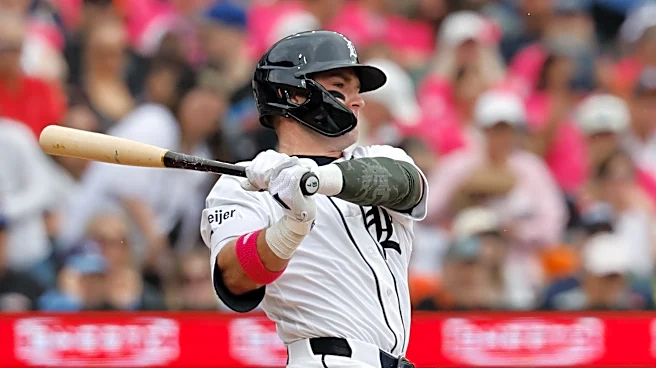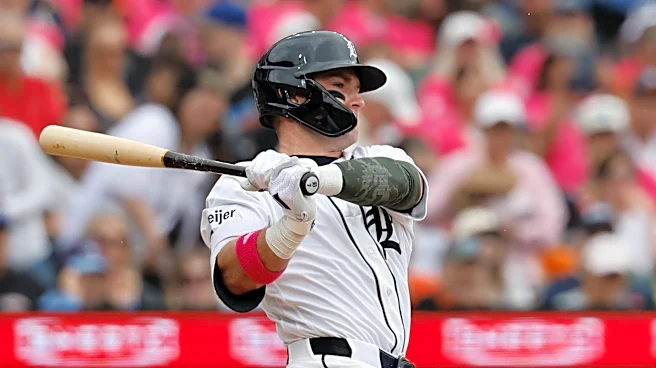




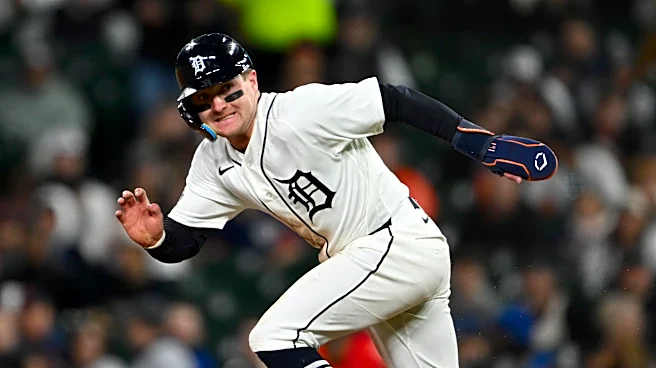

By any measure, Tigers’ rookie Kevin McGonigle is having an excellent rookie year. The number two prospect in all of baseball coming into the year has an impressive .291/.397/.424 slash for the season and is walking more than he’s striking out. With his blistering start, he quickly settled into the leadoff slot of Detroit’s lineup.
That said, his month of May has been a bit of a struggle, as his power has mostly evaporated. He’s still taking his walks, but a .224 SLG on the month really won’t do.
An exceptionally low BABIP for the month is deflating things even more, though a lot of routine fly balls and pop-ups will do that to you, but this is easily the worst stretch of his professional career. There’s nothing to be concerned about long-term at all, and we’re only talking about a few weeks for a 21-year-old rookie, but McGonigle is going to have to make some adjustments to get back on track.
To better understand what those adjustments might be, let’s pretend to be Red Team for the Detroit Tigers scouting department. Typically, MLB scouts focus on how to attack guys for the other team, but when you’re on the struggle bus, reverse scouting is the right idea. The premise is simple: if you put yourself in your opponent’s shoes and better understand how they want to attack you, you can adapt preemptively. To do so, I’ll try and find out McGonigle’s biggest weaknesses so far. Who knows, maybe he’ll read this and learn a thing or two about himself!
The first thing I thought I’d look at is pitch type distribution. Is there a pitch type the league has decided McGonigle can’t handle? I figured if that was the case, his pitch distributions before May 1 and since would look pretty different. Here’s that table:
There’s a small change there, but not the one I expected. Teams saw McGonigle spit on secondary pitches and ambush fastballs early in the year, so they responded by… throwing him more fastballs? That feels unintuitive, to say the least. For the whole season, both of his home runs have come on a fastball, and he’s only whiffing on 9% of them. On its own, this doesn’t feel like the solution to beat McGonigle. Trying to get McGonigle out on a fastball feels like crossing your fingers as you send the pitch out towards home plate, but the league seems to have a plan. Let’s keep going.
Next I decided to check pitch location. Maybe that could be more illuminating than pitch type, and indeed, I think it was. Here’s what I found, with the first image being the percentage of pitches he saw in April/May, and the second being for May so far:
Now the extra fastballs make sense. It’s no secret the modern pitcher loves fastballs up, and recently, McGonigle is facing a lot of those. That top right corner of the zone is a particular hot zone, as it’s the hardest pitch to pull for power. Pitchers seem to be coming in with a concerted effort, forcing McGonigle to play more to their strengths than his, knowing that he’s looking for fastballs to drive. The game plan appears to be trying to get ahead in counts with softer stuff, then challenging McGonigle and his average raw power up in the zone, assuming whatever air contact he makes will be more of a lazy fly ball than a crushed dinger. It’s a pretty solid plan, especially since McGonigle’s entire approach is predicated on singling out a few pitches to pull in the air for extra base damage; fastballs up and away help negate this.
Naturally, the follow-up is ‘is it working’? Is this new gameplan backing McGonigle into a corner? And the answer to that is… kind of? Let me try to explain. One way of looking at that would be launch angle; more pitches up probably means a higher launch angle, and we see that. Mostly:

I went ahead and highlighted May 1 in that photo to help give a timeframe. We see McGonigle’s rolling launch angle spike in early May, and then it drops almost as quickly as it climbed. This is measuring the launch angle of his previous 25 batted balls after every batted ball, so it’s susceptible to a lot of noise. In particular, since it’s an average, this isn’t a very precise instrument to begin with. A towering popup at 40 degrees and a weak grounder at -5 degrees average out at 17.5 degrees, same as two well-struck line drives, so it’s probably worth checking out how he’s getting to that mid-May average.
Here is where I have unfortunate news to share: McGonigle has seemingly entered his Ian Kinsler arc. His ground ball rate has spiked from 27.3% to 36.6%, his line drives are down from 27.3% to 19.5%, and worst of all, his infield fly rate has ballooned from 2.2% to a hilariously untenable 16.7% (note: infield flyball rate is expressed as the ratio infield fly balls/all fly balls, not infield fly balls/all batted balls, so it’s bad, but not as awful as it sounds at first blush). Still, this isn’t how a good hitter operates long-term. If McGonigle wants to start bashing again, he needs to either commit to punishing the fastball up he knows he’s going to get and going to the opposite field more, or spit on the fastball until two strikes and wait to ambush an in-zone mistake on a breaking ball.
The good news is he’s not broken and starting to chase: his plate discipline metrics are all still excellent. He’s not going out of the zone much, and he’s making as much contact in the zone as he did in March and April. Plus, as pitchers force him to look outside, he’s responded with more of an all-fields approach which should be the right decision, if he can get back to a line-drive swing. The only red flag is in his inability to punish the fastball up the way he needs to, or to just let more of those go since he isn’t getting that many of them actually in the zone where he can barrel them up. Instead, pitchers know he’s trying to read fastball out of hand, and they’re showing them to him while not really giving him many he can drive. Essentially they’re forcing him to take his walks and betting that he’ll be too tempted to offer when he does get the fastball.
Considering his short levers, great bat-to-ball skills, and strong eye at the plate, this shouldn’t be a pitch that breaks the whole profile long term. He’s really not built to barrel up pitches on the outer edge consistently, but he torched fastballs up in the zone throughout his minor league run and without regard to velocity. It’s likely the first time pitchers have consistently spotted fastballs up and away but close to the zone against him for weeks at a time, and now, the young rookie will have to adjust. This shouldn’t be a surprise for the kid who skipped AAA. MLB pitchers will eventually force some adaptations. Based on his career so far, and the excellent run we saw in March and April, I think we’re just one small approach tweak away from the on-base machine developing into a power hitting force at the top of the lineup.