



There is an old saying that water finds its level.
The 2026 Rockies are careening toward a fourth consecutive season with triple-digit losses. They are a bad team, and with eight games remaining, there is little left to be decided.
But this season has not always felt like watching a terrible team.
There have been stretches when the Rockies looked like a fairly normal, competitive baseball team. There was even a point when the offense was the best in baseball. There were stretches when the bullpen gave
them a legitimate way to protect a lead, and others when the whole thing fell apart.
The standings are not lying. They just flatten out a season that has been anything but flat.
So, with one final week left, maybe this is a good time to reconcile the record with the experience of watching the Rockies get here.
The standings flatten everything
To set some parameters, a competitive game here is defined as any Rockies win, regardless of margin, or any loss by three runs or fewer.
Through September 17, 108 of the Rockies’ 153 games fit that definition — 70.6% of the season.
There have also been long stretches when Colorado stayed in games almost every night. From June 9 through July 10, 27 of 30 games were competitive — 90% — and the Rockies went 15-15. Expand the window from June 9 through August 18 and 48 of 60 games were competitive, during which Colorado went 26-34.
A team can stay close regularly and still lose a lot of baseball games.
Colorado has done exactly that before.
*Through September 17.
The first two columns measure the full season. The best sustained stretch column shows the strongest extended run from each year.
The 2023 Rockies are a good example of how much a final record can hide. They lost 103 games and still played .500 baseball over one 40-game stretch.
So competitive stretches are not unique to the 2026 Rockies. What stands out is how dramatically this team has changed while doing it.
Six versions of the same team
The shifts become easier to see when the season is broken into six stretches.
For context, wRC+ is a park-adjusted measure of offensive production, with 100 representing league average and higher being better. ERA- is also park-adjusted, but works in the opposite direction: 100 is league average and lower is better.
Put those stretches next to each other, and the Rockies barely look like the same team twice.
They opened the season 14-17 with an offense that was well below average, but the rotation posted a 95 ERA- while the bullpen was excellent at 79. The offense did not have to carry the team because the pitching kept games close enough for Colorado to find a run somewhere.
April 1 in Toronto was a pretty good example. Kyle Freeland allowed one run over five innings, the bullpen followed with five scoreless innings, and the Rockies survived 17 strikeouts long enough for Troy Johnston to tie the game in the eighth.
Tyler Freeman gave Colorado the lead with an RBI single in the 10th before Jimmy Herget finished off the 2-1 win.
That was one version of the Rockies: keep the game close, get enough from the pitching and wait for the offense to find something.
Then the bottom fell out.
From April 30 through May 27, Colorado went 6-20. The offense cratered to a 62 wRC+, while the starting rotation posted a 156 ERA-. The bullpen was below average, too.
The May 19 loss to Texas showed how quickly that version of the Rockies could get buried. Colorado’s opener did not escape the first inning, and the Rangers were ahead 5-0 after two and 7-0 after four.
Joc Pederson was in the middle of it, finishing with four hits as Texas kept piling on.
The Rangers eventually won 10-0. The Rockies finished with three hits.
From May 29 through July 3, the picture flipped almost completely. Colorado went 16-16 and posted a 126 wRC+ — the best park-adjusted offensive mark in baseball over that stretch.
That number stands out beyond this season, too. The Rockies did not produce a full calendar month with a wRC+ that high anywhere in the previous decade. The best mark in the 2016-2025 monthly data was 116 in May 2019.
The pitching never really joined the offense. The starters posted a 125 ERA-, while the bullpen was even worse at 134.
June 26 in Minnesota compressed that entire stretch into one night.
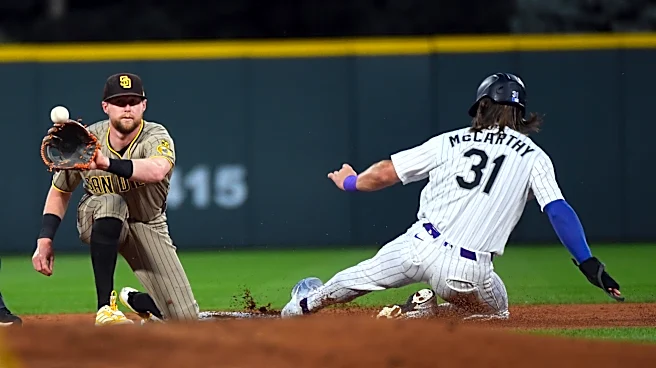
Colorado trailed 7-0 entering the eighth. The Rockies scored three runs there, then five more in the ninth. Jake McCarthy homered to pull Colorado within one, Kyle Karros doubled, and Hunter Goodman followed with a two-run homer that suddenly put the Rockies ahead 8-7.
Minnesota tied the game in the bottom of the ninth and won it in the 10th.
For a while, the offense was good enough to overcome almost anything.
Almost.
Then it disappeared.
From July 4 through July 29, the Rockies’ wRC+ collapsed from 126 to 72. The bullpen actually improved to a 92 ERA-, but the starters remained poor at 138.
Colorado had gone from asking one of baseball’s best offenses to carry bad pitching to asking one of its least productive offenses to survive it.
A couple of weeks later, the balance shifted again. From July 31 through August 16, the Rockies went 8-7. The offense was almost exactly league average at a 96 wRC+. The rotation remained below average at 124, but the bullpen posted a 78 ERA-.
For 15 games, that was enough.
The constants
Not every part of this team has moved up and down with the same volatility. Defense has been one fairly consistent weakness. The Rockies rank 28th in fielding percentage at .982 and 26th in Outs Above Average at minus-25. Without clean date-range defensive splits, it is harder to map the defense onto each rise and fall, but the larger picture is clear: Colorado has been a poor defensive team throughout the season.
The starting rotation has been the bigger problem. For most of the year, it has ranged somewhere between poor and very poor.
Colorado could survive a 124 or 125 ERA- from its starters when something else was working. The offense carried that burden during the 16-16 stretch from May 29 through July 3, and the bullpen helped do it during the 8-7 stretch from July 31 through August 16.
The two major collapses tell a different story. From April 30 through May 27, the starters posted a 156 ERA- and the Rockies went 6-20. From August 17 through September 17, the rotation posted a 152 ERA- and Colorado went 6-23.
That most recent stretch is particularly telling because the other units have not collapsed to the same degree. The offense posted a 90 wRC+, which is poor but nowhere near the 62 or 72 from the earlier offensive downturns. The bullpen posted a 109 ERA-, also below average but hardly catastrophic.
And lately, the games have looked like it. From September 9 through September 13, Colorado lost five straight by scores of 6-1, 10-3, 6-2, 11-7 and 8-1. After briefly interrupting that run, the Rockies were blown out again in consecutive 9-3 and 9-2 losses.
Starting pitching has been a weight on this team all season. The difference has often been how heavy that weight became — and whether anything else was strong enough to carry it.
Water finds its level
Maybe that is the simplest way to describe the 2026 Rockies. They have spent six months moving between different versions of themselves.
At times, the bullpen carried them. At times, the offense did. There were stretches when they stayed close often enough to give themselves a chance to steal games, and others when everything broke at once. Through all of it, the defense has generally remained below average and the rotation has mostly remained a problem.
Maybe water really does find its level.
The Rockies are eight games from the end of another ugly season, and no amount of slicing the schedule into smaller pieces changes the record.
But it does help explain why getting here has felt so strange. The final record will make 2026 look more straightforward than it has actually been.
There are eight games left in the 2026 season, and whichever version of the Rockies shows up, I’ll be watching.
On The Farm
Triple-A: Albuquerque Isotopes 3, Salt Lake City Bees 0 (6 innings/rain)
The Albuquerque Isotopes (72-76) picked up a rain-shortened 3-0 win over the Salt Lake Bees (66-80), with the game called after two outs in the top of the sixth.
Albuquerque did not exactly overwhelm Salt Lake offensively, finishing with five hits, but the Isotopes made enough of their chances count. Drew Avans walked to open the third and Tyler Freeman followed with a single before Charlie Condon reached on an error in left field that allowed both runners to score. Chad Stevens then opened the fourth with his second hit of the night and scored when Nic Kent ripped his 21st double of the season to make it 3-0.
Parker Mushinski worked two scoreless innings despite allowing two hits and a walk, Jarrod Cande followed with two scoreless frames of his own, and Keegan Thompson recorded the final five outs before the rain arrived. Cande earned the win, while Thompson was credited with his first save.
The Bees went 0-for-5 with runners in scoring position and stranded nine, while Albuquerque went 0-for-6 with RISP and left five aboard. The Isotopes pitching staff allowed six hits and five walks but struck out five and kept the Bees off the scoreboard.
White Sox lose grip on AL Central lead after Tigers score 9 unanswered | MLB.com
MLB.com’s Scott Merkin looks at a White Sox team trying to hold its place in a tightening playoff race. Chicago’s 11-8 loss to Detroit dropped the White Sox a game behind Cleveland in the AL Central, though they still hold a Wild Card spot with the final week of the season approaching. The margin for error is getting smaller, and the White Sox will close out the regular season with three games against the Rockies.
Ryan McMahon just gave Yankees all the necessary evidence for a future DFA | yankeesgoyard.com
Yanks Go Yard’s Pat Ragazzo looks at Ryan McMahon’s continued offensive struggles in New York and argues that his Yankees tenure may be nearing its end. McMahon has an 80 wRC+ over 162 games since the trade and is hitting .210/.275/.346 this season despite continuing to provide value defensively.
Rockies Manager Warren Schaeffer Explains Frustrating Tanner Gordon Trend | SI.com
Scott Roche of Sports Illustrated looks at Tanner Gordon’s rough September and a trend Warren Schaeffer wants to see him clean up. Gordon has generally done a good job getting ahead of hitters, but finishing them off with two strikes has been another story. That problem showed up again Thursday, when he allowed seven runs in three innings against San Diego, and it has helped push his September ERA to 12.34 over three starts.
Join the conversation!
Sign up for a user account and get:
- Fewer ads
- Create community posts
- Comment on articles, community posts
- Rec comments, community posts
- New, improved notifications system!
Download the SB Nation app on iOS or Android.
Please keep in mind ourPurple Row Community Guidelines when you’re commenting. Thanks!