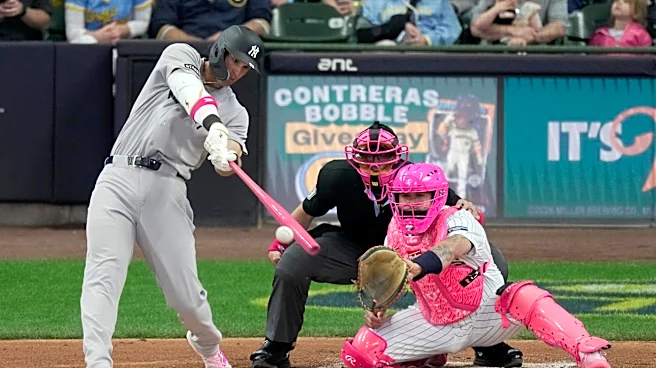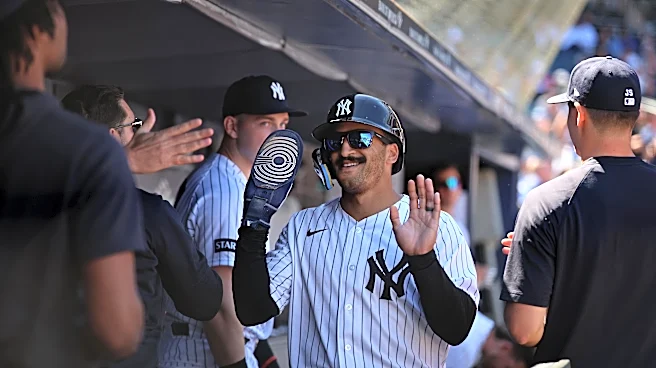





The Yankees offense is in a bit of a rut, losing their last four games by scoring three or fewer runs in each. It coincides with a period in which several of their hitters — Ben Rice, Giancarlo Stanton, Jasson Domínguez, and José Caballero — have dealt with or are dealing with minor injuries, but really the prime culprit has been a spike in strikeouts by the entire lineup. We therefore have to go back to the series finale against the Rangers for our At-Bat of the Week, courtesy of Trent Grisham.
We join Grisham with one out in the bottom of the sixth. The Yankees trail, 2-1, but have the bases loaded thanks to walks by Cody Bellinger and Ryan McMahon sandwiched around an Amed Rosario single and Jazz Chisholm Jr. pop out. It’s really only their second prime opportunity to score off of MacKenzie Gore, who had found his groove after yielding the pair of triples in the first. So far Grisham has flied out to left and singled on a pop up, Gore attacking him with four-seamers and sliders.
Gore got Grisham to swing over the top of a first pitch slider away the last AB, so he attempts the same tactic with the first pitch in this encounter.
Instead, Gore pulls this pitch badly and it ends up in the dirt for an easy take by Grisham. At no point was this pitch in the zone, meaning Grisham’s bat never leaves his shoulder.
After mis-executing the previous pitch, Gore switches gears to the fastball, but this time opts to go with the sinker instead of the four-seamer.
This is just rude from Gore, and highlights why it is so important for starting pitchers to possess more than one type of fastball. To this point, the only type of fastball that Grisham has seen from Gore has been the four-seamer. Grisham correctly diagnoses fastball out of Gore’s hand here and chooses a swing path based on the way he has seen the four-seamer move. However, rather than hold its plane vertically without much arm-side movement like the four-seamer, this sinker dives down and in. The result is an on-time swing from Grisham, but still a whiff over the top given how it is effectively impossible to distinguish sinker from four-seamer based on the ball’s spin.
After seeing Grisham whiff on the previous pitch by a fair margin, the logical course is for Gore to throw another one to the exact same location and see if he can induce the same outcome.
Gore leaves this sinker middle-middle, and Grisham does not miss. He stays back for an extra tick before firing a short-compact swing, driving the ball into the left-center field gap for a bases-clearing double to give the Yankees back the lead, knock Gore from the game, and spark an eventual six-run inning. I love how Grisham is able to make a mid-AB adjustment from one pitch to the next. All he needed was to see and swing over a single sinker, giving him enough information to doctor his swing path so that he can square it up on the very next pitch.
Here’s the full AB:

You might raise your eyebrows at a sub-.200 hitter batting leadoff. However, Grisham’s 15.5-percent walk rate places him in the 92nd percentile of qualified batters, making him one of the few on-base threats in the Yankees lineup. Much like Ben Rice last year, Grisham has been one of the unluckiest hitters in baseball when you compare his results to his batted ball and discipline data. He places in 100th percentile in squared-up rate and 99th percentile in chase rate while sitting comfortably in the top-20 percent of the league in average exit velocity, hard-hit rate, and barrel rate. The almost 50-point gap between his wOBA and expected wOBA is one of the largest deficits in the league, and his .184 BABIP is 75 points below his career average and is due for positive regression. As this AB showed, Grisham is one of the most adept Yankees hitters at making an in-game adjustment even one pitch to the next, which combined with the fact that Grisham’s under-the-hood metrics look quite similar to his career year last season gives me confidence that the results shouldn’t be far behind.