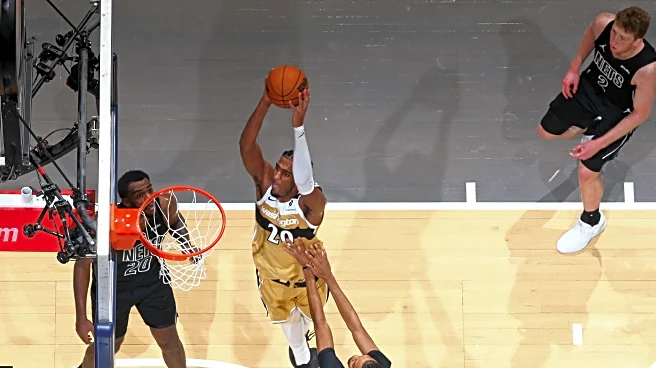

Early in the Wizards’ win over the Brooklyn Nets, a thought popped to mind for the first time this season (and probably last season too): The Wizards are better than these guys.
It surely helped that Michael
Porter Jr. — the Nets best offensive player — and Nic Claxton — their best defender — were out. But of the available players (the Wizards were missing Kyshawn George and Corey Kispert), Washington was bigger, more skilled, and more athletic. And that showed all night as the Wizards rolled to a comfortable 119-99 win.

The topline numbers (96 defensive rating) suggest the Wizards defended well, and they did…for the most part. Brooklyn got plenty of open threes, which is normal for a Washington opponent because the Wizards prioritize protecting the paint. The Nets bricked those looks, hitting just 6-29 (20.7%) from deep.
I did see some things that didn’t thrill me. Nets guards were able to drive effectively, generate paint touches and kick out to shooters. Bub Carrington could not stay in front of Nolan Traore, who somehow generated five assists on a night Brooklyn shot 39.5% from the floor.
Brooklyn’s offensive rebounding numbers were low (just nine offensive boards and a 19.1% offensive rebounding percentage), but I didn’t like how often Nets players were able to get their hands on missed shots. On several possessions, Wizards players corralled the ball after it had been tipped several times.
Nits picked, the Wizards won easily and have played better in recent weeks. As Yanir Rubinstein wrote in the recap, Washington has now won four of their last five games. That feels good, especially when wins are powered by youngsters.
Thoughts & Observations
- Other players put up more impressive numbers, but I really loved the way Sarr played in this one. He scored inside, hit a three, produced four assists, and blocked five shots. The Nets struggled inside against him all night.
- Also, I kinda liked Sarr committing a flagrant foul when he got annoyed with Clowney.
- Bilal Coulibaly shot just 2-8 from the floor, but finished with a 180 PPA because of 8 rebounds, 4 assists, 4 steals, and 2 blocks. He hit 7-8 from the free throw line and committed 2 turnovers. His offensive rating was 108 (league average is 115.9 so far this season) on 21.0% usage. The Nets didn’t learn key lessons regarding Coulibaly — don’t try to pass over him, and don’t try cross-court passes when he’s on the floor. He will steal the ball.
- Justin Champagnie continued to make the case that he should be a full-time starter. In 25 minutes, he scored 20 points (9-12 from the floor) and grabbed 7 rebounds. One of Washington’s defensive challenges is having anyone to get a rebound when Sarr is protecting the rim. Champagnie goes a long ways towards addressing that challenge.
- Marvin Bagley III was outstanding again, which makes sense considering the Nets were out of big men. Still, he bullied smaller Brooklyn players for 12 points (5-5 from the floor) and 8 rebounds in 16 minutes.
- Tre Johnson is such a deadly shooter, I’m actually surprised when he misses now. Last night: 5-7 from the floor, 2-3 from deep. The Wizards need to figure out how to get him more shots. Maybe also brainwash him with video loops of Stephen Curry and Reggie Miller off-ball actions.
- One of my favorite Johnson moments came early — 8:13 mark in the first quarter, Johnson side-stepped an aggressive closeout and drilled the wide-open three. That’s quality stuff, and he did it perfectly.
- The Nets were terrible, but their broadcast is top 2-3 in the NBA for me. Noah Eagle does a great job on play-by-play, and Sarah Kustok is a top-shelf analyst. I still think Marques Johnson (Milwaukee Bucks) is the best in the business, and Antonio Daniels (New Orleans Pelicans) is superb too. Kustok is up there with them, though.
- YODA (my stat-based draft prospect analysis tool) was not a fan of Traore, but I can see why scouts like him. He’s super-quick, and the Nets coaching staff is urging him to drive regularly. The Wizards could not keep him out of the lane when he did.
- YODA was a fan of Drake Powell (the Nets picked him about where I had him rated), and he looked excellent against Washington. He hasn’t been that good this season, but his physical tools are elite. That doesn’t mean he will be good, but he at least has a chance.
- YODA was really not a fan of Egor Demin, and he did not impress me at all last night.
- One item of concern from my notes: Will Riley had a difficult time dribbling anywhere near Brooklyn defenders. He coughed the ball up three times. I thought to myself he needs to be stronger with the ball. I suspect the issue is simple: he needs to get stronger — something perfectly normal for a 19-year-old.
- One example of the Wizards commitment to protecting the paint: in the second quarter, Champagnie left Powell alone at the weakside wing to come all the way to the restricted area and help on a cutter. Powell got a wide-open shot, but that’s a trade the Wizards are willing to make.
- Brian Keefe’s habit of not going to the bench late in a win is interesting. Brooklyn conceded the game with 3:04 remaining. Keefe stuck with rotation guys to the end — the Wizards used just 10 players in the game, and they all played at least 14 minutes.
Four Factors
Below are the four factors that decide wins and losses in basketball — shooting (efg), rebounding (offensive rebounds), ball handling (turnovers), fouling (free throws made).
The four factors are measured by:
- eFG% (effective field goal percentage, which accounts for the three-point shot)
- OREB% (offensive rebound percentage)
- TOV% (turnover percentage — turnovers divided by possessions)
- FTM/FGA (free throws made divided by field goal attempts)
Stats & Metrics
PPA is my overall production metric, which credits players for things they do that help a team win (scoring, rebounding, playmaking, defending) and dings them for things that hurt (missed shots, turnovers, bad defense, fouls).
PPA is a per possession metric designed for larger data sets. In small sample sizes, the numbers can get weird. In PPA, 100 is average, higher is better and replacement level is 45. For a single game, replacement level isn’t much use, and I reiterate the caution about small samples sometimes producing weird results.
POSS is the number of possessions each player was on the floor in this game.
ORTG = offensive rating, which is points produced per individual possessions x 100. League average so far this season is 115.1. Points produced is not the same as points scored. It includes the value of assists and offensive rebounds, as well as sharing credit when receiving an assist.
USG = offensive usage rate. Average is 20%.
ORTG and USG are versions of stats created by former Wizards assistant coach Dean Oliver and modified by me. ORTG is an efficiency measure that accounts for the value of shooting, offensive rebounds, assists and turnovers. USG includes shooting from the floor and free throw line, offensive rebounds, assists and turnovers.
+PTS = “Plus Points” is a measure of the points gained or lost by each player based on their efficiency in this game compared to league average efficiency on the same number of possessions. A player with an offensive rating (points produced per possession x 100) of 100 who uses 20 possessions would produce 20 points. If the league average efficiency is 114, the league — on average — would produced 22.8 points in the same 20 possessions. So, the player in this hypothetical would have a +PTS score of -2.8.
Players are sorted by total production in the game.