





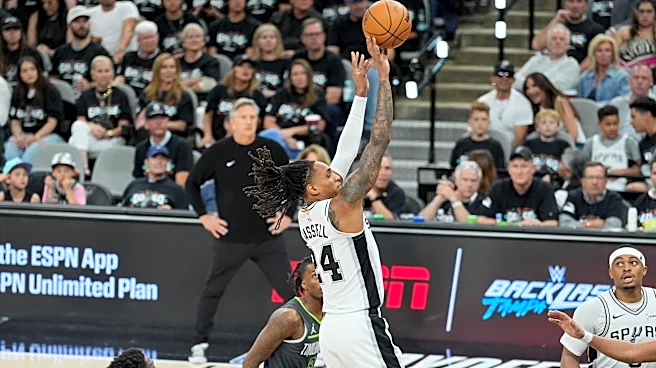
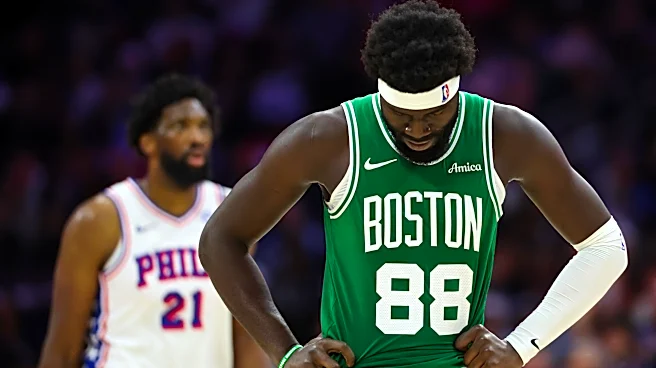
When the Portland Trail Blazers traded Anfernee Simons to the Boston Celtics for championship-winning guard Jrue Holiday, many fans voiced confusion. The trade signaled a transition from abject, shameless tanking to competitive basketball. Some felt that this transition was premature, and that a few more swings in the lottery were necessary before launching into win-now mode.
Holiday, off of one of the weakest offensive seasons in his career, had something of a resurgence on the Blazers. In spite
of an extended absence due to injury, Holiday found his footing on the Blazers, providing (when healthy) consistent production on a night-to-night basis. The question remains, though: what does Holiday’s future look like with the Blazers? How will the team balance his tenure with the long-term prospect of Scoot Henderson’s development? Can the two coexist?
Season Stats
- Minutes: 29.4
- Points: 16.3
- Rebounds: 4.6
- Assists: 6.1
- FG: 45.1%
- 3PT: 37.8%
- Blocks: 0.1
- Steals: 1.0
- Turnovers: 2.8
Other Standout Stats
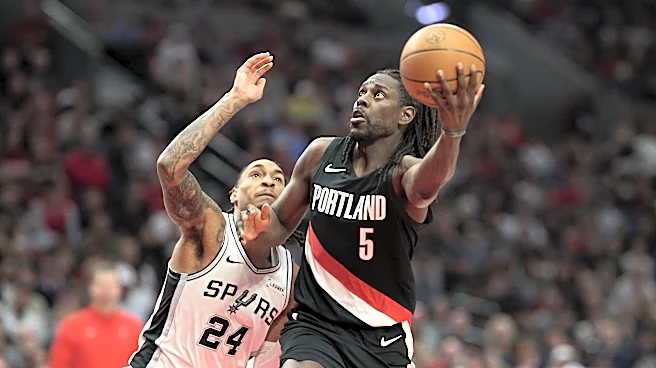
Jrue’s stat sheet shows us that he did exactly what the Blazers’ front office intended him to do: run the offense, lock up on defense, and hit threes. His efficiency from the beyond the arc should come as a relief to those who scouted holiday’s previous season in Boston, where he connected on 35.1% of his threes on 4.9 attempts. With the Blazers, Holiday hit on 37.8% of his threes on 6.8 attempts per game. His return to an effective perimeter shooter was an important catalyst for the Blazers playoff push. In his age 35 season, Holiday demonstrated an offensive resurgence, even as he shouldered a far greater offensive load than his previous two seasons in Boston.
Holiday lost a large portion of the season to a right calf strain, meaning he only saw action in 53 of the Blazers’ 82 regular season contests. In 29 games without Jrue, the Blazers went 14-15.
Change Year-Over-Year
Holiday was tasked with leading the Blazers’ young and inexperienced offense, a stark departure from his role in Boston. Holiday rose to the challenge, improving across nearly every stat while maintaining — or even increasing — his efficiency from the floor.
- Holiday was required to finish more plays on the offensive end this year. His FGA rose from 9.2 to 13.4, an increase of +4.2. As mentioned previously, his 3PA also increased from 4.9 to 6.8.
- Alongside an increase in volume, his splits improved across nearly all categories: his FG% rose from 44% to 45%; his 3P% rose from 35.1% to 37.8%, and his eFG% went from 53.8% to 54.8%. The only efficiency category in which he diminished was from the free throw line, dropping from 90% a season ago to 84% this year (in fairness, he averaged 1.2 attempts from the line during the 24-25 season).
- Scoot Henderson’s extended absence left Holiday to shoulder the team’s creation responsibilities. Thus, his turnovers increased from 1.2 a season ago to 2.8 this year. The eye test affirms these statistics: Holiday often got careless with the ball at inopportune times down the stretch. These turnovers aren’t necessarily all his fault, though. A severe lack of spacing and inexperienced offensive players meant defenses could load up on Holiday and clog passing lanes.
Analysis
From a fan perspective, Holiday felt like one of the Blazers’ more polarizing figures. As mentioned in the opening, Holiday represented more than just a steady veteran presence. Rather, he embodied the turning of a new leaf for the Trail Blazers, and — to some — unjustified hubris from the front office. Was it the correct move to bring in a veteran player, whose acquisition clearly signaled a pivot from playing tanking basketball to winning basketball, without yet employing “that dude?”
Holiday brought the exact qualities that you would expect. Down the stretch, he was a release valve against pressure defenses and could hit shots when needed. He was also the Blazers’ preferred champion in foul-up-three situations (the thought makes my heart shudder). He played between the lines, offering steadiness and organization to a team that desperately required both. When he needed to, such as during the final push of the season, Holiday could step up and be a primary offensive option. Of course, he was a stalwart on the defensive end, deploying the same perimeter wizardry that will likely land him in the hall of fame. If the intended effect of Holiday’s arrival was to help the Blazers win a couple more games down the stretch, then the front office can take a victory lap. Of course, there are off-court benefits to be reaped from Holiday’s tenure, such as mentorship for young guards like Scoot Henderson and Shaedon Sharpe, but it is difficult to quantify exactly how effective his teachings have been.
Holiday’s presence has muddied the water for the Blazers’ up-and-comers. In particular, Scoot Henderson was often sidelined in crunch time situations, where the Blazers would opt to ride with its veteran players. From a winning-games perspective, benching Scoot — whose volatility on both ends of the court has been a sticking point his entire career — was the objectively correct decision. You would have a greater chance to close out games with the tried-and-true Holiday guiding the team’s offense. However, the same fans that derided the Holiday trade fundamentally disagree with this philosophy. If you believe the Blazers’ goals should be to continue to develop their young players through any means necessary, then you reserve every right to sneer at Holiday’s preferential treatment. His presence certainly reduced Henderson’s playing time in the long run. However, there is an argument to be made that players get better not through reps, but through effective reps. Players need to learn through failure, this is undoubtedly true. However, as we saw with the Blazers teams of seasons past, continuously slamming your head into the wall and enduring 30-, 40-, even 50-point blowout losses does little for your young players’ morale or upskilling. Throwing Scoot into the fire on every single possession would mean less quality in the reps he is given. Playing behind and alongside Holiday provided Scoot optionality and consistency in the looks that he did get. Was Scoot erratic and ineffective on defense? Jrue time. Was Scoot’s decision making leading to turnovers? Jrue time. Only time will tell if this development strategy will serve Scoot well in the long-term.
Future Outlook
Holiday is entering the penultimate year of his contract, with the final year being a player option (an option he is all but certain to opt into — it will be hard to decline $33 million at 36 years of age). With the Blazers seeming to have turned a corner competitively, it feels increasingly likely that Holiday will stick around for the long-haul. Alongside the return of Damian Lillard, Holiday could serve in many different roles. He could continue to be a mainstay starter in the Blazers’ rotation, providing consistent production on a night-to-night basis. He could be relegated to the bench, and close games while guarding primary offensive options. He could be something in-between those two things, or something completely different.
The Blazers have choices to make with respect to their guard rotation. Scoot showed promise in the playoffs, dropping 31 points on efficient shooting, before his production plummeted at a familiar velocity. Is Scoot’s volatile play something the Blazers — who are presumably trying their darndest to win basketball games — something the Blazers can stomach? Or, will they lean on their vets, like Jrue Holiday, to try and bring a championship to Portland?