


I want to believe.
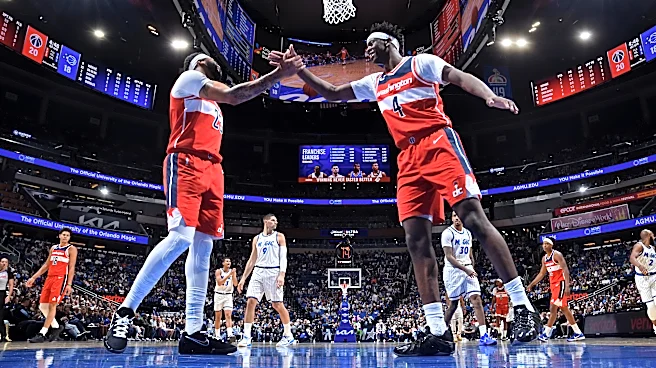
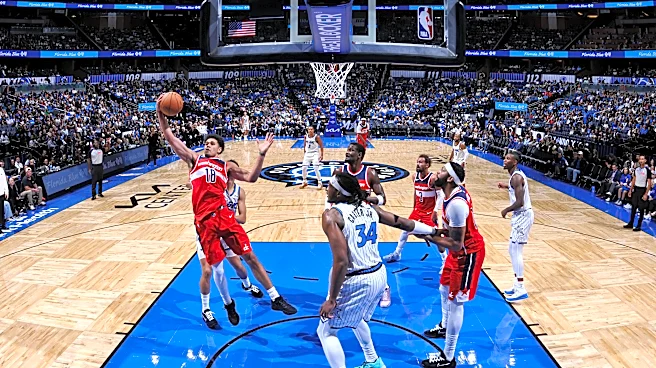
The Wizards entered last night’s game at the Orlando Magic ranked 10th in defensive rating (points allowed per 100 possessions). They then put the Magic into a figurative chokehold — limiting Orlando to 28.2% three-point shooting, 94 points in the game, and just nine points in a stifling third quarter.
It’s the second consecutive game that the Wizards opponent scored less than 100 points. Washington managed that feat just three times all of last season. And the Wizards did it without
Alex Sarr (out with a sore knee) and Justin Champagnie (broken foot).

The Wizards’ record is now 4-3. The last time they had a winning record this deep in the season was 2021-22.
Comparisons with last season are for illustrative purpose only, by the way. Washington was trying to lose last year. This is a different squad with a different purpose, and it shows. And it’s fun to watch.
Against the Magic, Kyshawn George was excellent on both end all night. He took good shots except when the only shots were tough ones — and he shot well. He defended, rebounded, set up teammates while avoiding turnovers and fouls. He finished with 22 points, 4 rebounds, 5 assists, a steal, a block and a turnover. That’s a helluva good game.
Anthony Davis dominated inside, scoring 27 points and grabbing 9 rebounds and 3 steals. He did get a bit sloppy at times, which showed in his five turnovers. Still, another strong game from the team’s best player.
In what might well be a sign, I thought AJ Dybantsa had a relatively rough outing. A few times in the second half, he had some trouble finishing through contact and managing against Orlando’s physicality. He shot just 7-17 from the floor. And yet, he finished with 21 points, 5 rebounds, 2 assists, and 3 steals. His PPA was 148, and the team was +10 in his minutes. Reminder: this is a 19-year-old rookie.
Bilal Coulibaly was disruptive on defense. Bub Carrington gave the team 19 productive minutes. Trae Young was kinda meh for him, and he still generated 9 assists and grifted free throws.
So why am I still at “want to believe” status? One big reason is the likelihood that they’re benefitting from opponent shooting luck. One of the lessons of statistical analysis is that defenses don’t have much effect on opponent three-point shooting. The fact that Washington’s opponents are shooting below 30% on threes is great. But over a small sample, it’s probably just luck. When opponent shooting regresses to the mean, so will Washington’s defense.
Probably.
I say “probably” because they’re doing a lot right on that end. Their effort is NBA level, which is something the franchise hasn’t had in a few years. They swarm, they pressure, they scrap, they chase and deflect and challenge shots. I see that and appreciate it while the analyst part of my brain keeps saying, “Tap the brakes. It’s not that hard to look good when opponents are shooting 28% from three-point range.”
From the Notebook
- The Magic targeted Young and had success, even on a bad offensive night. Young’s defensive effort is as good as it’s ever been across his entire career. My sense from watching him this season is that his (relative) defensive strength is as a help defender or jumping passing lanes. His point-of-attack defense is weak and will be a target as the Wizards play more meaningful games.
- I’m not sold on Dybantsa’s three-point shooting stroke. There’s something about his arms and the location of the ball as he’s shooting that’s not sitting right with me. It’s something like the ball spending too much time at eye level and a flat trajectory.
- The Wizards are huge and have a couple of elite athletes — Dybantsa and Coulibaly.
- Despite being tall, mobile, and athletic, Deandre Ayton has very little presence as a rim protector. In the second quarter, I jotted a note that Orlando guard Jase Richardson had found his ideal victims — Young at the point of attack and Ayton in the paint.
- Once again, Washington’s first offensive play was for Dybantsa. They set screens for him, and got him the ball on the move, which helped him drive to the room. He missed through contact that probably should have been called a foul.
- Once again, Young’s ability to threaten defenses with his passing set himself up for an open layup.
- Head coach Brian Keefe used essentially a nine-man rotation. Sarr and Champagnie were out with injuries, but Khris Middleton got a DNP-CD, and Will Riley played just four minutes.
Four Factors
Below are the four factors that decide wins and losses in basketball — shooting (efg), rebounding (offensive rebounds), ball handling (turnovers), fouling (free throws made).
The four factors are measured by:
- eFG% (effective field goal percentage, which accounts for the three-point shot)
- OREB% (offensive rebound percentage)
- TOV% (turnover percentage — turnovers divided by possessions)
- FTM/FGA (free throws made divided by field goal attempts)
Stats & Metrics
PPA is my overall production metric, which credits players for things they do that help a team win (scoring, rebounding, playmaking, defending) and dings them for things that hurt (missed shots, turnovers, bad defense, fouls).
PPA is a per possession metric designed for larger data sets. In small sample sizes, the numbers can get weird. In PPA, 100 is average, higher is better and replacement level is 45. For a single game, replacement level isn’t much use, and I reiterate the caution about small samples sometimes producing weird results.
POSS is the number of possessions each player was on the floor in this game.
ORTG = offensive rating, which is points produced per individual possessions x 100. League average so far this season is listed in the Four Factors table above. Points produced is not the same as points scored. It includes the value of assists and offensive rebounds, as well as sharing credit when receiving an assist.
USG = offensive usage rate. Average is 20%. Median last season was 17.7%.
ORTG and USG are versions of stats created by former Wizards assistant coach Dean Oliver and modified by me. ORTG is an efficiency measure that accounts for the value of shooting, offensive rebounds, assists and turnovers. USG includes shooting from the floor and free throw line, offensive rebounds, assists and turnovers.
+PTS = “Plus Points” is a measure of the points gained or lost by each player based on their efficiency in this game compared to league average efficiency on the same number of possessions. A player with an offensive rating (points produced per possession x 100) of 100 who uses 20 possessions would produce 20 points. If the league average efficiency is 115, the league — on average — would produced 23.0 points in the same 20 possessions. So, the player in this hypothetical would have a +PTS score of -3.0.
Players are sorted by total production in the game.