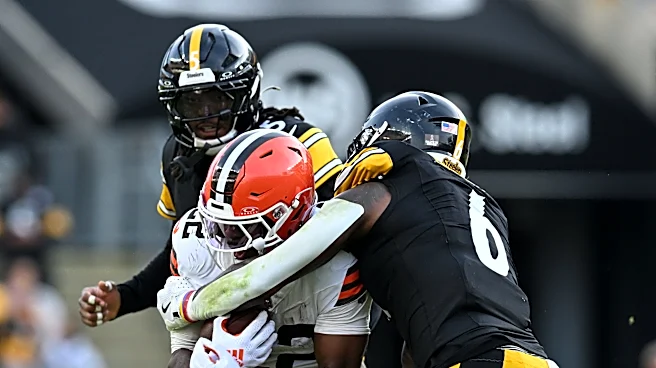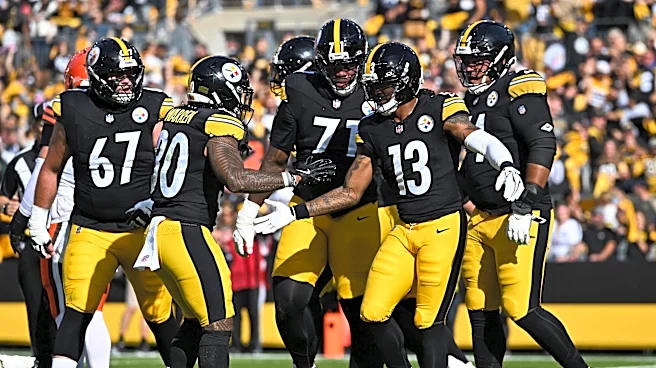




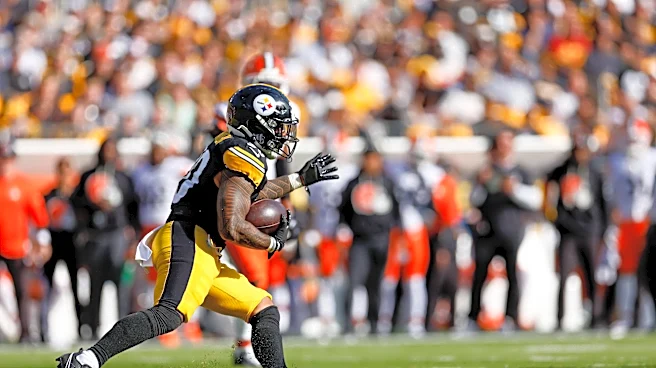

After trouncing the Cleveland Browns 27-6 at Acrisure Stadium on Sunday, the Pittsburgh Steelers are one of the hottest teams in the NFL. Heading into their bye, the team is riding a four-game winning streak and starting to generate some national buzz after pundits mostly wrote them off as irrelevant over the summer and first quarter of the season. Whether it’s talking to fellow fans or listening to the players conduct interviews, there’s an unmistakable energy and optimism surrounding this team that
hasn’t been felt in quite some time. The vibes are thriving in Pittsburgh right now.
But it wasn’t that long ago that the exact opposite was true. Following the Steelers October 1 loss to the Browns on Thursday Night Football, the Steelers felt lost. With a 2-2 record and both sides of the ball struggling to find any semblance of an identity, the fanbase was dejected. And judging by how players and coaches alike spoke this week about the trip home from Cleveland, they were doing some soul-searching of their own.
T.J. Watt and the defense’s performance since that game are, of course, a crucial element in the winning streak the Steelers find themselves in. But what I want to examine further today is something that first began to emerge when the Steelers were overseas in Paris: the return of Pittsburgh’s formations utilizing six offensive linemen.
In 2025, the Steelers and then-offensive coordinator Arthur Smith began experimenting with jumbo packages that brought guard Spencer Anderson onto the field for some extra heft in the trenches. Not to disimilarly from the NBA, Anderson began to fill a “Sixth Man” role for the team, frequently joining the starting five linemen and tight end Darnell Washington up front. The strategy was easy enough to follow; in a league where defenses are trying to match up with high-flying passing attacks by using lighter linebackers and getting five or more defensive backs on the field, countering with bigger bodies presents an offensive the opportunity to overpower their opponents on the ground.
With a coaching staff shakeup and Anderson initially opening the season as the starting right guard, the Steelers abandoned their trendy 2025 formation during the first month of the season. However, given how successful it was last year and how running the ball is clearly still their biggest strength, it shouldn’t be that surprising to see the Steelers re-exploring this wrinkle in their offense.
Since Week 7, the Steelers have called 29 plays with Anderson on the field as a sixth lineman. Turns out, it’s not unlike riding a bike, because the team has picked it up right where they left it. Pittsburgh has used four different personnel groupings with jumbo, but they have heavily leaned into one grouping:
- 11 personnel (one running back, one tight end, two wide receivers) — 21 plays
- 12 personnel (one running back, two tight ends, one receiver) – four plays
- 20 personnel (two running backs, zero tight ends, two wide receivers — three plays
- 22 personnel (two running backs, two tight ends, zero wide receivers) – one play
When you look at the stats above, you may be wondering what this exactly tells us. For those of you less familiar with the Expected Points Added (EPA) metric, it’s a stat that takes into account field position, as well as down and distance, and how many points years and years of historical data tell us we can expect from a given play based on those factors. Outperforming those expectations gets you a positive EPA, and underperforming generates negative EPA.
Running plays, historically, are less likely to generate explosive plays than passing. Likewise, an offense is considered less likely to pick up a first down with a rushing attempt from second-and-long or third-and-long. That makes generating positive EPA on the ground much more difficult overall. Through eight weeks, only five offenses average a positive EPA per rush: Buffalo (+0.11), Kansas City (+0.11), Pittsburgh (+0.07), San Francisco (+0.07), and Jacksonville (+0.01).
Consider that further. On 17 attempts, the Steelers are averaging more than three times as much EPA per rush from their jumbo 11 personnel package than they are this season overall. That highlights just how explosive they’ve been from these looks.
Put in simpler terms, the Steelers have run the ball 24 times with linemen on the field, whether that be with 11, 12, 20, or 22 personnel. Nine of those rushing attempts (37.5%) converted a first down or scored a touchdown. Nine of those plays also generated gains of at least five yards. Four runs (16.6%) went for 10 or more yards.
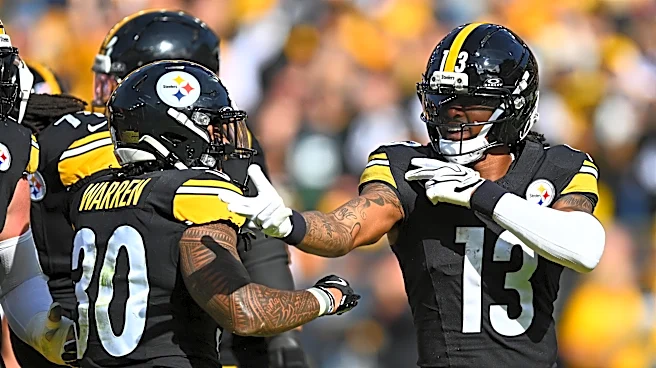
And it hasn’t mattered which player the Steelers have had in the backfield; both Jaylen Warren and Rico Dowdle have been productive. Warren has 16 carries for 95 tards (5.9 YPC) and a score. Dowdle has turned eight carries into 35 yards (4.4 YPC) and a touchdown.
This play was a fun one that saw Rodgers manipulate the defense with the threat of a pass, even though the Steelers have only a handful of passing attempts from these looks.
The Steelers ran the ball 12 times against one passing attempt in Paris while playing the Saints. In Week 8 against the Browns, they once again ran it 12 times. Here were five of the highlights:
1. Dowdle 9-yard TD
2. Warren gains 15 w/ 2o-personnel
3. Warren makes defenders miss for 13 yards
4. Frazier shows out on 8-yard run
5. Warren hammers in a one-yard TD w/ 22-personnel
But running the ball is only one phase of the Steelers’ jumbo package revival. If the team wants to continue to feature these personnel groupings, they’ll need to pose a viable threat in the passing game. Otherwise, opposing defenses will be able to sell out to stop the run. As good as these highlights are, if you exclude two short-yardage situations that resulted in a touchdown and a first down, the Steelers have had 10-of-22 rush attempts (45.4%) result in three or fewer yards gained. The jumbo packages have been effective, but they aren’t automatic big plays.
Against the Saints, the Steelers attempted just one pass out of a jumbo package look. They completed it for a respectable gain on a first-down play.
They dialed up four pass attempts against the Browns. They left a lot of meat on the bone, but I’m encouraged they can build off of these results if they continue to pursue them:
1. Backed up, quick pass to Bernard to set up third-and-short
2. Rodgers calls his own shot in 12-personnel
3. Would-be big gain turns into interception
4. Drag route to Washington gains 12 yards + 15 more from a CLE penalty
I’ll be curious to see how much Pittsburgh continues to deploy these jumbo packages as the season progresses. Was this deployment strictly matchup-based?
If not, what does this mean for the long-term prospects of Spencer Anderson? A seventh-round pick from the Steelers 2023 draft class, he’s already seen three of his classmates extended, and another two traded away. If this jumbo package remains viable, could Anderson be retained? He’s not a starter-level guard in my estimation, largely because he lacks enough power to consistently win against stronger and bigger defenders in the defensive interior. But in these packages, he’s playing outside of the tackles more like a tight end, meaning he’s taking on lighter edge players, linebackers, and defensive backs. Could the Steelers train one of Brock Hoffman, Gennings Dunker, or a future rookie to fill this just as well?
I’m curious to find out.
Let us know what you think in the comments. Be sure to bookmark Behind the Steel Curtain for all the latest news, breakdowns, and more!