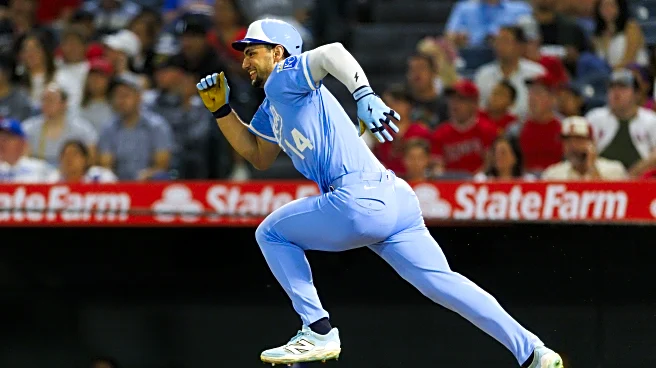




At first glance, the 2026 ZiPS projections for the Royals look familiar. ZIPS is the projection system formulated by Dan Szymborski at Fangraphs that looks at historical playing aging curves and applies them to current players. The topline projected total for the Royals in 2026 is similar to last year’s, with modest gains on the position-player side offset by more skepticism about the pitching staff. But a closer look shows a roster that is structured very differently than it was a year ago.
Here
are the 2025 ZIPS projections.

And here are the 2026 ZIPS projections.

The top line of this is simple, 2026 ZiPS likes the Royals’ position players better than last season at this time. It does not like the pitching as much, mostly Seth Lugo and Cole Ragans, though Kris Bubic and Noah Cameron keep it from being way different than last offseason. That is to say, it would be easy to just decide this team looks a lot like last year’s from a win expectancy perspective and move on to something else. I am a nerd, so that is not enough for me. Let us go in a little deeper and see if we can learn anything from the new ZiPS.
One thing I wish we emphasized less is point estimates. Instead, the 20th and 80th percentile outcomes that Dan Szymborski provides are far more informative. This is where players like Bobby Witt Jr. stand out, with a projected range of roughly 5 to 8.8 fWAR, compared to younger or less established players like Jac Caglianone and Jensen, whose ranges are much narrower in absolute terms. That might seem counterintuitive, but it is exactly what you would expect – players with higher true-talent levels naturally carry more absolute variance. When I teach and explain this concept, I point to my weight. If I lose 10 pounds, it is no big deal, but if my 85-pound son loses 10 pounds, it is a medical emergency. Bigger things have more pure volatility.
Relatively speaking, however, Witt is far more stable. His 3.8 WAR spread represents a little over 50 percent of his midpoint projection, while a three-WAR range around a 1.6 WAR midpoint represents nearly 200 percent volatility. That kind of uncertainty is typical for young players with shorter track records. What is interesting here is that Jensen’s 80th percentile projection is still below what he produced late last season, while Caglianone’s 20th percentile outcome sits meaningfully above his 2025 performance. As fans, it is easy to imagine Carter repeating his late-season success while Caglianone takes a major step forward, but ZiPS is doing what projections are supposed to do—regressing performance toward perceived talent level, with minor-league data doing much of the work. If both players settle in as roughly league-average contributors, that would already be a positive outcome given their ages and experience. Hoping for more is reasonable. Expecting both to be stars right away is not.
It is also worth noting that these projections were run before the additions of Isaac Collins and Lane Thomas. Even so, the corners were already projected 2.3 WAR above last year’s projection and way above the actual 2025 outcomes. It turns out not having MJ Melendez and elder Hunter Renfroe manning the corners is a good idea. The current 1.8 WAR projection for those spots also feels light. Thomas is a left-handed masher who should be deployed primarily in that role, something this roster badly needs. He is coming off a disastrous season, so health remains the obvious concern.
Isaac Collins is probably not going to repeat last year’s batting line, but his 80th percentile projection suggests that something close to it is still within reach. Defensively, he seems solid in left. Neither Thomas nor Collins should be in there 150 games, so used sparingly, I think they can help out the offense a lot and make it so the team does not need to lean on guys like John Rave, Dairon Blanco, and Tyler Tolbert much. That frees them up some interesting pinch-hitting and late-inning defense scenarios that could meaningfully impact the team since Thomas could become a platoon partner with Kyle Isbel to some extent if Jac Caglianone earns everyday time.
The largest negative change from last year’s ZiPS projections comes on the starting pitching side. Ragans is projected for nearly one fewer win, Lugo for almost two, and Michael Wacha for about half a win. In Ragans’ case, the decline is driven primarily by workload concerns, as his projected innings drop from 156 to 118. Lugo’s drop reflects both a reduction in expected innings and a worse ERA forecast, with his 20th–80th percentile range shifting from 3.32–4.33 to 3.75–5.02. Wacha’s slide is more straightforward aging-curve regression.
Luckily, Bubic has stepped into that second starter spot, again assuming health, and is projected to be very similar in ERA to Ragans. As with Ragans, workload concerns cap his WAR projection. Cameron’s projections are very similar to Wacha’s, mirroring last year on a FIP basis but not ERA. Where I think the projections are less reliable are with the depth pieces. Last year, Alec Marsh, Michael Lorenzen, and Kyle Wright had solid projections, but Marsh and Wright were not healthy enough to be factors. I would prefer this year’s depth with Ryan Bergert and Stephen Kolek despite better projections for last year’s depth pieces. ZIPS only looks at full-season stats and both Bergert and Kolek improved upon being traded to Kansas City, so their respective projections are not able to build off of the changes they had after the trade. This rotation is deeper this year and could still have a better top end than last year if health does not derail it again. Health is always the X-factor with pitching. I prefer deep and high-quality depth, which is what the Royals have right now in my opinion.
Maikel Garcia is another player worth revisiting. His projected 20th–80th percentile OPS+ range jumps from 68–105 last year to 82–119 for the upcoming season. That places his 2025 production around or slightly above the 80th percentile for the coming year, so some regression is expected with the bat. That is inevitable when you use projections based on three years of stats and the player only has one good year under his belt. Garcia had a rough September, but was shockingly consistent for the five months prior to that. He has pushed his baseline expectation higher while leaving open the possibility of continuing at an All-Star or even slightly higher level without needing a lot of luck to get there. That is a marked change from where he was.
Another thing of note, Nick Mears’ projection with the Brewers (released before the trade) shows a better ERA in fewer innings than Angel Zerpa. That is a bit surprising due to ast year’s FIP and xFIP numbers for the pair. ZIPS seems to like Mears much better, though his range of possibilities is wider, and the workload difference matters here. He will almost certainly throw more innings in Kansas City than he would have in Milwaukee just due to the difference in bullpen quality. That deal makes more sense when you look at it from that perspective – The Brewers traded from two areas of strength with Mears being their fifth- or sixth-best bullpen arm, and they had an outfielder where Isaac Collins was likely the fourth option. The trade was still a great steal for the Royals.
Just looking at the roster, the depth for both the position players and starters has improved significantly. The position-player group is deeper, the outfield is in far better shape, and the infield remains a strength. The rotation math does not fully reflect the improvement in depth, even if the top-end projections have softened. The Michael Massey/Jonathan India spot at second base looks shakier than last year, and locking in 1.9 WAR there would be appealing, but that may now be the most fragile part of the roster.
I think the team is two players away from being ready for opening day if they want to start being considered to win the AL Central. One more bat would be helpful, and it could be another outfielder or someone to add depth to the infield. Preferably, it would be better than any of the current options at second or one of the outfield positions, but even a solid utility bat that can step in where something fails would make the 26-man roster stronger.
My optimism for 2026 is starting to grow in a way it never quite did last year, when the holes were more obvious. ZiPS is beginning to outline a team that looks sturdier, deeper, and closer to contention than it has in some time.