


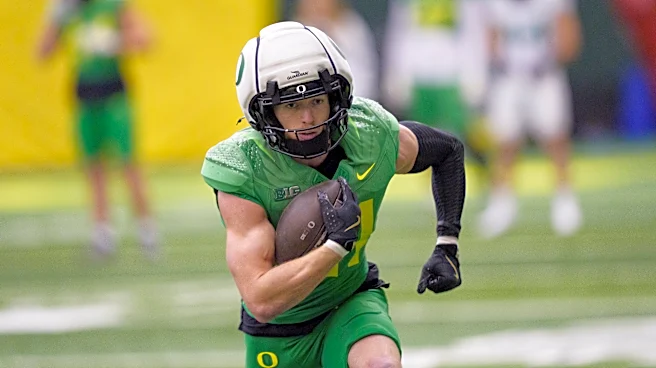
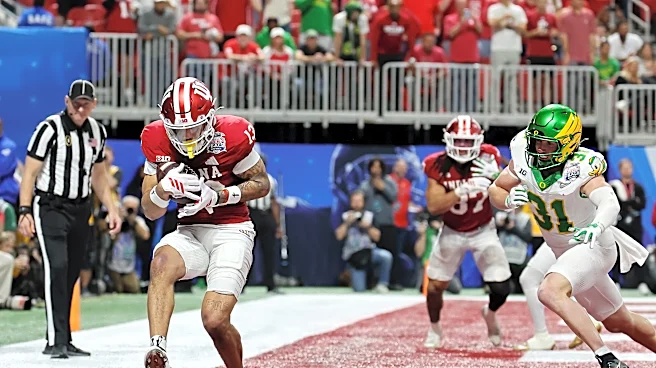
The best athletic programs, in any sport, don’t manage their rosters one year at a time. While the transfer portal is an important tool in roster management in modern college football, many contributing starters spend time on the team developing as young players.
In this article, I present my findings from reviewing the garbage time footage of Oregon’s offense this season that features developmental players. These players are usually in their first two years in the program and did not see regular
playing time until the outcome of the game has already been decided.
Readers should note that the sample of plays for each of these players is relatively small. Further, playcalling by both teams tends to be different to reflect the game effectively being over when these players are on the field.
As such, though I graded each player’s performance on every play I charted, I do not have the kind of information I would need to make a prediction about how these players would perform as starters. Rather, this footage is useful to gauge a player’s potential should they develop fully, as well as to inform offseason roster management decisions made by the coaching staff.
In contrast to last year (when I had separate articles for offensive and defensive players) I’ve condensed this year’s review into a single article, and have also included young players who saw some non-garbage time but stayed on the field late in lop-sided games. This wasn’t due to a dearth of garbage time, but rather because a large number of players who I would have considered developmental in 2025 but expected to be part of the primary rotation in 2026 have left the program in the January 2026 transfer window – I was looking for fewer jersey numbers than in previous years.
The Ducks had probably the deepest backfield in the nation in 2025 once it became clear that true freshmen (in this article all players will be referred to with their 2025 eligibility) #0 Jordon Davison and #23 Dierre Hill Jr. weren’t just playable but in some ways the best backs on the team.
This led to the surprising situation where the 2024 offensive developmental player I was most confident would become a 2025 contributor, R-Fr. #21 Da’Juann Riggs, was relegated to the bench. He suffered an injury late in the season and was unavailable in the playoffs when he probably could have seen the field against Indiana. With no less than four veteran backs lost from the 2025 roster due to graduation or transfer, my initial impression is that a healthy Riggs should find meaningful playing time behind Hill (who will probably remain the primary “speed” back).
Below is an illustrative collection of clips featuring Riggs. As a reminder, you can use the “Settings” gear in the bottom right of the player to adjust the playback speed.
- :00 – I hadn’t expected to find a play where Riggs was in pass protection, so this was a pleasant surprise. He’s not the biggest back, but he diagnoses the blitz correctly and engages the linebacker at a good angle.
- :16 – Riggs’ speed was never in doubt, which he shows off here as he follows the pulling guards around the the right side of the offense. I’m anxious to see if he is available for the spring game to see if his injury has affected his burst at all.
- :33 – I’d like to see a bit more patience from the young back on this play. Davison has inside leverage on the outside linebacker, so if Riggs presses the hole he’ll be able to get up the field trimming off the outside shoulder of the left tackle #56 Trent Ferguson. He does what a lot of young backs need to learn not to do and immediately tries to get outside. Against a more athletic defense’s starters it might not end this well.
- :41 – Riggs is lined up in the pistol out of this diamond formation. He shows just about every ability you look for in a young running back on this play. His vision leads him to pick the correct hole, his acceleration lets him escape backside pursuit, and his agility allows him to cut back against the flow of the defense for extra yards.
- :59 – The only knock I’ve found against Riggs when I have seen him on the field is that he is on the smaller side. Still, he’s not lacking in strength as determination, as he demonstrates here by dragging defenders for an extra two yards after contact.
- 1:15 – Riggs makes a great decision to cut up the field as the double team moves the defensive tackle all the way up the linebacker. He then sees the corner has lost outside contain so he breaks the nickel’s ankles and heads for the sideline.
Due to transfer portal attrition, the only remaining offensive developmental players who are still with the program and with tape to show are on the offensive line.
We saw R-Fr. #59 Fox Crader play meaningful snaps at LT against USC due to a rash of injuries, but he was also often on the field after the starters had left. Also playing tackle was R-Fr. #56 Trent Ferguson, who did see occasional snaps during meaningful play in heavy formations. Oregon was pursuing a transfer tackle but didn’t end up landing him, so I expect the trio of Crader, Ferguson, and #78 Gernorris Wilson to sort themselves into the two starting tackles and first off the bench.
These were the only two underclassmen I regularly saw, though the clips of the offensive line below show a couple of other underclassmen who got on the field early in the season.
- :00 – The broadcast went to an overhead shot this close to the goal line, but it is a great rep for two developmental linemen so I kept it in. Ferguson is at left tackle with Utu outside of him as a tight end while a second tight end goes in motion to that same side. The run is toward all that extra beef, and both young linemen wash down their assigned defenders to help clear the way for Davison.
- :15 – On this play we see Utu at right guard inside of true freshman #57 Zac Stascausky well into the most lopsided victory of the season. Utu combines with R-Fr. #53 Devin Brooks on a double team but fails to release to the second level. Stascausky is also beaten to the outside so Riggs has nowhere to run.
- :31 – Riggs can work free of the first defender who gets into the backfield. However on the offense’s left Ferguson’s weight is too far in front of his feet and he loses control of his man. Riggs now cannot escape outside and three Scarlet Knights combine for a TFL.
- :45 – Later in the season Crader saw more time at left tackle. On this rep it is a quick pass to the sideline so he doesn’t have to hold up in pass protection for long, but does need to make sure his defender cannot get into the throwing lane. He drops back to the proper depth and keeps his weight over his feet so he can stall the defensive end once contact is made.
- :59 – Young linemen often need more experience to master run blocking than pass blocking, and Crader is no exception on this play. He needs to maintain inside leverage and kick out the edge defender who is expecting to rush the quarterback. Instead he shuffles too far outside and lets the defender and gets “ole’d.”
The Ducks turned over their entire secondary from 2024 to 2025, bringing in veteran transfer #5 Theran Johnson who teamed with R-Fr. #7 Ify Obidegwu and true freshman #4 Brandon Finney Jr. to form the primary rotation at outside corner.
When more than one of these players needed a break, we did occasionally see true freshman #14 Na’eem Offord in meaningful play, though he took most of his snaps in garbage time. I thought Offord held up very well physically but, as most true freshman do, had a lot of work ahead to master the technique of his position.
Here’s a compilation of Offord’s play during garbage time.
- :00 – Offord is lined up over the outside receiver at the bottom of the screen. He fails to disengage from the block on this screen pass, but does make an impressive effort to at least prevent a touchdown.
- :31 – Again Offord is at the bottom of your screen, though this time over the boundary wide receiver. In this coverage scheme with only one deep safety he has to prioritize not getting beaten downfield, so he turns his hips to run almost immediately. This means he cannot stop the completion on this short hitch, but he makes a good tackle to prevent any run after the catch.
- :49 – Offord is now lined up at the top of the screen to the offense’s right. He’s in man coverage so isn’t involved against the run at first. After the running back bends back (since #47 Elijah Rushing doesn’t keep backside contain) he knows he needs to find work in run support and isn’t shy about getting stuck in.
- 1:07 – I noted Offord was quite handsy when I saw him in coverage and he drew a couple of penalties when tested 1-on-1. On this play he though he successfully uses contact. He maintains downfield position so he can legally force the receiver toward the sideline where there is no room to make the catch.
Like Offord, sophomore safety #12 Peyton Woodyard was not part of the primary rotation but saw significant snaps in garbage time at the field safety position. This included being in the middle of the field in what I referred on my tally sheet as the “strong safety” alignment when the nickel defender set up deep in the defense’s alternate two-high configuration.
Since the scores of the games he played in were out of control and both teams were running to keep the clock moving, I didn’t get any good clips of Woodyard covering receivers downfield. I did like his speed and instincts for the position, but he seemed a bit undersized for the field/strong safety spot.
Below are clips of Woodyard in action.
- :00 – Woodyard correctly plays his responsibility by coming down into the box at the snap in case the run cuts back to the offense’s right. He isn’t too aggressive though and parks himself in the throwing lane against a possible RPO slant. The quarterback has been baited into pulling the ball when the linebackers shift to the offense’s left. Now all Woodyard has to do is follow the QB’s eyes and collect his reward.
- :34 – Though not the most physically imposing safety, Woodyard does have long arms that give him excellent open field tackling ability. He comes down under control in run support and correctly plays his gap before wrapping up the runner short of the line to gain.
- :52 – This the quintessential role of a safety: to be the last line of defense when things go wrong. The tight end shakes the underneath coverage and is open for a first down. Woodyard keeps the play in front him and breaks down to wrap up the legs of the big Beaver to minimize the damage.
- 1:08 – This was one of the few plays I had on my tally sheet for Woodyard where I was critical of his performance. There is some confusion about responsibilities between him and the linebacker here as they are frantically signaling each other as the slot receiver comes across the formation. Woodyard ends up stepping down too far and gives up outside leverage on this RPO screen. Fortunately #4 Finney is so fast he is able to erase the error.
As far as edge players on the defensive line the only underclassmen the Ducks return are R-Fr. #47 Elijah Rushing and true freshman #32 Nasir Wyatt.
Wyatt had a considerable number of snaps during meaningful play as a pass rush specialist in “racecar” packages. I had hoped to see him used more broadly in garbage time, but he remained in a pure pass rushing role as older players (who have since transferred) took the snaps in case they were needed at some point in 2025. As such, I cannot comment on how Wyatt might be used outside of these situations in 2026.
Rushing played like a young lineman with limited experience under his belt, but I saw enough flashes to think he could earn an expanded role over the off season.
Here is a sample of plays featuring the developmental edge players.
- :00 – Rushing is lined up to the offense’s right. When the offensive line takes a kick step to their left he does well to work his way across the tight end’s face to protect the C-gap. He needs to do a better job of keeping his hips and shoulders parallel to the line of scrimmage, as it is he gets washed down the line. If DT #1 Bear Alexander hadn’t worked free this run could have been a successful first down gain.
- :14 – Again Rushing is on the offense’s right. He blows past the offensive tackle, but cannot bend sharply enough to get a hand on the quarterback. He still speeds up the timing of the throw, helping to cause an incompletion.
- :30 – Watch where the defensive players on the line of scrimmage are headed at the snap. Both Rushing and blitzing ILB #38 Will Straton work outside of their blockers to collapse the pocket if this is a pass on second and short. This is by design; the defense is willing to give up a first down as long as Rutgers doesn’t hit a big play. The backside contain needs to stay wide in case the quarterback keeps, but once he hands off Rushing disengages from his blocker to help Offord and Woodyard hold the running back to a short gain.
- :44 – This is the first game of the season, but Wyatt doesn’t wait to show off his athleticism against the Ducks’ best non-conference opponent. The running back plays this simulated pressure correctly, but Wyatt just runs through him and reaches out his long arms to trip up the quarterback and cause a sack.
Mirroring the situation on the edge, R-Fr. Aydin Breland was used almost purely as an interior pass rush specialist. I like Breland’s quickness as a 3-tech and hope to get a better look at how he plays the run during the spring game.
True freshman #55 Matthew Johnson (who is listed as a DE for peculiar reasons) only saw snaps in garbage time. Johnson showed some flashes, but like any true freshman has some work to do in the weight room to stand up to FBS opposition.
Below are clips featuring the two developmental interior defensive linemen.
- :00 – Johnson is lined up as a 1-tech to the offense’s left. At the snap he moves into the A-gap to force the ball carrier to bounce outside where backup Straton and woodyard are waiting for him. This shows good comprehension of his responsibilities in the scheme.
- :14 – This play shows some of the limits of Johnson’s strength during the 2025 season. He is lined up at 3-tech to the offense’s right and gets moved by the double team off the snap. The B-gap is his responsibility but he’s been pushed so far to the offense’s right it’s created space for the runner to work. The other DT is struggling as well, opening a cutback lane.
- :26 – This is one of the rare instances where I got to see Breland outside of his pass rush role, lined up as a 1-tech to the offense’s right with Johnson as the 3-tech. Breland’s pad level is too high coming out of his stance and gets pushed backward. Johnson, by contrast, uses some good footwork to control the B-gap and make sure the center cannot get to him so he only has to take on one blocker. He can then use a swim move to get off his block and hunt down the running back.
- :42 – Johnson is lined up at 1-tech to the offense’s right and immediately slants to the opposite side of the center. This helps create a jam in the middle of the defense, so if the QB had handed off the back would have had nowhere to go. The play side linebacker, #13 Gavin Nix, mis-plays this and doesn’t stay wide enough to take away the edge so the quarterback pulls the ball from the mesh. Fortunately the offense hasn’t accounted for (since transferred) safety #2 Kingston Lopa who chases the play down from behind.
I had been disappointed during the 2024 season not to see then-true freshmen ILB #20 Dylan Williams and #23 Brayden Platt on the field (even in garbage time) as they had come in as highly regarded recruits. I had speculated they might work into the linebacker rotation during meaningful play in 2025 as redshirt freshmen, but that possibility was cut short by injuries to both. They did recover in time to see some action against Iowa as emergency depth, as well as garbage time snaps late in the year. Both showed flashes of the athleticism that had them so highly rated out of high school.
I was also able to find some clips of 2025 true freshman ILB #13 Gavin Nix, whose foot speed was evident on the film, but he struggled to hold his ground against blocks and needs to keep attacking the weight room over the off season.
Below are examples of plays by the developmental linebackers.
- :00 – Nix is lined up at inside linebacker to the offense’s left. He follows the movement of the offensive line at first, but keeps his hips parallel to the line of scrimmage so so once he sees the bootleg he can change direction. He’s too fast for the Bobcat’s running back to cut him off. Though he doesn’t make the tackle, he ensures the quarterback cannot cut back to the middle of the field so #54 Jerry Mixon can take him down.
- :10 – I’d prefer Williams to be more decisive as he reacts to the run action so he can build up momentum and attack the tight end’s inside shoulder. He gets pushed back a few steps, but does show good use of his hands to disengage and assist with the tackle.
- :25 – This was easily the most exciting clip I had of any of the linebackers. Williams could do better timing up this blitz, but since the slicing tight end never adjusts it is a moot point. Once the quarterback turns away from him he can draw a bead on the running back and make a perfect form tackle.
- :37 – Platt is lined up toward the offense’s left where the play is headed. He reads the offensive line correctly and gets outside of the offensive tackle trying to block him at the second level. The tackles (including Johnson) have clogged up the middle. When the back tries to bounce outside he’s turned back in by Offord and Woodyard where Platt can now help wrap him up.
- :56 – Notice Platt (on the offense’s right) and Nix (to the offense’s left) signaling before the snap to make sure everyone is on the same page. They both take the correct gaps, though I would like to see Nix attack downhill more. The Minnesota running back does a great job running through contact, but Woodyard comes down from his safety spot to put a stop to that.