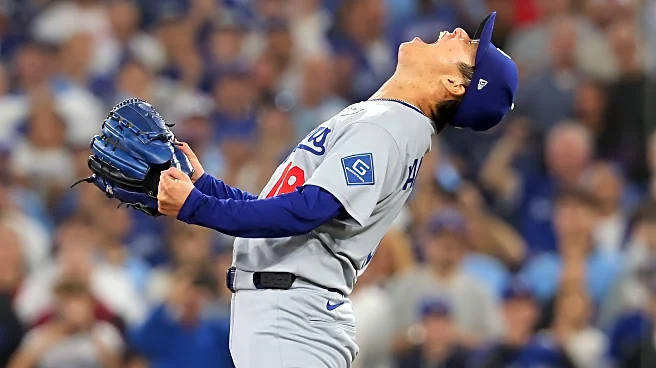

From Tokyo to Toronto, this season belonged to Yoshinobu Yamamoto. In my view, both as a journalist and as a traveling correspondent, Yamamoto was the best pitcher in MLB in 2025, with no disrespect to either
Cy Young winner.
He was the Dodgers’ Rock of Gibraltar. He threw the first pitch of the season in Tokyo at the Tokyo Dome in front of the rapt silence of his countrymen.
He made every assigned start and led the Dodgers in innings pitched, strikeouts, and wins. He led the league in allowing the fewest hits over nine innings (5.9) as opposing batters had a slash line of .183/.257/.283 against him during the regular season (think a slightly worse Michael Conforto).
Yamamoto made his first All-Star team. He won pitcher of the month honors in both March/April and September, becoming the first Dodger to win multiple awards in the same year since Clayton Kershaw in 2014.
He had the best Dodger pitching postseason since Orel Hershiser in 1988, which is damning Yamamoto with faint praise. Yamamoto fittingly threw the final pitch of the season in Toronto, while somehow getting the most outs on no rest to earn World Series MVP honors.

One has to dig really deep to find flaws with Yamamoto’s sophomore campaign. He had four starts in which he gave up more than four earned runs. He gave up twice as many home runs this year compared to last. He has forgettable entrance music.
For entrance music, Yamamoto should embrace the anthem of another confident, stylish Japanese (fictional) icon: Char Aznable. Is it an excuse for 1970s’ beats at Dodger Stadium? Partially, but the horn intro would mesh well with the recent addition of Edwin Diaz.
A good place to start this final review in depth is to compare what he did from where he left off last year:
Going forward, Yamamoto needs to work further acclimating to the American pitch schedule and his pitch efficiency as he averaged about 4⅔ innings in the playoffs and five innings during the regular season…
If Yamamoto reaches even close to his NPB metrics for effectiveness and length in 2025, the Dodgers will certainly take those results without any complaint.
All that can be said about this goal is mission accomplished. But before rightfully celebrating Yamamoto as a player, it is worth taking a moment to celebrate him as a man.
Measure of a Man
In October, Dylan Hernandez, previously of the Los Angeles Times, published an article on how Yamamoto helped his translator, Yoshihiro Sonoda, acclimate to the team, even though he was separated from his wife.
On Yamamoto’s first day of Spring Training in 2024, Yamamoto stopped Sonoda from collecting the javelins that Yamamoto has become famous for using in training by saying, “Please, you’re my interpreter,” he said. “You’re not my servant.” Hernandez continued:
In the months that followed, Sonoda noticed how Yamamoto treated others. He wasn’t kind only to other players. He was also conscientious of the organization’s rank-and-file employees.
“He pretends he’s not watching, but he’s watching,” Sonoda said. “He seems like he’s not listening, but he’s listening.”
Every day the Dodgers are on the road, Yamamoto has Starbucks coffee delivered to the team hotel. He always orders something for Sonoda.
Sonoda wanted to resign after two days because he had no experience as an interpreter. Sonoda reconsidered and has been a fixture with Yamamoto for the past two years.
“[Sonoda’s] efforts in the shadows have been to where I can feel them,” Yamamoto said. “He’s a very pure and straightforward person. I think he’s really wonderful.”
Vindication
One might ask how the Dodgers gave the largest pitching contract to someone who had not thrown in MLB… if they had spent less than five minutes on research. If anything, as someone who did do the research, the public ignorance was amusing.
For the past two years, it has not been an overexaggeration to say that Yamamoto is the best credentialed pitcher in the world. I am all for healthy skepticism, but even with Yamamoto’s learning curve in 2024, the fanbase was slow to jump on the hype train regarding Yamamoto, even with shaky debut in South Korea aside.
If 2024 was his introduction, 2025 was his ascendance into Dodger lore.
While Yamamoto did not eclipse the most impressive Dodger regular-season performance in modern history (Kershaw, 2014), he was still worth every penny of his contract in both general effectiveness and being the first Dodger hurler to qualify for league leaderboards since 2022.
Yamamoto used his six-pitch arsenal to confuse hitters throughout the league, much as he had done in Osaka playing for the Orix Buffaloes. Yamamoto’s true splitter was one of the best pitches in baseball, as hitters hit just .132 against it in 2025.
Yamamoto finished third in the NL Cy Young race with a 12-8 record. While wins are not the end-all statistic that they once were, Yamamoto’s success in the regular season was deflated by two factors outside of his control. For instance, in September, Yamamoto gave up two runs all month. To be fair, one of those runs was a big one.
But in earning his second monthly award, two trends persisted all year, which, if addressed, could vault Yamamoto into legendary status for his third MLB campaign.
Oh, Offense, where art thou?
Yamamoto often had to be so efficient and effective because his offense literally did not show while he was on the mound. In 2025, Yamamoto had 2.9 runs of support while he was on the mound.
Only six qualifying pitchers received less run support while pitching: Miles Mikolas, Chase Dollander, Erick Fedde, Ranger Suarez, Antonio Senzatela, and Michael Wacha. In contrast, Kershaw received 5.8 runs of support per game in 2025, tied for third-best in the Majors.
When Yamamoto left a game he pitched, the team’s offensive output spiked to 4.1 runs of support. Accordingly, Yamamoto had many more no-decision and tough-luck loss outings than one would think, considering his statline.
Dirty Work
Looking over the game logs, there were several games throughout the year where Yamamoto left the game winning, having thrown a quality start or better, only for Tanner Scott, Blake Treinen, or a combination of both to spoil excellent outings.
- May 20: vs. Diamondbacks (Scott)
- July 13: @Giants (Scott)
- August 31: vs. Diamondbacks (Scott)
- September 6: @Orioles (Treinen and Scott)
Admittedly, some of these outings were dampened by the lack of offense as described above.
Yamamoto had the grace to accept these setbacks and move forward, when many others would have held a grudge or complained publicly. The closest thing to reproach was said after the September 6 debacle to The Orange County Register:
“Obviously, it’s really hard to swallow,” Yamamoto said of the loss through his interpreter. “But the only thing we can do is we’ve got to get together, put things together, and overcome it.”
The no-hitter in Baltimore would have been the only no-hitter in MLB in 2025 and the first of Yamamoto’s MLB career. Yamamoto previously threw no-hitters in 2022 and 2023 in NPB, becoming the first pitcher in that league to toss no-hitters in consecutive seasons.
“Losing Isn’t an Option”
Yamamoto had the most outstanding Dodger postseason for a pitcher in the franchise’s history, inarguably. Hitters had a slash line of .174/.224/.258 against him during the entire postseason run, which was comparable to last year in almost double the workload (18 2/3 IP in 2024 vs. 37 1/3 IP in 2025).
Yamamoto started slowly, by his standards, with only a 6 2/3 inning, two runs (none earned), nine strikeout performance against the Cincinnati Reds in Game 2 of the Wild Card Round, followed by a middling, 4 inning, three run, two strikeout outing against the Philadelphia Phillies in Game 3 of the National League Division Series, being outpitched by the tandem of Aaron Nola and Ranger Suarez, who in a change of pace actually got run support.
Before Game 2 of the National League Championship Series, the Dodgers Social Media Team produced a gem about Yamamoto’s next start in Milwaukee, featuring a battle cry that he carried for the rest of the postseason.
Yamamoto gave up a leadoff home run to Jackson Chourio and then breezed through the Brewers, striking out seven, in the first postseason complete game in the Majors since 2017, to put the Dodgers up two games to none, in a series that would end with an emphatic sweep.
The Bane of Toronto
In the World Series, Yoshinobu Yamamoto became the Bane of Toronto (and Canada as a whole), earning three victories in the Fall Classic against the Toronto Blue Jays, all in Toronto. Per Sarah Langs of MLB.com, Yamamoto was the first pitcher to win three games in a single World Series since Randy Johnson in 2001 and the first pitcher to ever win three games in the same Fall Classic on the road. Further, Yamamoto became the fourth pitcher ever to win both Games 6 and 7, joining Johnson, Harry Brecheen (1946), and Ray Kremer (1925).
Contrary to Derek Jeter’s definitive proclamation that Yamamoto would not throw a consecutive complete game after dispatching the Brewers, Yamamoto did just that feat in Game 2, allowing a single run and striking out eight to even the Fall Classic at one game apiece. He retired the final 20 batters in a row, setting a new franchise record, supplanting Carl Erskine (19) in 1952 World Series Game 5.
With Yamamoto’s second complete game of the postseason, he joined Curt Schilling as the only pitchers with multiple consecutive complete games since 1993. Moreover, these complete games were the first of Yamamoto’s MLB career, joining Josh Beckett as the only two pitchers to do the feat for the first time in the postseason. Yamamoto had eight career complete games while pitching for the Orix Buffaloes in NPB.
Two days later, Yamamoto etched himself into Dodgers’ lore by being willing to pitch on one day’s rest in the entertaining marathon that was Game 3 to the shock and admiration of his teammates. Had Freddie Freeman had a walk-off home run for the second World Series in a row, Yamamoto would have pitched in the nineteenth inning to the conclusion of the game.
Instead, Yamamoto returned to pitch the first elimination game back in Toronto in Game 6, stymying the Blue Jays over six innings and again only allowing one run, while striking out six.
At this point, Yamamoto had become the de facto final boss for the Blue Jays to overcome. During Game 7 at the watch party of nearby Scotiabank Arena, the crowd reacted visibly when Yamamoto started warming up on no day’s rest in the do-or-die classic.
On no rest, clearly tired and aided by his defense, Yamamoto bent but did not break, pitching the final 2 2/3 innings, which was the longest outing of any Dodgers’ pitcher in Game 7, rightfully earning Most Valuable Player honors as the Dodgers repeated as champions for the first time in franchise history.
At the Championship Rally, Yamamoto addressed his adoptive hometown crowd in both Spanish and English, proudly proclaiming that losing wasn’t an option. Finishing his age-26 season, Yamamoto stands atop the pinnacle of the sport, lacking only a Cy Young in his American trophy case.
Now, Dodgers fans hold their breath as Yamamoto returns to play for Samurai Japan in the 2026 World Baseball Classic. Yamamoto’s unique mobility mechanics lend him to effectively be a rubber band man, and his youth lead him to wear life gloriously. For as good as Yamamoto was in 2025, based on his prior successes in NPB, he still has another gear to unlock in MLB.
No one doubts Yamamoto anymore.
2025 particulars
Age: 26
Stats: 30 G, 12-8, 173 2/3 IP, 2.49 ERA, 2.94 FIP, 59 BB, 201 K, 2.72 xERA, 0.990 WHIP, 4.9 rWAR, 5.0 fWAR
Postseason Stats: 6 G, 5-1, 37 1/3 IP, 1.45 ERA, 2.79 FIP, 6 BB, 33 K, 0.780 WHIP
Salary: $10 million
Game of the year
While honorable mentions must be given to his near no-hitter on September 6, his consecutive complete games of NLCS Game 2 and World Series Game 2, and his stopper of a start in World Series Game 6, Yamamoto’s Game of the Year was the final day of the year, Game 7 on November 1.
With no rest, he pitched 2 2/3 scoreless innings, serving as the final boss of the World Series in a performance so gritty and legendary that Yamamoto rightfully earned World Series MVP honors. About a month later, Blue Jays Manager John Schiender could only remark, “I hope he’s still tired” in response to Yamamoto’s Game 7 heroics.
Schiender may not have gotten the memo: losing for Yamamoto was not an option.
Roster status
Yamamoto is under contract through 2035 and will earn $12 million in 2026. He has two opt-out clauses, the first of which could potentially be triggered after the 2029 season, barring any right elbow injury lasting for at least 134 consecutive service days during the 2024 through 2029 seasons.