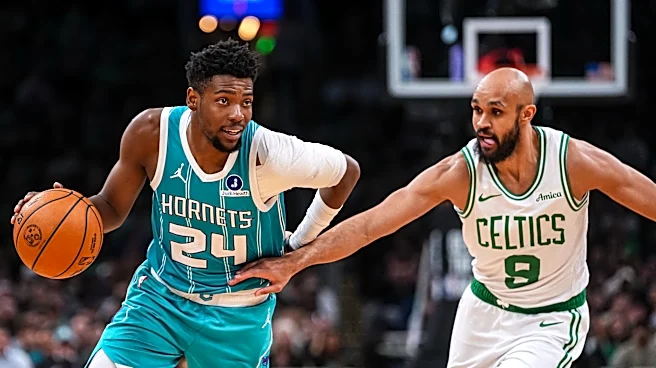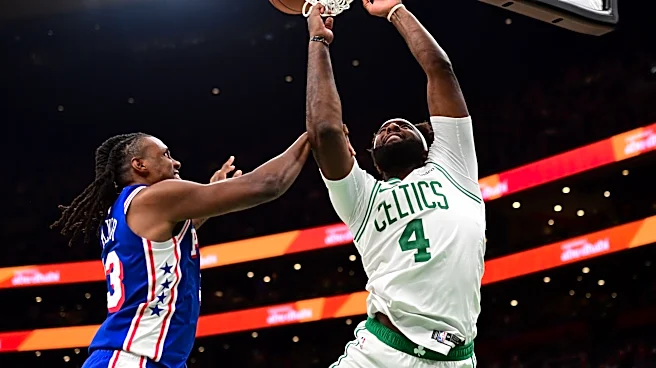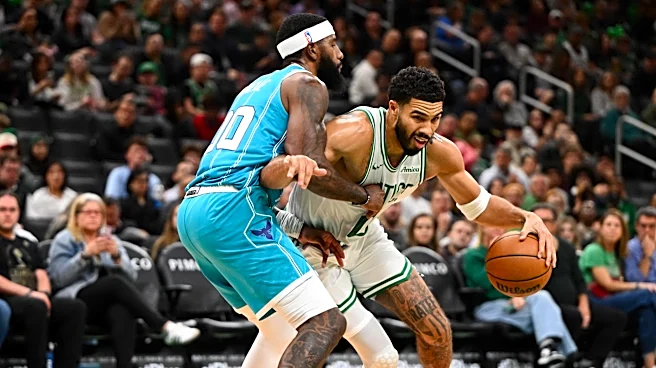


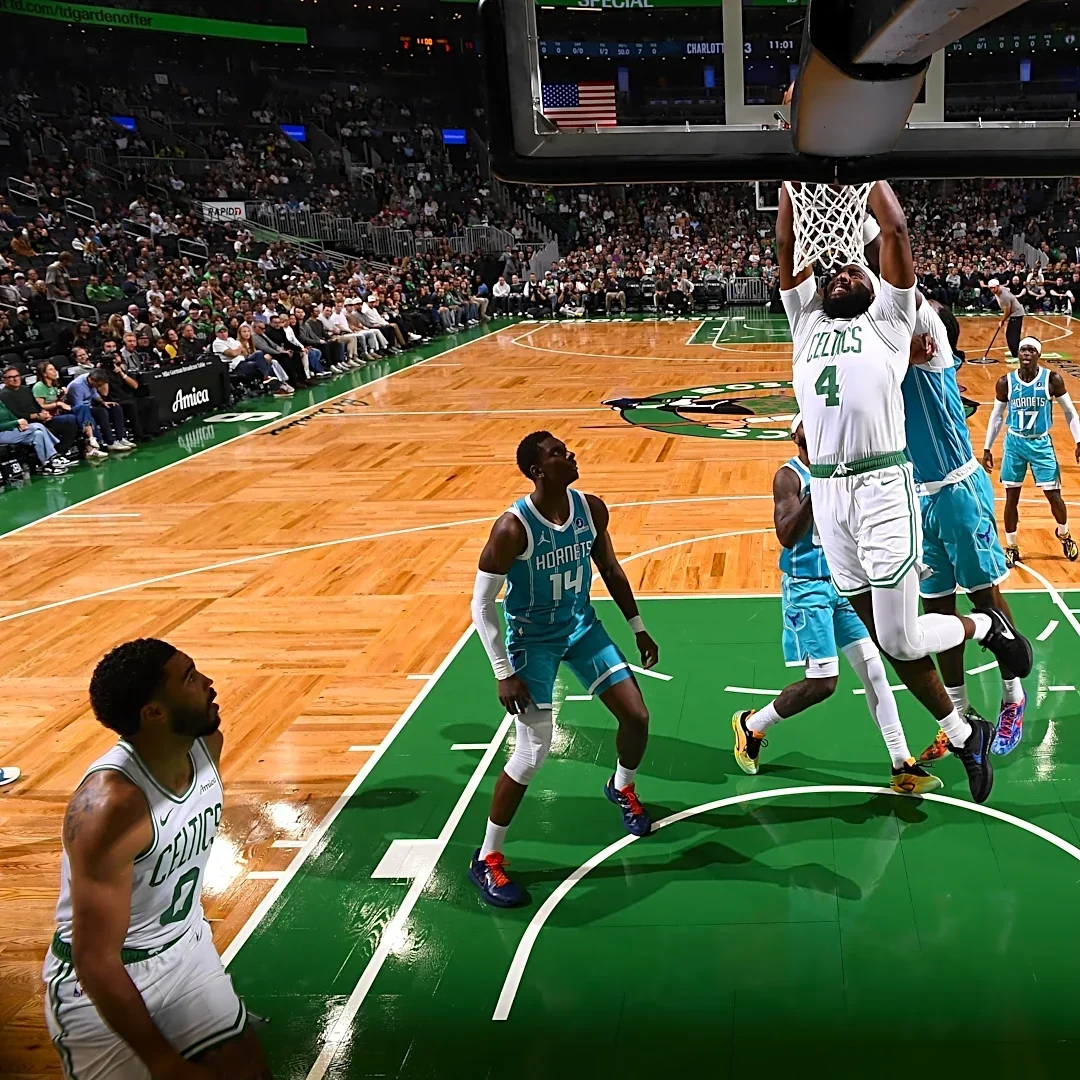

The Boston Celtics secured their third consecutive preseason victory last night, defeating the Charlotte Hornets by a commanding 113–94 margin.
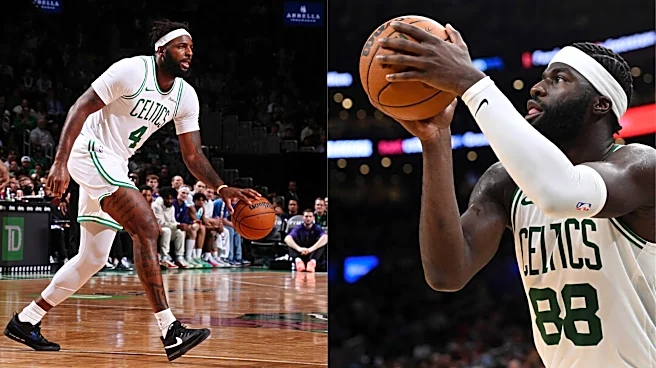
There were many interesting takeaways from the victory, but the one that stood out most to me was the six minutes and 58 seconds we got of a Neemias Queta and Mitchell Robinson double big lineup.
When asked about the decision after the game, Celtics head coach Joe Mazzulla explained the reasoning behind the experiment.
“Get some game reps in it so we can have
it on film to see what we want to work on if it’s something we have to do before the regular season.”
The decision also reflects Mazzulla’s willingness to explore the various combinations available to him, particularly given the depth Boston possesses on its roster.
Mazzulla emphasized that the Celtics have a “deep bench [with] a lot of depth,” adding that they “just want to give every look imaginable so that we’re able to have a general idea of how we want to attack it defensively and offensively when the season starts.”
As it turned out, the lineup was an entirely new look for the players, who had not practiced together in that configuration before taking the floor.
“The guys didn’t know we were going to do it; we hadn’t practiced it. The first time they knew was at the beginning of the quarter,” Mazzulla recalled.
Robinson offered a similar account of how the decision unfolded, reacting to the surprise with a smile.
“He did not tell us… caught us off guard,” Robinson remarked.
Despite the unexpected introduction, when asked about the lineup, Robinson recognized that he and Queta “are both talented players,” while also conceding that there are “a lot of things we have to clean up.”
Queta, meanwhile, added what he thought the pair brought to the team.
“A lot of presence in the paint on both sides,” Queta told reporters. He also expressed confidence in the partnership, adding that “we can be really good together.”
Mazzulla was more measured in his assessment, acknowledging that the lineup still has some rough edges to work through, like Robinson said before.
The Celtics head coach noted that they “got caught up in some janky spacing that you ideally wouldn’t want,” but also pointed to encouraging flashes of playmaking from Queta.
Despite being thrown together without prior preparation, the pairing showed encouraging signs.
The opening possession was far from ideal, as the pair surrendered two offensive rebounds. However, the initial struggles gave way to an impressive stretch of play, with the Celtics outscoring Charlotte 12–3 during the bigs’ first stint while holding the Hornets to just 1-of-7 shooting. Across a smidge under seven minutes on the floor together, Robinson and Queta helped Boston outscore Charlotte 19–8.
Even on a disjointed opening possession, the rationale behind the pairing is evident. Both players possess impressive mobility for their size, and Robinson showcases that versatility here, navigating the space between the ball handler and the roller before recovering to contest Brandon Miller’s jumper and block it.
The offensive end, however, was where I was most interested in seeing how the Celtics intended to utilize them. One thing I knew for sure was that the screening would be off the charts.
Queta and Robinson are two of the NBA’s premier screeners, and their effectiveness in that area helped unlock Derrick White offensively. White erupted for 13 points in the second quarter, converting all five of his field-goal attempts. Notably, every basket during that stretch came off a screen set by either Queta or Robinson.
On this possession, Queta showcases his versatility as a screener, setting an on-ball screen, following it with a “Flare” screen, and then slipping the subsequent screen in quick succession leading to a White score.
A Flare screen is an off-ball screen set in between the passer and the recipient for someone to go away from the ball.


Next play we see Queta and Robinson both in direct action.
Boston initiates the possession with an empty-corner angle pick-and-roll, a set that unfolds exactly as its name suggests. White and Queta execute the action at an angle, with the strong-side corner left vacant to create additional space for the ball handler to operate.

Meanwhile, Robinson is parked on the opposite side in the midrange area, positioning himself to set a screen should the initial White-Queta pick-and-roll fail to generate an advantage.

White doesn’t find anything and passes to the top of the key which triggers a Robinson screen. He sets a “pin down screen” for Sam Hauser. A pin down is an off-ball screen angled towards the baseline.

The goal for most pin downs is for the shooter to get open enough to take a shot after his defender has been screened. Miller plays this close enough to where that can’t happen for Boston. Hasuer knows this and instead just uses the screen to set one for White which initiates what the Celtics call “Double Get.”
The “Double” in this action refers to the two screens set during the play, with Hauser and Robinson each providing a screen to help generate separation and create an advantage for the offense.

The “Get” component describes an action in which a player passes to a teammate only to immediately run and get it back for a dribble handoff. This can also be called “Chase” action as the player is chasing their pass.
White runs to Robinson for the handoff and has enough space to hit the three.
Here, Boston runs a straightforward high pick-and-roll with Queta screening for White. Comparing Miller’s positioning before and after the screen highlights just how much separation Queta creates for White, forcing the defense into a two-on-one situation and giving Boston a clear advantage.


Perhaps the most obvious strength of this pairing is its rebounding. Here, Robinson isn’t credited with an offensive rebound due to the foul, but he nonetheless extends the possession by using his size and physicality to prove difficult for Charlotte to contain on the glass.
Next, we see Boston go to “Spain” pick and roll which gets White a layup.
Spain is a pick and roll in which there is a back screen on the on-ball screeners man. This can also be called “Stack.” So, in this case Hauser is setting the back screen on Robinson’s defender.

This completely stops Moussa Diabate in his tracks, making him unable to contest White at the rim.
On the defensive end, the activity remains relentless.
Charlotte initiates “Zoom” action (an off-ball screen followed by a dribble handoff), but Payton Pritchard steps in as the “next” defender, completely cutting off Brandon Miller’s driving lane and preventing him from turning the corner.

But after the pass goes to Sion James in the dunker spot, just look at how fast Robinson is able to get in front of Diabate and poke the ball loose.
The ball does find an open man because of the scramble, but a late Queta contest might have done the job.
Here, we see the kind of paint presence Queta alluded to. Charlotte runs a “Chest” action (an on-ball screen followed by a flare screen) which initially opens a driving lane for the speedy Dennis Schr0der. However, as Schroder attacks the basket, both Queta and Robinson converge to close off the lane. Queta’s length may have disrupted Schroder’s vision and contributed to an errant pass.
Back on the offensive side, we have Charlotte giving up an easy two-on-one near the logo.
Robinson sets another Flare screen that gets Pritchard to the wing.

It’s a subtle detail but notice how Hauser doesn’t pass directly to where Pritchard is standing. Instead, he leads him into open space, allowing Pritchard to move into the pass and maintain the flow of the offense. Almost everybody on the roster has that micro skill of pass leading to Flares.
Pritchard’s pump fake losses one defender, causing another one to leave the corner, which opens Baylor Scheierman for the three.
And another play of Robinson owning the offensive glass.
Now this shows a very key part of why this duo can work.
Queta is continuing to expand his range, but until proven reliable from deep, he is considered a non-shooting big. A designation that also applies to Robinson. Them being really good screeners, rebounders, cutters and smart players in general helps them work in tandem on offense. What unlocks this pairing, however, is Queta’s improved mobility and ball-handling ability.
As I discussed in greater depth in a previous piece, his FIBA footage offered encouraging evidence of growth in both areas, adding another dimension to his offensive game.This gives Queta more of a power forward slasher vibe, giving the lineup another potential creator which is really needed next to Robinson.
“That playmaking is an area we’d like to see Neemi take to a little bit of a different level,” Mazzulla outlined.
Queta’s ability to sell the dribble handoff before keeping the ball and creating scoring opportunities for himself could introduce another dangerous wrinkle into an offense already rich with options. With opposing defenses forced to devote so much attention to Boston’s perimeter threats, Queta could regularly exploit the resulting openings, catching defenders off guard and punishing them for overcommitting his teammates.
Last but not least, Queta showcases his improved mobility on the defensive end, switching onto a dynamic scorer and getting a stop.
Ultimately, the Robinson-Queta pairing remains a work in progress, but its early flashes have made a compelling case for further experimentation.
Their screening, rebounding, and combined size give Boston the tools to create two-on-ones, force defensive rotations, and generate additional scoring opportunities. Defensively, their length and mobility provide a formidable presence around the rim, with the potential to disrupt driving lanes and make life difficult for opposing offenses.
Meanwhile, Queta’s improved mobility and developing playmaking add another dimension to a duo that could offer more than just a physical presence in the paint. There are still questions to address, particularly regarding spacing and how the two can coexist within Boston’s offensive structure, but the ability to manufacture advantages, extend possessions, and control the game on defense makes this combination intriguing on both ends.
If the Celtics can iron out the kinks, Robinson and Queta could give Mazzulla another way to play ball.