
Organized professional baseball has been played in Kansas City since 1884, when the Kansas City Unions of the Union Association took the field. Despite this long history, the city has been light in witnessing baseball milestones.
Organized professional baseball has been played in Kansas City since 1884, when the Kansas City Unions of the Union Association took the field. Despite this long history, the city has been light on witnessing baseball milestones.
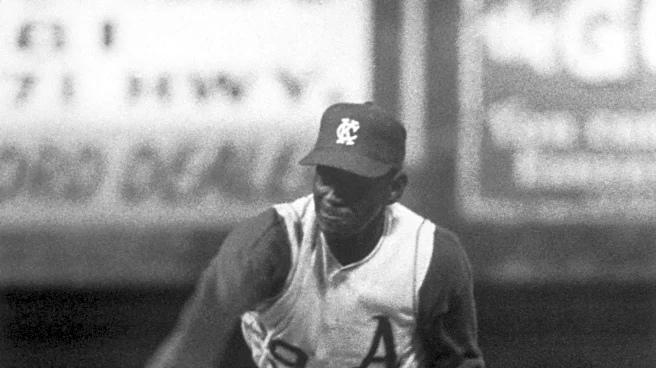
Not a single pitcher for the Kansas City Athletics
threw a no-hitter at Municipal Stadium. The first two no-hitters in Royals history were thrown on the road. Neither franchise has had—or ever will have—a 300-game winner. The closest Kansas City came was Gaylord Perry, who pitched the final 14 games of his career here. George Brett remains the only Royal to eclipse 3,000 hits, and he recorded the milestone hit on the road—then promptly got picked off first base. The city has never had a 500-career home run hitter, save for Harmon Killebrew’s final 106 career games in 1975.
Of the notable milestones reached in Kansas City ballparks, one of the first occurred on June 26, 1947, when Carl DeRose—once the Yankees’ top pitching prospect—begged his manager for one more start. DeRose, a Milaca, Minnesota native, made his debut with the Amsterdam Rug Makers, the Yankees’ Class A affiliate, in 1942 and, at age 19, promptly went 19–6. Armed with what was described as a heavy fastball, DeRose was labeled the next Bob Feller.
World War II interrupted his ascension, costing him the next three years to military service. While pitching for a military team, DeRose threw a three-hit complete-game victory over Satchel Paige’s All-Star team. He appeared poised to make his Yankees debut, but a broken knuckle sent him to the Kansas City Blues for the 1946 season. DeRose went 12–6 and seemed ready for his breakthrough, but the baseball gods had other ideas.
He injured his shoulder on a cold, snowy day in Denver and was never the same. Experimental surgery loomed—the only chance to save his once-promising career. Thus, on that June evening in 1947 against the Minneapolis Millers, DeRose begged his manager for one last game. He gutted his way through nine innings, often with tears of pain streaming down his cheeks. Twenty-seven batters up, twenty-seven batters down. Carl DeRose, missing his once-prodigious fastball, threw the first nine-inning perfect game in American Association history at Municipal Stadium.
DeRose spent a couple more seasons bouncing around the Yankees’ minor league system before leaving the game after the 1950 season at age 27. He later played independent league ball in Iowa and Minnesota but never got the opportunity to toe a major league rubber.
On July 11, 1960, local fans—30,619 of them—got to see the game’s biggest stars when the Major League All-Star Game was played at Municipal Stadium. The contest featured 18 future Hall of Famers and was won by the National League, 5–3. The NL stars wasted no time. Willie Mays led off the game with a triple down the right-field line and scored on a Bob Skinner single. With two outs, Ernie Banks smashed a two-run home run. In the second inning, Del Crandall added another long ball to make it 4–0.
The Junior Circuit got on the board in the sixth inning and made it respectable in the eighth when Al Kaline cranked a two-run homer. Bud Daley was the only member of the Athletics selected and entered to a rousing ovation to pitch the ninth inning. He struck out Vada Pinson and Orlando Cepeda, and retired Roberto Clemente on a lineout. Daley later called the appearance the greatest thrill of his career. The game was also notable as the final All-Star Game for Ted Williams and the first for Clemente and Brooks Robinson.
On August 27, 1962, Municipal Stadium hosted the 36th—and final—Negro League East-West All-Star Game, a 5–2 victory for the West. It was the only Negro League All-Star Game hosted by Kansas City, which is notable given that the Negro Leagues were formed just a few blocks north of the stadium at the Paseo YMCA. Willie Hardwick of the Kansas City Monarchs homered in the second inning to spark the West. The East squad struggled defensively, committing five errors that led to four unearned runs. Another Monarch, pitcher Sherm Cottingham, earned the win. During the fifth inning, former Monarch Jackie Robinson was honored with a key to the city, and Satchel Paige and several other former Monarchs were also introduced.
On July 13, 1963, Early Wynn of the Cleveland Indians pitched five innings against the Kansas City Athletics to secure his 300th career victory in a 7–4 win. At 43, Wynn was the oldest player in the majors and became just the 14th pitcher to reach the milestone. He made his major league debut in 1939 as a 19-year-old with the Washington Senators and missed the entire 1945 season due to military service. His best years came with Cleveland, where he won at least 20 games in four different seasons. Wynn spent five seasons late in his career with the Chicago White Sox before returning to the Indians for the sole purpose of winning game No. 300. The victory against Kansas City proved to be the final win of his career, leaving him with a 300–244 record and a 3.54 ERA. That Athletics roster included an 18-year-old Tony La Russa, who appeared as a pinch runner. Future Royal Moe Drabowsky took the loss for Kansas City.
In a desperate attempt to boost attendance, Athletics owner Charlie O. Finley declared September 8, 1965, “Campy Campaneris Night.” The promotion centered on Campaneris playing all nine positions against the Los Angeles Angels. The stunt drew 21,576 fans to Municipal Stadium, and the 23-year-old Campaneris delivered a memorable performance. He started at shortstop before moving, in order, to second base, third base, left field, center field, right field, first base, pitcher, and finally catcher.
Things grew heated in the ninth inning when future Royal Ed Kirkpatrick led off with a single. Kirkpatrick promptly stole second, moved to third, and then attempted to steal home. Campaneris caught the pitch from another future Royal, Aurelio Monteagudo, and applied the tag as Kirkpatrick barreled into him in an effort to dislodge the ball. Campaneris held on for the final out and appeared ready to brawl before being restrained by José Cardenal, who also happened to be his cousin. Campaneris was removed from the game and taken to St. Luke’s Hospital with a shoulder injury. The Angels won, 5–3.
Next week, we’ll look at milestones achieved at Royals/Kauffman Stadium.