






Happy Labor Day to you and yours, I hope you’re enjoying the unofficial end of summer/beginning of autumn. And as we roll from one season into another, we have important Devils business to discuss.
Last week, Sunny Mehta took a major swing, though not one anyone really saw coming. The new Devils general manager traded Colorado’s first round pick in 2028 (acquired in the Simon Nemec deal) and New Jersey’s own second round pick in 2028 to the Nashville Predators for forward Luke Evangelista. He might
not be Quinn Hughes or Connor Hellebuyck, but Evangelista is a darn good player, someone that folks around the Devils have had their eye on for a while now. Not to mention that this move came out of nowhere, proving that Mehta wasn’t all talk when he said that he views the roster as “a painting that’s never finished” back in July.
With Evangelista’s acquisition, there are now other roster questions that seemingly need to be resolved before the season starts. A few of those include who the odd men out at forward will be, will Evangelista (who has one year remaining on his current deal) be signed to an extension, and who plays with who. That last one is what we’re going to focus on today, although we’re really only going to look at one potential line: Timo Meier, Nico Hischier, and the newest Devil, Evangelista.
As soon as news broke that Mehta traded for Evangelista, Devils fans everywhere started putting together new line combinations to accommodate the former Predator. From what I have seen, the majority (or at the very least, the plurality) seems to have Evangelista lining up with Meier and Hischier in New Jersey’s top six. It makes sense considering the quality and style of Evangelista’s play, and while I can’t sit here and tell you I’ve watched a ton of Evangelista tape over the years, what I can tell you is that based on every bit of Evangelista info I got my hands on upon hearing of the trade, I am very, VERY bullish on this particular combination.
What could make a Meier-Hischier-Evangelista line combination special? What about Evangelista’s game makes him a good fit? How was he deployed in Nashville? What are some of Evangelista’s more intriguing comps? We’ll tackle all of that today as we dive deep on the newest Devil.
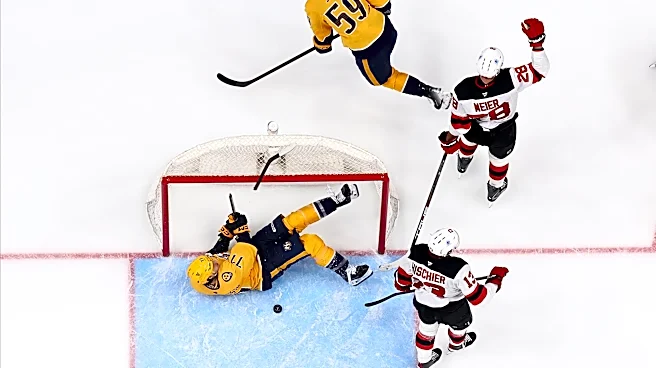
(P.S. – My deepest apologies to Evangelista for going with that photo for the headline picture, it was the only one in our system I could find that included all three of you!)
Evangelista’s Time In Nashville
Luke Evangelista was selected in the second round, 42nd overall, of the 2020 draft by the Nashville Predators. So while he’s not a late-round miracle like Jesper Bratt, he doesn’t come with high-end draft pedigree either. He first made it to the NHL in the 2022-23 season, where he appeared in 24 games. In that time, he scored seven goals and registered 15 total points, a promising debut indeed.
In his three full seasons in Nashville, Evangelista provided good but not great production:
This past season was a bit of a breakout for him. He produced exactly twice as many assists as the season prior, and while his goal total still left something to be desired, 56 points is quality production for a player like Evangelista. It’s probably not a coincidence that he set a big career high in points, as his average time on ice went from the 13:50’s in his first two full seasons to 16:37 in 2025-26, a major increase.
In addition to the added responsibility in terms of minutes played, he also saw added responsibility in terms of who he played with. At 5-on-5 last season, Evangelista’s most common forward linemates were Ryan O’Reilly (607:30 minutes), Filip Forsberg (401:31), and Steven Stamkos (347:55). Those are Nashville’s top dogs, so for Evangelista to be trusted with their ice time says a lot about how he performed and how he was viewed by the coaching staff.
At 24 years old (he will turn 25 in February), Evangelista seems to be a player on the rise. But of course, point totals and common linemates can only tell us so much. What about Evangelista’s advanced metrics? What do those tell us?
Long story short, those tell us that Evangelista is a powder keg ready to explode.
Another Shutdown Forward
Now that we’ve discussed how Evangelista played with Nashville’s big guns last season, let’s take it a step further by looking into the finer details of his deployment and competition. After all, Hischier and Meier get the toughest minutes of any forwards on the team. If Evangelista is going to skate with them, and if head coach Sheldon Keefe isn’t going to ease the Hischier line’s burden by giving more tough matchups to, say, Cody Glass, then Evangelista is going to need to be able to play defense well. Let’s take a look at a variety of models to see what the consensus is on Evangelista’s defensive chops.
PuckIQ
We’ll start with PuckIQ, a public hockey analytics website that has a great tool that tracks how difficult a player’s role is. Using their “Woodmoney” metric (yes, Woodmoney), they separate a player’s competition into three buckets: elite competition, middle competition, and gritensity (AKA weak) competition. According to PuckIQ, Evangelista spent 37.2% of his 5-on-5 ice time playing against elite competition. He was effectively tied for second-most among Nashville forwards, behind only Ryan O’Reilly (42.0%). To give a little context to those numbers, Nico Hischier, who we all know faces a ton of elite competition season after season, spent 36.0% of his minutes battling elite competition in 2025-26. Meier, the third member of this potential line, was at 35.5% last year.
So Evangelista actually spent more of his time absorbing matchup minutes than Hischier and Meier a season ago, at least according to this metric. And not only that, but Evangelista was winning those minutes as well. Instead of something like Expected Goals%, PuckIQ defaults to a metric called Dangerous Fenwick For%. According to the site’s glossary, Dangerous Fenwick is a “Weighted shot metric using shot distance location and type of shot to give each shot a “danger” value”. So think of this as PuckIQ’s version of xG%. In this metric, Evangelista logged a DFF% of 51.1 against elite competition, which was the single highest on the team (excluding Brady Martin’s seven minutes of ice time). Again for context, Hischier’s DFF% was 55.1, and Meier’s was 53.5. It stands to reason that if Evangelista can keep his head above water playing with a bunch of people who can’t, then he should get even better with teammates who can thrive in tough minutes.
Hockey Stat Cards
Next, we’ll check out Hockey Stat Cards. This model uses a system called net rating, which can be broken down into offensive and defensive net rating. Last season, Timo Meier registered a defensive net rating of +1.5, which was in the 77th percentile league-wide. And similarly to PuckIQ, Hockey Stat Cards also tracks how tough a player’s minutes are, charting out their quality of offensive competition and quality of defensive competition. During the 2025-26 campaign, Meier’s quality of offensive competition was in the 89th percentile, while his quality of defensive competition was in the 92nd percentile. In other words, Only about 10% of the rest of the NHL saw tougher matchups than Meier. I know we’re all disappointed in Meier’s offensive production since he came to New Jersey, myself included, but we do have to give him credit for how strong he’s become defensively. Being better than 77% of the rest of the league is impressive work.
But of course, Meier pales in comparison to the captain. In 2025-26, Nico Hischier produced a defensive net rating of +4.6, placing him in the 94th percentile in the league. Hischier managed this despite (or perhaps due to) the fact that his quality of offensive AND defensive competition were also in the 94th percentile. The captain locked everything down against the best of the best. This is why there may very well be a Selke trophy in his future.
Now comes the truly wild part: Luke Evangelista actually finished with a higher defensive net rating than Hischier last season. Yes, Hockey Stat Cards had Evangelista tabbed at a +5.1 defensive net rating, putting him in the 96th percentile league-wide. His quality of offensive competition was basically on par with Meier and Hischier’s in the 93rd percentile, though his quality of defensive competition was in the 80th percentile. Not quite on the level of Meier and Hischier, but still quite tough. Yet another model that is very, very high on Evangelista’s shutdown capabilities.
Natural Stat Trick
What about ol’ reliable, Natural Stat Trick? We’ll use their metric of Expected Goals Against Per 60 as a nice, clean way of measuring Evangelista’s defensive impact. According to NST, Evangelista registered an xGA/60 of 2.46. There were 384 forwards who played at least 500 5-on-5 minutes last season, and Evangelista’s 2.46 xGA/60 placed him at 85th in that group, which is roughly the 78th percentile in that metric. For reference, Hischier finished with a 2.61 xGA/60 (163rd out of 384), and Meier was at 2.67 (199th out of 384).
It’s not just xGA/60 either. Evangelista was an analytics darling per Natural Stat Trick:
Corsi Against/60: 50.09 (35th out of 384)
Scoring Chances Against/60: 23.33 (36th)
High Danger Corsi Against/60: 9.81 (51st)
No matter which angle you look at it from, Natural Stat Trick was very impressed with Evangelista’s 2025-26.
Moneypuck
Finally, I thought it would be good to check out Moneypuck’s forward line tool to see how Evangelista’s most common forward lines fared when comparing to the rest of the league. According to Moneypuck, there were 52 distinct forward lines that played at least 250 minutes together at 5-on-5 in 2025-26. Two of those lines involved Evangelista: One with O’Reilly and Stamkos (266 minutes), and one with O’Reilly and Forsberg (274 minutes). His line with O’Reilly and Stamkos finished 14th in xGA/60 (2.18), and his line with O’Reilly and Forsberg was right behind that in a tie for 15th (2.23). If you’re curious, the Meier-Hischier-Dawson Mercer line played 476 minutes together and finished 13th with a 2.13 xGA/60.
Yes it is obviously possible that O’Reilly, Stamkos, or Forsberg were the defensive drivers there. O’Reilly would be the most likely candidate considering his defensive aptitude and the fact that he graded out exceptionally according to Hockey Stat Cards (+5.6 defensive net rating, 99th percentile quality of offensive competition). Though he did fare less favorably in the eyes of PuckIQ (46.4 DFF%) and Natural Stat Trick (2.7 xGA/60; 212th out of 384). But first there’s the fact that every other line O’Reilly, Stamkos, and Forsberg found themselves on that didn’t feature Evangelista all fared worse than any line with him. Plus there’s another line that involved Evangelista (with Michael Bunting and old pal Erik Haula) that played 124 minutes together last season and posted a sparkling 1.99 xGA/60. So all the evidence here points to Evangelista being the biggest defensive difference-maker on any line he found himself on.
These models are not the be-all, end-all of course. But combined, this is a good sample size of metrics that all say the same thing: Luke Evangelista is a defensive stud that suffocates opposing offenses. For a while now, I’ve been intrigued by the possibility of giving Cody Glass more matchup minutes, thus freeing up the Hischier line to thrive in more offensive deployment. It’s something I wrote about recently regarding Meier specifically. It’s something I considered LAST summer when Glass was still very new to the club. Others on this site have also pounded the drum for Glass to help free up Hischier and pals. And yet, Hischier remains the matchup man. But with Evangelista now in the fold, I wonder if that’s enough to push this line into truly matchup-proof territory. Maybe Evangelista is the key to unlocking that next level of offense for Meier and Hischier while still allowing Keefe to use this line as the team’s eraser. It’s something to consider.
Speaking of which…
Strong Offense And Stylistic Fit
Of course, incredible defensive impacts are not the only thing that Evangelista brings to the table. As mentioned, 56 points is nothing to scoff at, even if he could stand to score more goals himself (put a pin in that). Meanwhile, all the metrics we’ve used today all paint a bright and happy picture of Evangelista on the offensive side of the rink as well. PuckIQ has Evangelista measured at a Corsi For/60 of 66.9 against Elite competition. That was the highest on the Preds last year by far, and higher than any Devil in 2025-26, save for Zack MacEwen’s three games of work.
Hockey Stat Cards had Evangelista’s offensive net rating at +6.0, good for the 86th percentile across the NHL.
Per Natural Stat Trick, Evangelista’s xGF/60 sat at 3.15, ranking 42nd out of those same 384 forwards with at least 500 5-on-5 minutes in 2025-26.
And according to Moneypuck, of those 52 forward lines with at least 250 minutes together, the two Evangelista lines that qualified ranked 9th (with O’Reilly and Stamkos) and 20th (with O’Reilly and Forsberg) in xGF/60 with 3.26 and 3.08 respectively.
So don’t sleep on Evangelista’s ability to drive offense either. The man posted excellent numbers while dragging around a pretty mediocre Nashville team. Remember how a lot of us were talking about perhaps trading for Stamkos because he bounced back from a pretty disappointing first year in Nashville? It’s quite possible that was way more Evangelista than Stamkos. And if he can help a mid-30’s Stamkos find his game again, imagine the boost he could give to Hischier and Meier, two players that are currently in their primes.
There’s also the stylistic fit to consider. As you can probably tell from his goals/assists breakdown from last season, Evangelista is way more of a playmaker than a shooter. To back this up, we have some microstats from JFresh of HockeyStats:
Take a look at that middle column, where all the passing metrics are located. Those are outrageously good impacts across the board. Evangelista can make plays in the cycle. He can make plays off the rush. He can make dangerous passes. He can set up chances in a house, with a mouse, in a boat, or over a moat. The man just makes play after play after play. I can’t be the only one who is salivating at the idea of him setting up Meier and Hischier at will. As we all know by now, Meier is a volume shooter. He has led the team in shots on goal the past two seasons, and has a pair of campaigns with 300+ shots on goal under his belt. Meanwhile, Hischier has quietly turned himself into one of the premier goal-scorers in the league, potting 121 goals over the past four seasons, almost exactly a 30-goal per season average.
This is partially why I think Evangelista would be a better fit on this line than with Jack Hughes and Jesper Bratt. Hughes is an elite playmaker himself, and like Hischier, he has also transformed into an incredible shooter and goal-scorer. But Bratt is a playmaker through and through, sometimes to a fault. So while a Hughes-Evangelista pairing could work wonders, putting Evangelista on the same line as Bratt might not be the best stylistic fit. Not to mention the fact that, according to those microstats from HockeyStats, Evangelista is elite at generating zone entries, sitting in the 92nd percentile. That’s an area that Hughes and Bratt thrive in, and while Meier and Hischier are no slouches in this regard, I do think adding another zone-entry weapon is needed more on the Hischier line than the Hughes line.
But here’s where we get to one more exciting part of Evangelista’s potential. Remember when I asked you to put a pin in his goal-scoring abilities? Well, in his introductory press conference with the New Jersey media, NHL.com’s Mike Morreale asked the newest Devil what part of his game he thinks can reach another level in New Jersey. The question and answer come around the 2:30 mark of the video below:
For those who can’t/don’t want to watch the video, Evangelista’s answer was his goal-scoring ability. Apparently he’s been watching a lot of video and working on his shot and his release quite a bit this summer. So while Evangelista appears to be a pure playmaker right now, perhaps we see a big bump in his goal-scoring numbers as well, which is an intoxicating thought for a Devils team that was absolutely starved for goals in 2025-26. If his offseason work translates to actual improvement in this area, I don’t think it would be a stretch to say that this proposed Meier-Hischier-Evangelista line would instantly become one of the very best units in the league.
Sky’s The Limit
We are obviously not guaranteed a Meier-Hischier-Evangelista line once the season begins. Maybe Sheldon Keefe thinks Evangelista belongs somewhere else. Maybe injuries to one of those three players keeps this from happening. Maybe injuries to other players necessitates splitting these three up. But if we do end up getting this combination for an extended stretch this season, I think it has as much potential as any line the Devils have put together in the last decade.
There are two comps that I keep coming back to here. The first is Sam Reinhart. There are differences to be sure, such as draft pedigree, age and track record, and style of play. But the similarities are intriguing. Reinhart was a player that had good but not great production during his years in Buffalo, making him a little disappointing for a former second overall pick. But his underlying metrics were quite good relative to the trainwreck that usually surrounded him, so the Florida Panthers (with Sunny Mehta in the front office at the time) took a chance on Reinhart’s production catching up with his process and swung a big trade for him. With a better team and better system surrounding him, Reinhart did indeed blossom into a point-per-game, Selke-level winger, and one of the best overall players in the sport.
The second comp is Brandon Hagel, for many of the same reasons. After a mere 108 games in Chicago, the Tampa Bay Lightning traded a boatload of picks for the young winger. And just like the Panthers with Reinhart, they watched Hagel transform from a player with promising underlyings that posted okay point totals into an all-consuming dynamo and one of the best forwards in hockey. Hagel was 23 when he was traded, not to mention a sixth-round pick, so he’s the better analogue for Evangelista in that regard than Reinhart. But I do think both players work as potential comps.
Reinhart and Hagel are obviously the best-case scenarios, and I certainly won’t fault Evangelista if he can’t reach those lofty heights. But even if he does fall short of those two, there’s still plenty of room for him to turn into an excellent Devil, even if “top 10 winger in the NHL” isn’t attainable. But if things break right with Evangelista’s development, I really do think we could be looking at our own version of Reinhart or Hagel. Call it a bold take, call it foolish optimism, but I have very high hopes for Evangelista now that he’s in New Jersey. In fact, considering that Evangelista is in the final year of his contract and is currently eligible for an extension, I’ll say right now that I would love for Mehta to be able to extend him for as long as possible. Between his counting stats, advanced stats, and age, he seems like the exact player the Devils need to help supplement their core.
Regardless of whether he lines up with Meier and Hischier or not, I am a big believer in Luke Evangelista, and I can’t wait to watch him play for the New Jersey Devils.
Your Take
Do you agree that as of right now, the Devils should start Evangelista on a line with Meier and Hischier? Are you as high on their potential as I am? If you’d rather see Evangelista lined up somewhere else, where would you slot him? Is there anything in the stats or stylistic comparisons that concern you about Evangelista? As always, thanks for reading!