


Today’s Reflections
What a winnable mess that was in Seattle Friday night.
And Matthew Boyd created it. The lefthander allowed just six home runs in his first 12 games this season. In four August games, Boyd has allowed eight home runs in the last four starts, including two three-run and three two-run blasts.
Boyd called it part of the gameplan to throw Cal Raleigh a juicy high heater because he’s struggled with them this season. If you are a guy that hits 100+ with your fastball, maybe. But when yours
is mid-90s at best, (not that I was a pitcher, but) it seems like you would set it up with something off-speed. In general, throwing a fastball at the top of the zone isn’t a bad idea, but it is when it’s right in the middle of the plate. Same thing a few batters later against Brendon Donovan — Boyd got the ball to the bottom of the strike zone, but it also was in the middle of the plate. Two pitches turns a 3-0 lead to a 4-3 deficit.
Suddenly Boyd’s fastball dropped 2.5 miles per hour from his maximum pitch between the third and fourth innings. It looked like Boyd was trying to pitch around it, though, in the bottom of the fifth. After the “Balk Heard ‘Round the World”, Boyd threw a 78 mile per hour curve to Donovan to move the runner to third. That was followed by a 72 mile per hour curve to Randy Arozarena to make the score 5-3. His curves were all well below its fastest pitch late in his outing. Something was off.
NOTE: The article below by Evan Altman by Cubs Insider came out after I wrote this, but has some addition deep stats and opinion on Boyd.
None of that was related to the balk call. But my thought on it — I’ve thought it was balk nearly every time he throws over to first. Friday may be the best example of it. His step toward first is no more than a shoe-length, and the rest of his motion sends his body more toward home plate than normal. In other words, he had decreased his move toward first to almost zero. It will be interesting to see next time if he has made his move more traditional. It doesn’t have to be a lot more — just a more definite move toward first than home. I think a balk call (other than a twitch) should normally be made by the field umpires, but in this case, it was most obvious from home plate.
And if the Raleigh blast was just a one-off mistake and the Cubs won 5-3, little would be said about the RISP. Which is unfortunate, because this stat is just as important in a win as it is in a loss. As I’ve said before, continuous contributions from the entire offense (just a bunch of singles is fine) is at least as important as the 2-3-4 guys that hit solo home runs. As we saw last year, failing in all RISP situations is contagious. Its head has peaked above water a few times lately. The hitters need to avoid that.
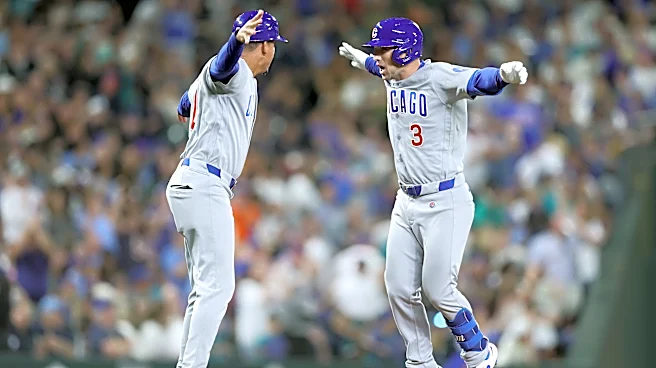
Okay, positives. Alex Bregman’s 3-for-5 night with two home runs and three RBIs was huge. Ian Happ and Michael Busch both went 2-for-5 with Happ adding a solo homer, and Busch two doubles and a run scored. And PCA started the game with his 32nd home run of the season.
Despite the poor RISP numbers and being struck out 11 times, seven of the nine starters did get a hit. The rest just weren’t timely. And the lack of production set the Cubs up to lose in the 10th inning, as with two outs, Cubs righty Ryan Zeferjahn allowed a walk-off single to Leo Rivas, at .130 hitter, to lose, 6-5.
The main highlight from the pitching staff was the return of Daniel Palencia. He pitched a scoreless inning with two strikeouts on 10 pitches and seemed no worse for wear.
*means autoplay on, (directions to remove for Firefox and Chrome). {$} means paywall. {$} means limited views. Italics are often used on this page as sarcasm font. The powers that be have enabled real sarcasm font in the comments.
Friday’s Game Stories:
- Jordan Bastian (MLB.com): Bregman homers twice, but Cubs fall in extras. ‘The North Siders were unable to push a run across in the top of the 10th, ending the night 1-for-16 with runners in scoring position and giving the Mariners the opening they needed.“
- Megham Montemurro (Chicago Tribune {$}): Matthew Boyd allows big HR and is called for costly balk as Chicago Cubs waste early lead in 10-inning loss. “The Chicago Cubs finished an ugly 1-for-16 with runners in scoring position and left 11 on base Friday night in a 6-5, 10-inning loss to the Seattle Mariners.“
- Vinnie Duber (Chicago Sun-Times): Matthew Boyd called for balk on pickoff try, Craig Counsell ejected in Cubs’ loss: ‘The umpire got fooled’. “Boyd led the majors in pickoffs last year, but an attempt Friday was deemed a balk. Counsell disagreed to the point of getting ejected from the Cubs’ extra-inning defeat.”
More about Friday’s game:
- Evan Altman (Cubs Insider): Matthew Boyd’s Recent Struggles Underscore Concern About Cubs’ Postseason Viability. “Unless they pull some 1969 BS, the Cubs will be in the playoffs after the regular season concludes.”
- Jordan Bastian (MLB.com): Happy Birthday, you’re outta here! Counsell tossed over balk call. “One of Matthew Boyd’s specialities is his pick-off move — a bit of deception that has caught plenty of baserunners by surprise over the years.”
- Brett Taylor (Bleacher Nation): A Lousy, Frustrating, Annoying Loss, Boyd’s Fastball, Missing Swanson, and Other Cubs Bullets. “The reason the word annoying comes to mind for me with last night’s loss is watching Matthew Boyd have costly, big misses with his fastball in the middle of the plate time and time again.”
Assorted Stories:
- Vinnie Duber (Chicago Sun-Times): Slow start behind him, Alex Bregman piling up big moments, looking capable of carrying Cubs deep into October. “Bregman, who signed a $175 million contract last offseason, has emerged from a sluggish start at the plate and has caught fire in the second half, looking like the player who was promised, capable of starring in the postseason.”
- Jake Misener (Cubbies Crib): Explaining why the Cubs keep sending a successful Javier Assad to Triple-A. “As Craig Counsell noted, it’s certainly not because he hasn’t pitched well.”
- Patrick Mooney (The Athletic {$}): Big picture, Cubs are thinking World Series: Explaining the Assad decision, plan for Palencia. “”We’re getting to a point in the year where … we’re trying to do something that’s really hard to do,” Craig Counsell said.”
- Chris Pownall (DaWindyCity): The Cubs are experimenting with a fascinating postseason possibility. “The Chicago Cubs are preparing for the postseason, even if they have not officially secured their place yet. One subtle choice during Matt Shaw’s return to game action revealed a fascinating option the club could carry into October.”
- Randy Holt (North Side Baseball): Weighting Cubs’ Historically Good Defense By Position. “The 2026 Cubs are turning in a historic defensive season. But where in the field is such prowess being compiled?”
Food For Thought:
Muddy Waters (born April 4, 1913?, near Rolling Fork, Mississippi, U.S.—died April 30, 1983, Westmont, Illinois) was a dynamic American blues guitarist and singer who played a major role in creating the post-World War II electric blues that typified the Chicago blues style. His music profoundly influenced many rock artists, especially British blues-based bands of the 1960s. Waters, whose nickname came from his proclivity for playing in a creek as a boy, grew up in the cotton country of the Mississippi Delta.
He taught himself to play harmonica as a child and took up guitar at age 17. He eagerly absorbed the classic Delta blues styles of Robert Johnson, Son House, and others while developing a style of his own. As a young man, Waters drove a tractor on the sharecropped plantation, and on weekends he operated the cabin in which he lived as a “juke house,” where visitors could party and imbibe moonshine made by Waters. He performed both on his own and in a band, occasionally earning a little money playing at house parties. He was first recorded in 1941, for the U.S. Library of Congress by archivist Alan Lomax, who had come to Mississippi in search of Johnson (who had already died by that time).
World’s fastest motorized clog shoe exceeds 70 mph
Please be reminded that Cub Tracks and Bleed Cubbie Blue do not necessarily endorse the content of articles, podcasts, or videos that are linked to in this series.