
In John Green’s 2005 novel Looking for Alaska, the main character Miles is obsessed with famous people’s last words, and especially those of the 16th century French writer François Rabelais: “I go to seek
a Great Perhaps.” Over the course of the novel, the Great Perhaps becomes shorthand for the kind of life Miles wants to have; he’s tired of his provincial, “minor” life. He wants something more—he’s just not exactly sure what that might be yet.
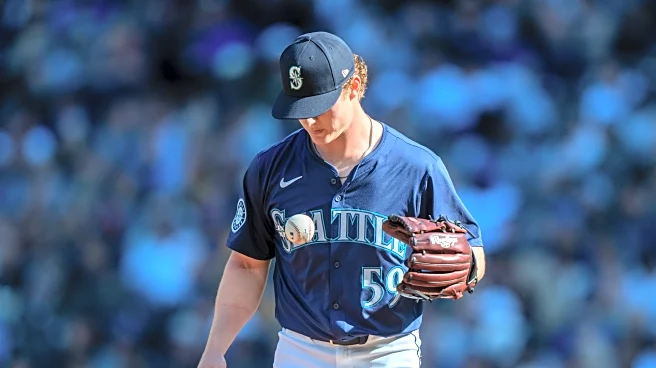
For baseball players, the Great Perhaps is pretty clear-cut: ascend the minor-league ladder, make the big leagues and stay there, hopefully for a long time. But while aspiring big-leaguers might have the advantage of a clear path to what they want—they know what’s around the riverbend, over the rainbow, that the somewhere that’s green is a major league field—that doesn’t make the path easy, and there’s no guarantee that once you get there you can stay. This is where Troy Taylor finds himself: caught between the Great Perhaps and the Quad-A Perhaps, looking for a breakthrough.
Taylor crossed into the MLB record books as the 23,305th player in the majors on August 11, 2024, 29 days before his 23rd birthday. The Mariners were trouncing the Mets, 12-1, on the strength of a two-homer day from Cal Raleigh and a nine-strikeout day from Luis Castillo, giving the rookie the softest of landings to make his debut. Not that he needed it: Taylor issued a walk to former Mariner Ben Gamel but also collected his first two big-league strikeouts to finish out the game and secure the series sweep, both on a nasty buckling slider. It was a particularly electric debut, especially combined with Taylor’s top-shelf fastball velocity.
Taylor built on his strong debut with a solid performance down the stretch, striking out over a third of batters faced and working his way up the depth chart with 25 strikeouts in 19.1 innings, and looking like he would be in the mix for a major bullpen role in 2026. But an off-season lat injury held Taylor out of spring training, costing him development time. He scuffled through five rehab appearances with Tacoma, only recording 3.2 innings over the five appearances and allowing six runs on nine hits. But he also struck out four, and the bullpen-needy Mariners recalled him in mid-April at the start of a three-city, 10-day roadtrip with an eye to bolstering the bullpen.
Once again, Dan Wilson tried to provide Taylor a soft landing, putting him in against the bottom half of the lineup in the seventh inning of a 5-0 lead at Cincinnati. By the time Taylor walked off the mound, the score was 5-2 and he hadn’t recorded an out. Taylor’s fastball had good velocity, ticking 96-97, but he struggled to throw strikes with it, keeping him from getting to his best putaway pitch, the slider; and when he did throw the slider, hitters were ready for it, as Christian Encarnacion-Strand pummeled one below the zone for a two-run double.
The Mariners optioned Taylor back to Triple-A after that rough season debut, but were forced to recall him a week later when Logan Gilbert went down with forearm tightness. The team tried to protect Taylor, lacking now both spring training and minor-league rehab innings, using him only in the lowest-leverage situations—blowouts against teams like the Angels and Marlins, as well as a laugher in Texas—as he worked to get back in stride. But he continued to struggle with command, falling behind in counts, and when he did work his fastball in the zone, hitters were able to make solid contact on it. The sweeper, formerly his best whiff-getter, also failed to tempt hitters into swings. Back to Tacoma he went, only to again be recalled just six days later when another injury hit the pitching staff in the form of Trent Thornton’s appendicitis.
Ironically, where things improved for Taylor is where he looks least impressive on paper, in outings against the Blue Jays and Yankees on a particularly dreadful May homestand. Coming into the seventh inning in a game where the Mariners trailed Toronto 5-3, he wound up giving up a run due in part to an extremely weird leadoff hit (nine-hole hitter Tyler Heineman broke his bat on a pop up but somehow made it to first base, charge that run to the Leody Taveras Experiment.). But in the most high-leverage work he’d gotten so far that season, Taylor looked…better. He still walked a batter, falling well behind Bo Bichette when the lineup turned over, but his misses weren’t as wild, he hit more of his spots, and overall seemed to have more confidence on the mound and a better handle on his stuff, an impression backed up two days later by a 1-2-3 inning against those same Jays (this time in a blowout against the Mariners where Leo Rivas would be the final Mariners pitcher).
But because the Mariners pitching at the time was so thin, Taylor had to be called on for back-to-back duty against a hot Yankees team the very next night. Once again, Taylor suffered some bad luck on batted balls, giving up a two-run homer on a well-placed fastball, and then had to face the top of the Yankees lineup, somehow escaping with just one additional run on an Aaron Judge sac fly. However, it was enough to put the game out of reach for the Mariners, and included a gut-wrenching moment where Oswaldo Cabrera, running home on the sac fly, broke his ankle while crossing home plate, suspending play for about ten minutes.
Being a sinker-slider reliever doesn’t work if you don’t have your slider, and it was becoming apparent that Taylor just wasn’t able to rely on that pitch consistently. His relatively good turns against the powerhouses of the AL East was followed by a poor performance against the lowly White Sox, where a 5-0 Mariners lead turned into an already overworked Andrés Muñoz having to come in to finish the game after Taylor issued back-to-back walks to open the frame. After that outing, the Mariners sent Taylor back to Tacoma. He would not return.
Even in Tacoma, away from the pressures of the big leagues, Taylor posted a career-high walk rate, almost 14%. While he’s never been a poster boy for sterling command because of the way his stuff moves, that’s a significant jump from his career average. His ERA/FIP in Tacoma is also a significant outlier—double, or even triple at times, his career average. That’s largely driven by an inverted bell curve of performances: Taylor either gave up no runs or 3-4 runs at a time, with little in-between. To me, all this suggests a performance and execution issue rather than a degradation of stuff or batters figuring him out. That’s encouraging, because it seems like a solvable issue. That’s terrifying, because anyone who has fought for a bigger dream—a Great Perhaps—knows what a cunning adversary one’s own mind can be.
Along with the Great Perhaps, the other controlling quotation in Green’s book comes from the (supposed) last words of Simón Bolívar: Damn it! How will I ever get out of this labyrinth? The characters in the book choose different routes, some more destructive than others, in exploring the question. At the end, Miles comes upon a scribbled notation from his friend Alaska in the margin next to the question of how to escape the labyrinth of suffering: “straight and fast!” While Troy Taylor shouldn’t take this advice exactly—fast okay, straight not so much—the spirit of it is correct: launch yourself into the Great Perhaps, fast and fearless, to achieve escape velocity from a minor (league) life.