

I’m a bit stubborn about injuries, particularly with pitchers. One injury riddled season is par for the course for pitching prospects, and we don’t want to move pitchers way up and down the rankings, changing grades constantly unless there’s sustained growth or a sustained issue. Unless a pitcher becomes a regular feature on the injured list, I take it as a matter of course that they’re all going to have an injury year on the path to the major leagues. Jaden Hamm was a borderline top 100 prospect coming
into 2025, but he had a pretty brutal year in the injury and performance department. Still, since there was nothing requiring surgical intervention and we don’t really have any information on his injured list stint to work from, we’ll hold on him and expect a bounce back season in 2026.
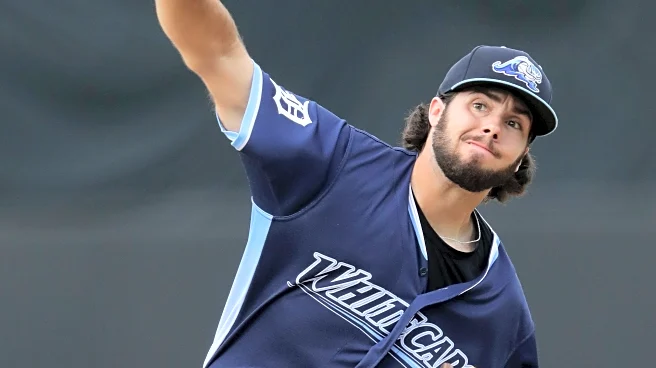
The Tigers nabbed Hamm with their fifth round pick in 2023, signing the Tennessee native out of Middle Tennessee State for $397,500, just a little under slot value. In college, Hamm was a pretty raw product until his junior year when his stuff made a leap forward. Even so, he didn’t use his high IVB fourseamer to good effect by pitching up in the zone, and that was one of the first big steps for him going from a solid, if unheralded college pitcher to a well regarded prospect. The Tigers sent him out to High-A West Michigan in 2024 with instructions to start pounding the top of the strike zone and no other major changes, and Hamm shredded hitters en route to a Midwest League Pitcher of the Year award.
Hamm’s 30.6 percent strikeout rate was impressive, and he also limited walks and home runs, putting up a 2.64 ERA with a 3.09 FIP. Other than some minor work to tune up his delivery and instructions to throw his fastball up at the top of the zone a lot more, the Tigers hadn’t even tinkered with him much.
Hamm was sitting at 93 mph and touching 96 in West Michigan, and routinely topping 20-21 inches of induced vertical break out of his high arm slot. His 80-81 mph curveball was of the overhand, 12-6 variety with plenty of depth. When he established the fourseamer up, hitters struggled to lay off the curveball, and he got better and better at dropping it off the eye line of the fastball and landing it on the bottom rail for called strikes as the year went along. His circle change had good velocity separation, typically 83-84 mph, and while the movement was pretty pedestrian, Hamm’s delivery and high slot made it difficult to pick up the changeup as well and it really falls off the table. The depth of those secondary offerings, playing off the steady diet of high fastballs, gave hitters fits. Both pitches will flash plus at their best.
All this was enough to get Hamm into the 45+ tier on several sites, with predictions that he’d be a top 100 prospect by the end of 2025. The 6’1” right-hander needed to keep adding strength and flexibility. With long legs for his height and less than ideal athleticism, his delivery was a bit stiff, with a short stride and a long arm path that was sometimes tricky for him to sync up. Hamm reaches his arm back, dips, and then whips his arm over the top and through with a lot extension, rather than keeping it folded and using his drive down the mound to generate his power. It’s a little bit of a throw back. However, while that often triggers a high relief risk tag, location hasn’t been much of a problem for him and he consistently throws strikes and works the ball well to both sides of the plate.
What Hamm needed was to develop a harder breaking ball to give him a weapon in between the 93-94 mph fastball and the low 80’s curve and circle changeup. Hamm and the Tigers worked on a slider last offseason to give him something breaking away from right-handed hitters, and reports indicated him making progress with the pitch and looking good in camp. He threw some good ones in 2025. It started out more cutterish, but Hamm was able to start getting more depth and developing it into a mid 80’s gyro slider. The velocity issues tended to overshadow everything and he still leaned on his curve and changeup in most outings, but the slider looked pretty solid on the rare occasions he leaned into it after returning from injury in August and September.
Things quickly went south for Hamm in 2025 after a few good starts to begin the year. His velocity flucutated wildly for a few starts in May, and we didn’t see many mid 90’s fastballs. He was still getting a similar rate of whiffs compared to his High-A work, but hitters were having a lot more success putting the ball in play with two strikes. Hamm managed to keeping throwing a solid ratio of strikes with all his pitches, but he just looked out of sync much of the time. To his credit he didn’t fall apart, and was rarely wild at all, but he struggled more to put hitters away and he just wasn’t repeating his delivery with the same consistency he had in 2024.
In late June, the Tigers shut him down for a month with an undisclosed injury. He returned for a few short outings in late July, and then settled back in and finished out the season, but never really looked back in form. His ability to get whiffs and weak contact in the air with high fastballs kept him from getting shelled out of games, but from outing to outing his performance was pretty inconsistent and his mistakes were getting hit quite a bit harder. Worse, Hamm was still averaging 89-90 mph in a few outings, and 91-92 mph in his better ones.
The Tigers unwillingness to report on injuries makes the situation tricky to evaluate. Clearly they didn’t have him trying to pitch through an injury, but the velocity drop over the course of the season was striking. If Hamm had shoulder trouble, or if he’d even blown out his UCL, explanations would be simpler. In some ways, his profile would be less affected nationally if there was a straightforward issue to pin the loss of velo and inconsistency on. What is clear is that the fastball velocity has to return or his profile is really going to suffer. He doesn’t have to build up to 95-96 mph all the time to be an effective major league starter. The movement alone plays up quite a bit. But he can’t sit 90-92 mph and thrive as a starter either.
Right now, Hamm’s status is very up in the air. He was young on draft day, and he’s still only 23 years old, so there’s time to put 2025 behind him and get back on track. If his velocity is back up after an offseason’s rest and re-conditioning, it’s game on. Hamm’s distinctive delivery takes some athleticism to time up, and it would help him to keep building strength and flexiblity in his lower half to help power his delivery and smooth out his footstrike.
While the circumstances make him tricky to evaluate heading into the season, the equation here is pretty simple. If Hamm gets his velocity back, the fastball will play in the big leagues and gives him a strong base to work from. Hamm already throws enough strikes to work in a relief role even if he can’t hold up to a starter’s workload consistently. At times he threw some good sliders as he worked on that pitch, and the curveball and changeup give him a solid pitch mix to work with, but the whole profile revolves around having a dominant riding fourseamer for everything else to play against.
For now, we’ll put 2025 in the rear view mirror and wait to see how Hamm looks like spring. If he’s really 90-91 mph now, he’s in trouble, but I don’t want to dump him way down our board and then turn right around and call false alarm if his velo is back where it should be early this season. Without any hard injury information to attribute the down year to, it’s impossible to make an educated guess. He’ll return to Erie and try to settle in there and make the jump to Triple-A late in the season if things go well. If the fourseamer is back in form, Hamm will go right back to profiling as an interesting potential mid-rotation arm with a group of pretty good secondary pitches. That fastball also gives him a nice floor as a potentially dominant reliever as a fall back plan. If the velocity isn’t there and he struggles again, all bets are off and his stock is going to drop like a stone.