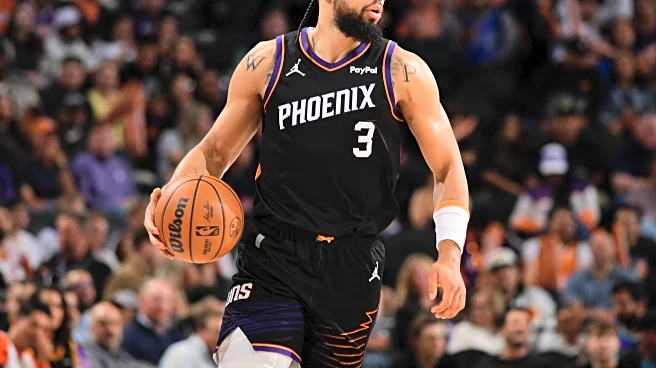




My son brought home his mid-term grades last week, and I realized that it would be fun to give players on the surprising Suns team one, too. The grades are somewhat subjective and are on a curve: they’re based on expectations for the player, value for salary, past performance, statistical impact, and the subjective eyeball test.
If Collin Gillespie and Devin Booker get the same grade, it’s not because Gillespie is as good as Booker; it’s because an undrafted two-way player has made himself into a very
good starter, and Booker has played at his usual All-Star level.
So here we go in alphabetical order by last name:
Grayson Allen: B+
This is going to be a common theme: Grayson Allen is having a career year in points and minutes per game because the Suns can’t seem to stay healthy for more than 5 minutes at a time, literally. He has stepped up and hit clutch shots. However, his shooting efficiency is down (36.8% from three), and his on-court/off-court numbers suggest that he’s not helping quite as much as his numbers suggest.
Devin Booker: A
His numbers are down across the board, including a putrid 31.3% career low 3-point percentage. Even if Father Time and lots of NBA minutes are catching up with him, his three-point shooting should still be good. So, why does he still get an A? Because he answered the question of whether a Suns team with an unbalanced roster, led by him, could actually be a good team, and the answer was yes. If they had more talent at power forward, they’d likely be the 2 team in the West now.

Jamaree Bouyea: A
This might not make sense, but the expectations for a two-way undrafted free agent pulled out of the G-League are pretty low. His previous stints in the NBA didn’t show this sort of potential. The expectations for him were to be a warm body on the bench, ensuring the team met the mandatory minimum number of players active. Instead, he’s basically the team’s fourth guard in the rotation with Booker and Green out, while averaging 15 mpg.
His shooting efficiency is good, defense is good, and his net +/- per 48th is 6th on a good team. So, he gets an A mostly for exceeding expectations by a huge margin.
Koby Brea: Incomplete
Brea has played a grand total of 8 minutes over 2 games for the Suns in garbage time minutes: not enough to make any sort of judgment. That said, his play in the G-League has been “meh”.
Dillon Brooks: A-
This was a tough one. He’s exceeding expectations by having a career year in points per game, while maintaining shooting efficiency on a par with previous years where he wasn’t expected to carry the offensive load. He’s shown an array of crafty moves on offense (including a reliable, unguardable Jordan-esque turnaround fadeaway jumper from mid-range) and is much more than just a 3-and-D guy.
His fiery personality energizes the team. At the same time, his antics cost the team points, and his net +/- numbers suggest he’s not helping as much on the court as the raw numbers suggest. In the end, the “minus” is for the techs.
Ryan Dunn: C
Dunn gets a passing grade for playing exactly the way he did last year. There’s been very little noticeable improvement in his game, other than slightly improved rates of rebounding and free throw percentage (which is still an awful 64%). You’d hope for some sort of tangible improvement on a team starved for front-court depth, but there hasn’t been any.
Thus, he gets a C for doing the absolute minimum by not regressing in his second year, but it is still disappointing: other players have stepped up to fill the void when given the opportunity, and he hasn’t.

Rasheer Fleming: D+
In my draft analysis, I liked Fleming’s physical tools, including his size, athleticism, wingspan, vertical, and shooting touch. What I didn’t like was his lack of instinctive play and mediocre-at-best basketball IQ, and I worried that he was a tall athlete and not a basketball player.
So far, the latter has been true. On a team where Isaiah-Freaking-Livers is the best power forward on the team, he cannot carve out a niche for himself. The +/- numbers bear out the eye-test observation that he looks lost. D+ for failing to meet the very minimal expectation of being better than a perpetual NBA journeyman.
Collin Gillespie: A+

Collin’s raw numbers don’t jump out at you, but you can sense he makes the team better. The advanced stats bear it out as well: he leads the team in raw +/- and also leads the team when you calculate net +/- per 48 differential. He’s a former two-way player, doing it all on a league-minimum contract for a team that could finish the season as high as second in the West.
Gillespie has become as crucial to the team’s success as Booker. Easy A+ for exceeding expectations by a ridiculous amount.
Jordan Goodwin: A+
Goodwin is having a sneaky career-best year and is quietly one of the best defensive guards in the NBA. Dunks and Threes’ Estimated Plus Minus stat rates him as the fifth-best guard in the NBA defensively. He passes the eye test as well: you can see him wreaking havoc and turning deflections and steals into points at the other end. He’s got uncanny instincts for where the ball will be, and where he needs to be on defense.
He’s having a career year in most categories, including three-point percentage (35.6%). His 6’10” wingspan on a 6’2” guard makes him a solid rebounder as well. He’s fifth on the team in +/- per 48 differential. The Suns are getting a ridiculous return on investment on another vet minimum contract, earning him an A+.
Jalen Green: Incomplete
Green has played eight games for the Suns, and he has limped off the court with an injury in three of them. It’s tough to rate his play because we haven’t seen enough, but if he can’t start to stay healthy, this turns into an F. A perpetually injured Jalen Green has the same value as Bradley Beal’s dead money on the court and the salary cap.
Oso Ighodaro: B+
Ighodaro has developed into an absolute defensive menace, ranking in the 96th percentile in both estimated and actual defensive +/-. He’s fourth on the team in net +/- per 48 differential on the team and ran away with the back-up center job from Nick Richards, who the team opted to deal at the trade deadline.
There are some egregious holes in his game: his offense is negligible, and free throw shooting percentage execrable (49%, down from 58% last year). He has no shooting range, and his shot-put style floater doesn’t go in nearly enough. On the plus side, he sets good screens, passes the ball well, and maintains a 1.5-to-1 assist-to-turnover ratio as a center. The Suns are getting amazing value again out of a mid-second round pick. In most respects, he’s doing better than Ryan Dunn.
Isaiah Livers: C+
Isaiah Livers is the best power forward on the Suns while averaging 2.3 ppg and 2.0 rpg on 42.3% shooting in 10 minutes per game. He’s also second on the team in net +/- per 48 differential. He gets that high number by being the only marginally competent payer on the Suns with the size for the position, sort of like Will Ferrell in “Elf”. He’s not playing any better than he did in his previous stints in the NBA: he’s just better than the other guys doing the same job (which is why I bled 3000 words on how the Suns can upgrade at PF).
C+ for exceeding expectations by a little bit. He’s not a great student. He’s just the only one in his grade not eating the minty-fresh Elmer’s glue.
Khaman Maluach: D-
Man Man is another guy that I love as a person, and hate seeing on the court. When the Suns drafted him, I loved the size, athleticism, and potential. I didn’t love how raw he is, how little experience he has playing basketball, and ESPECIALLY how much he reminded me of all-time draft bust Hasheem Thabeet.
So far, he’s doing worse than Thabeet. He’s super young, has plenty of room to grow, and has shown some flashes in the G-League, but that’s not the NBA. He has a long way to go. So, D+ for failing to meet most expectations of a tenth pick in a loaded draft, but not an F for working hard, having a good attitude, and having a lot of room to grow.
Royce O’Neale: B-
Royce is another Suns player having a career year, but it’s mostly due to the team’s utter lack of frontcourt depth. On the plus side, he’s a 40% three-point shooter who provides spacing and doesn’t make many mental mistakes. He’s just solid. On the downside, at 32, he’s getting slower and slower, turning him into a traffic cone on defense. Or a matador.
Regardless, he’s not the defensive plus he used to be. He’s also undersized at PF and ranks fourth from last on the team in net +/- per 48 differential. All that said, he gets a B- for being game every night to guard whoever he’s told to, providing spacing, and holding down a starting spot at a position he’s too small for.
Mark Williams: B
Can you give a player a good grade for not getting hurt? The knock on Williams has been his health and his lackadaisical defense. This year, he’s been great with the former and average at best on the latter. He is somewhat under-utilized on offense, despite his efficiency, averaging his career average of 12 ppg and 8 rpg. On defense, he should be able to do more with his size and athleticism. But, unlike Ayton, you can see consistent effort. He will receive some reward in the offseason, but the Suns can’t over-pay for a guy producing his numbers, which put him behind Iggy in terms of on-court +/- metrics. So, B for exceeding expectations in terms of health and effort (though I could be talked into a B+).
Now it’s your turn. Time to dish out your All-Star Break report cards!