


After a two-week wait, Missouri has found its ball-handler — in theory.
On Friday afternoon, BYU guard Kennard Davis committed to the Tigers, becoming the fourth transfer addition this offseason with Jamier Jones, Bryson Tiller and Jaylen Carey. Moving ahead, the question is whether coach Dennis Gates and his staff further supplement Davis, who projected to slot in as a combo guard in MU’s rotation.
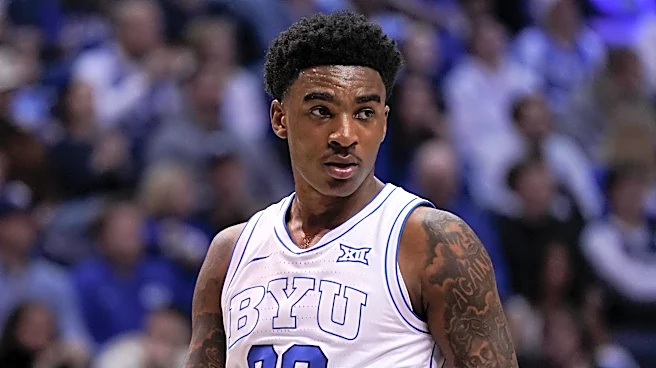
Davis, a St. Louis native and Vashon product, was also firmly on the Tigers’ radar a season ago after he entered the transfer portal following a stellar sophomore campaign with Southern Illinois. Instead, he wound up at BYU, where he averaged 8.5 points and 2.7 rebounds while starting every game for the Cougars.
But as you’ll see in a moment, this homecoming also comes with a significant change in Davis’ job description.
Let’s Meet Kennard Davis Jr.
- From: St. Louis
- Previous School: BYU
- Position: CG
- Ht/Wt: 6-6/215
- 247Composite Ranking: 0.900
- EvanMiya Forecasted BPR: 2.94 (No. 236)
Again, the job Davis had in Provo is not the one he’s likely to take up once he settles into Columbia.
Around the middle of January in Davis’ sophomore season, SIU coach Scott Nagy’s squad sat at 5-11 overall and was winless in the Missouri Valley. So, he made a logical choice: he converted Davis to a point guard and put the ball in his hands.
Turns out the role suited Davis well. He averaged 16.3 points per game and landed on the All-MVC second team. It went so well, in fact, that MU sized him up as an addition last spring. But ultimately, Davis landed with BYU, which was adding Rob Wright III and A.J. Dybantsa to its roster — and pretty much scotched any notion that Davis would have a major creative role.
That’s backed up by a cursory look at play-type data.
As you can see, Davis spent a lot of his nights playing off the ball for the Cougars as a 3-and-D specialist for coach Kevin Young. It wasn’t until guard Richie Saunders went down with a torn ACL that Davis saw extended duty as a combo guard, but that was mostly in name only. Wright and Dybantsa still powered the Cougars.
Drilling deeper into Davis’ profile doesn’t excavate any exciting insights. As you can see below, his most common touches on offense were spotting up from deep.
What we care about, however, is how Davis performed while running the show at SIU. Moving forward, the question will be how cleanly he can replicate those efforts while wearing black and gold.
Over his last dozen games with the Salukis, he averaged roughly 8.5 on-ball touches per game, which are made up of pick-and-rolls, isolations and handoffs. That spike coincided with Davis putting up 18.4 points per game. Now, Davis could be a little turnover-prone, but it doesn’t totally undermine the body of work he put together.
When the season wrapped up, Davis ranked in the 87th percentile nationally for efficiency in pick-and-rolls, per Synergy Sports. Crucially, it aligns with what Davis produced while at BYU, where he averaged 1.08 points when attacking from a ball screen. And regardless of where Davis has plied his trade, his best weapon is punishing defenders who duck under a ball screen.
It’s also a skill that MU can use to anchor his game.
When Davis was decisive at SIU, the results could be bountiful. The action didn’t need to be complex, either. Simple drag screens, butt screens, and step-ups could give him some breathing room, and Davis understood how to use his dribble effectively to create space and rhythm.
While Davis doesn’t get a ton of lift on his jumper, he consistently establishes a solid base, and from the waist up, his release is compact and fluid. You might want his pick-up to be a tad quicker, but Davis rarely wasted motion. And against drop coverage, he would step back slightly. When a guard fought over the top, he used a side dribble to create more space.
Yet there’s also an important caveat. Davis’ pull-ups weren’t nearly so potent once he worked his way into the mid-range. Instead, he improved once he relied on his strength after turning the corner to go downhill.
In the Valley, he could easily bump defenders off. Even when big men sat in drop coverage, it was hard to keep Davis from getting where he wanted to go. And even if he didn’t convert at the cup, Davis’ free-throw rate (48.5%) meant there was a decent chance he’d toe the line for free throws.
Now, SIU would shift Davis off the ball, but the results come with a critical caveat. He knocked down 12 of 51 catch-and-shoot 3-pointers with a hand in his face, while he was 20 of 38 when left alone. That’s a significant performance delta. It also aligns with Davis’ tendencies last season at BYU. So, when a defender remains attached, they can eat into Davis efficiency.
What’s unclear is what level of facilitating Davis might bring to the table.
At SIU, he posted a 14.5 assist rate, according to KenPom. That’s what we’d expect from a perimeter player who will move the ball along during the course of a possession, but well below what we see from players teeing up teammates. Meanwhile, Davis checks in with a 1.3 assist-to-turnover ratio across three seasons. Again, that doesn’t fit the profile of a ball handler setting the table.
The bottom line? Davis has flashed real potential as a bigger creator, but he’s not a plug-and-play answer. There’s still an element of projection involved — and uncertainty. MU’s job is blending the two versions of Davis we’ve seen at SIU and BYU into a secondary handler who can run some PNRs to attack mismatches while shooting it consistently enough off the catch to keep gaps open for Jason Crowe Jr. and Aaron Rowe.
A similar contrast exists on the defensive end on the floor.
Last season, Davis performed well as an on-ball defender. Yet he also ranked in the fourth percentile in guard spot-ups, the by-product of letting opposing shooters knock down nearly 46 percent of threes off the catch.
So, when we do a line-by-line evaluation of Davis’ defensive profile, it can leave you feeling conflicted. There’s enough evidence to make you think he’s the kind of physical point-of-attack defender MU needs, especially with two smaller guards in Crowe and Rowe that can be targeted in ball-screens. However, that notion is undercut if Davis routinely breaks down as an off-ball defender.
That’s where film — and additional context — comes in handy.
Let’s start with Davis’ performance in spot-ups. He defended 50 spot-up threes last season, allowing a 52 percent clip. Sifting tape, though, shows that a dozen of those triples were fired immediately after an offensive rebound, a situation where the floor is broken after a defense crashes the glass and finds itself in scramble mode. Unfortunately for Davis, opponents knocked down eight of those daggers.
There’s also a bit of variance at play, too.
In man-to-man defense, Davis had to guard nine threes taken after he stunted into a gap — usually toward the nail — to slow down a driver, and then recover back to his man. Well, opponents buried seven of those shots, including four where Davis did a credible job closing out on time and under control.
Obviously, Davis isn’t totally vindicated by these clips, but they do give us a better sense of how those looks came about. Last season was a major regression from his performance guarding spot-ups at SIU, where he ranked in the 58th percentile nationally, and might hint at other, more nuanced explanations for objectively putrid metrics.
Crucially, it’s also offset by genuinely good work stymying pick-and-rolls. Davis was particularly effective on those runs in the middle of the floor, allowing only 0.722 PPP, per Synergy Sports. For example, opponents made just 3 of 16 threes taken off the dribble after using a high PNR, and on film, we can see that screeners struggled to bump Davis off. He was also dogged about trying to fight over the top and stay connected.
Davis’ physicality and length could also affect a ball handler’s vision when they try to move the ball. He forced a turnover 19.1 percent of the time when defending a PNR, the kind of disruption MU could use next season to boost a transition attack that lost some juice.
Evidence tells us that Davis is reliable enough when he can leverage his size and strength to bother ball handlers. But we can’t entirely dismiss the potential red flag in his off-ball defense. Opponents consistently found success on catch-and-shoots and attacking closeouts going right. That’s particularly worrisome given MU’s penchant over the past couple of seasons for conceding 3-pointers while trying to seal off the paint.
For MU, the bet is that they’ve done enough to upgrade their overall talent and athleticism on the wing and in the frontcourt to provide backstop perimeter defenders to the point where those jumpers won’t come so easily.