



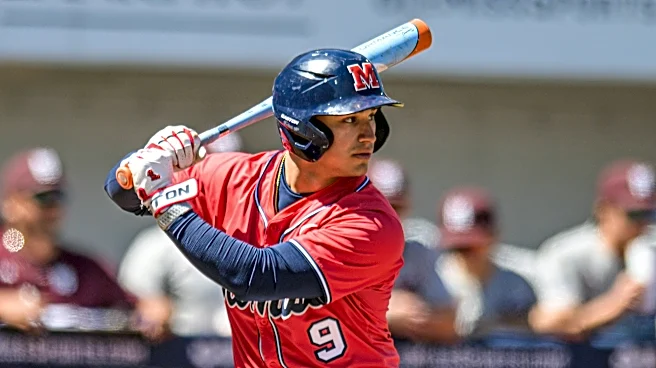
Three weeks ago, Ole Miss baseball sat at the intersection of Serenity Now and Thanks, I Hate It.
They couldn’t hit, struck out like it was their oxygen, and were inconsistent on the mound. As I documented on March 31st, they had just completed a 4-8 stretch with losses to Southern Miss, Texas (x2), Kentucky, Memphis, and Mississippi State (x3) while averaging 4.08 runs per game (4.11 in SEC). It was among the grossest of times.
Now here we are three weeks later, and the fellas have pulled themselves
out of a nose dive, winning 7 of their last 9 SEC games, including a sweep of LSU, and 10 of their last 11 overall. Their run differential in that SEC stretch was +19, and they averaged 6.11 runs per game, which is, uh, somewhat better than 4.11.
With four SEC series remaining (Georgia, @Arkansas, Texas A&M, @Alabama), Ole Miss is 10-8 in conference play, and the math says a 5-7 finish is probably enough to host a regional. They’ll take the five wins in any order, but the most reasonable path is to win one of the remaining four series and not get swept in the other three.
Obviously, it would be super cool and fine if they went like 12-0 or 10-2, but let’s dial back the delusion (FOR NOW). Anything in the 7-5 range gets them in contention for a national seed with the same chance as above to lose a home regional (TOO SOON).
So how did Mike Bianco and company bring their season back to life? As the stats below show, they stopped being an offensive nightmare, and the pitching got stronger.
Offensive Numbers
For the purposes of this exercise, we’ll compare their current SEC-only stats to where things stood on March 31st. So you’ll see their current rank and the March 31st rank in parentheses.
Ole Miss’ SEC-only ranks in the categories below:
- Runs – 11th (13th)
- Home runs – 9th (9th)
- Slugging percentage – 10th (14th)
- On-base percentage – 11th (11th)
- Total bases – 10th (14th)
- Strikeouts – 15th – 2nd most (15th)
The strikeouts are still an issue, as their strikeout-to-walk ratio went up to 2.8 from 2.7, but their slugging percentage jumped, and the team batting average exploded from .210 (15th) to .246 (10th).
Most importantly, the offense is now not entirely reliant on dingers. In the first three SEC series, 54.1 percent (20 of 37) of Ole Miss’ runs came via the home run. In the last three series, that number shrank to 36.8 percent (21 of 57).
We all love dingers, but good things can happen when the ball is in play between dingers. And given the team’s dinger power source is in two players (Judd Utermark and Tristan Bissetta), they can’t afford to go through the order and wait for their at bats.
However, the aforementioned strikeout problem is a disaster throughout the lineup. Look at these strikeout-to-walk ratios:
- Austin Fawley – 4.1 to 1
- Collin Reuter – 7.25 to 1
- Tristan Bissetta – 2.1 to 1
- Judd Utermark – 2.7 to 1
- Brayden Randle – 7 to 1
- Will Furniss – 2 to 1
NOT GREAT, BOB.
I assume 18 games into conference play that problem is not fixable and they are who they are, but could it be slightly mitigated? Preferably not on the level of putting a Band-Aid on a turd, but more like we’re only leaking *some* oil, gas, brake fluid, and power steering fluid. WE CAN BUILD ON THAT.
Finally, the team has also improved to 10th in total errors, which is up from a tie for 13th. Again, not great and you better believe it’s a concern, but we will cling to the warmth of this iota of improvement in fundamentals.
Pitching Numbers
Here’s the introduction I wrote in March:
As for the starters, Hunter Elliott hasn’t been elite on Friday nights, but he’s done enough to win games with a competent offense. Cade Townsend is still a TBD (due to injury), and Wil Libbert has been a mess, lost his starting spot, and may not even have a role out of the bullpen.
Speaking of the bullpen, Walker Hooks and Taylor Rabe have been the best of the bunch, and then it’s a lot of who knows. Hudson Calhoun has looked good for stretches as a substitute starter, but inconsistency is the theme for the bullpen group as a whole.
Since that writing, Hunter Elliott continued to be Hunter Elliott, Cade Townsend returned and has been who Ole Miss thought he could be, and Taylor Rabe has taken over the third weekend starter role (for now).
Walker Hooks is the workhorse closer and easily the best of the bullpen, and Hudson Calhoun and Landon Waters have emerged as two of the trusted arms. After Hooks, the bullpen still needs consistency and another arm or two in Mike Bianco’s Circle of Trust. The depth is especially important should things go sideways in a regional or they’re playing meaningful games after that.
As we did with the hitting, here are Ole Miss’ SEC-only ranks in the categories below:
- Earned runs allowed – 7th (8th)
- ERA – 7th (8th)
- Strikeouts – 4th (4th)
- Walks – 6th (8th)
- Hits allowed – 9th (11th)
- Home runs allowed – 11th (11th)
Of note, they’re also 7th in WHIP and 5th in total batters faced.
The pitching needed to get better, and it’s now trending in the direction of good to very good. Townsend’s successful return to the starting rotation and Hooks becoming a DUDE™ had a lot to do with it, but it takes a village to improve an entire staff’s numbers.
If the pitching trend continues and the offense keeps up its non-dinger-reliant ways and scores 6+ runs in SEC games, Ole Miss will be a tough team to beat and firmly entrenched at the intersection of Important May/June Baseball and Anxiety Ahoy.