

The conclusion of the Falcons’ season felt reminiscent of how it ended in 2019. Although the start of 2025 was nowhere near as painful as it was with a 1-7 start in 2019, both seasons had stretches where the organizational
outlook couldn’t look more grim. A team built to compete now either found ways to lose or lacked the spirit and cohesiveness to win when they were expected to. A coaching staff making frequent self-inflicted errors and being plagued by predictable offensive tendencies. A general manager who was too aggressive for his own good and mismanaged major free agent signings. The way both teams faltered felt eerily similar.
I wrote about how the dangers of the current Falcons team falling into similar patterns to that disoriented 2019 team last May. While Jeff Ulbrich worked wonders in doing a stellar job of reconstructing the defense, an inability to evolve offensively and underwhelming free agency, largely due to Kirk Cousins’ staggering contract, left the franchise practically where they were six years ago.
Impressive road victories over two of the three top NFC teams that season, against New Orleans and San Francisco, ultimately saved Dan Quinn and Thomas Dimitroff in a 6-2 finish. A remarkable upset win over the Rams highlighted a four-game winning streak to end the season. Unlike Quinn and Dimitroff, Raheem Morris and Terry Fontenot won’t be offered the opportunity to rectify their mistakes.
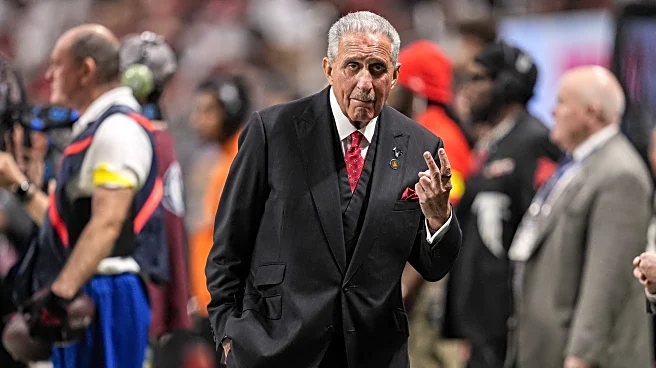
Many will point to Blank learning from 2019 in making this decision. No owner wants to make an in-season firing, as the Falcons did in 2020 following a 0-5 start. While players spoke highly of Morris, they held Quinn and Arthur Smith in a similar regard when they were let go. Words only hold so much weight when the franchise hasn’t made the playoffs since 2017. The Panthers winning the division leaves the Falcons with the Jets as the only teams not to make the playoffs since 2020.
The NFC South was there to be won, yet they were eliminated by early December. A strong late-season finish doesn’t hold more substance than inexplicable narrow defeats to division rivals, appalling blowout losses to mediocre teams, and bizarre personnel management at the wide receiver position. Morris and Fontenot made too many pivotal errors to retain the belief that they were going to be the people in power to get the franchise back on track.
Finding a way is not the way to build a winning culture
As the losses accumulated in November, the mantra became “we got to find a way” from Morris. That carried over into December when the team managed to start winning games. Coaches will come up with mantras that often seem silly. The aim is to inspire confidence within the locker room in establishing a strong identity. There wasn’t much Morris did that instilled faith toward building a sustainable, successful culture. Team leaders like Jessie Bates were candid about how much they support him as a coach. Although it’s encouraging for players to share their admiration for their head coach, the roster consistently struggled to produce in high-leverage moments or compensate for poor coaching, situational mismanagement, and lackadaisical offensive play-calling.
Morris’ inability to properly use timeouts in two-minute situations cost the team opportunities to score points in pivotal moments. It played a role in a devastating overtime defeat to Washington last season, where he let precious time go to waste after Michael Penix Jr. connected with Darnell Mooney on an explosive play downfield. Not getting into a better range to kick a game-winning field goal essentially cost them a playoff spot, where they no longer controlled their own fate over Tampa Bay. He failed to learn from that mistake, as evidenced by his subsequent similar errors against Buffalo and Indianapolis.
The team became undisciplined with numerous pre-snap penalties, communication errors leading to timeouts, and frequent failures in short-yardage situations. When a team doesn’t use mistakes as teachable moments and learn from them, it’s an indictment of how the coaching staff’s methods are not just failing translating to the players but also the personnel decisions they made in building the roster they envisioned. To make matters worse, Morris didn’t handle multiple particular situations well, which left an entire positional group in disarray.
Mooney broke his collarbone on the first day of training camp. The team never made any genuine attempt to add a suitable replacement. The organization was adamant that he would be ready by early September. Mooney never looked healthy the entire season, dropping numerous passes and struggling to handle any ounce of physicality at the catch point. Rushing him back for him not to come close to being the prolific playmaker he was in 2024 wasn’t the only baffling decision. The relationship breakdown between fan favorite Ray-Ray McCloud III and Morris led to McCloud’s unexpected release. Nothing was ever reported or shared from it. That put the offense in a precarious position with limited capable pass-catching options.
For someone who emphasizes the importance of communication, Morris was responsible for several internal and external communication breakdowns. The shocking firing of wide receivers coach Ike Hilliard after an embarrassing loss to Carolina was a result of communication failures. The same was said about McCloud, who teammates loved for his aggressive, tone-setting playing style. As Morris attributed two high-profile exits to not meeting communication standards, he didn’t reveal that Mooney broke his collarbone until mid-November in a radio interview. How does a coach advocate for consistent candid communication, but doesn’t live up to his message as the primary leader? The lack of clarity on why Troy Andersen missed the entire season is another prime example of how operations became so dysfunctional.
How Zac Robinson and Marquice Williams became liabilities in their respective positions as offensive and special teams coordinator falls on Morris. Defensive players on Miami, San Francisco, and Carolina revealed in postgame interviews that they knew specific plays were coming off certain motions and personnel alignments during a three-game stretch. All three of those games resulted in painful defeats. From having an incredibly predictable running game to screens consistently resulting in negative plays, Robinson never showed any signs of progressing.
Opponents targeted their ineptitude on special teams, from the Jets and Colts finding plenty of success on returns to the Rams blocking a kick on a night where everything else went right for the Falcons. The Seahawks accomplished both with a kickoff return and a blocked field goal to spark their blowout victory in Atlanta. Both coordinators were consistently overmatched in their roles. Morris didn’t make many in-season adjustments, outside of Robinson moving from the coaching booth to the sideline, or speak about taking an active role in addressing these glaring issues. Both units consistently faltered, which led to several agonizing losses.
For all of the defensive success between Ulbrich’s excellence and young players making enormous strides, it was nowhere near enough to justify Morris as the person to lead this team going forward. The same applies to Fontenot, who made too many consequential errors to retain his position as general manager despite what appears to be a tremendous 2025 draft class. Glimpses of success can’t overshadow five years of highly questionable, ultra-aggressive draft decisions and failing to address positional flaws in free agency.
Roster delusion and misconstruction
Some general managers march to the beat of their own drum. They have a scouting department to help determine what traits are most valuable when assessing prospects. They will have the coaching staff use potential connections to attract free agents. Dimitroff became known for selecting players in the first round when they were largely considered second-round talent by draft analysts. Those selections proved to be highly successful, with A.J. Terrell, Chris Lindstrom, and Keanu Neal considered as reaches when they were picked. Free agency and salary cap management proved to be Dimitroff’s biggest shortcomings.
Fontenot certainly had his own team-building philosophy in reshaping the offense with premium picks. Using your first three top picks on tight end, wide receiver, and running back was a vivid statement of intent to get the dynamic talent needed to execute Smith’s coaching vision. That never came to fruition, as Fontenot couldn’t find the long-term solution at the most important position, which proved to be his biggest undoing during his tenure. From mercilessly forcing Matt Ryan out the door when failing to acquire Deshaun Watson, to inserting full belief in Desmond Ridder as a starter after four games without signing a dependable backup who doesn’t put the ball in dangerous areas like Taylor Heinicke, it’s hard to escape the wrath of criticism when you make numerous high-profile errors in attempting to find a capable quarterback, let alone a franchise one.
Signing Cousins was a risk worth taking, given the roster was in a prime position to win the division. It made far less sense when Penix Jr. was drafted. No matter how much the organization openly expressed its reasoning behind selecting a quarterback in that they wouldn’t pick in the top ten again anytime soon, the thought process was always nonsensical in making two massive investments at quarterback on a roster with several defensive flaws.
While some free agent signings proved to be difference makers, it wasn’t necessarily because of Fontenot making shrewd decisions. Jesse Bates, Kaden Elliss, and David Onyemata have all been excellent in Atlanta. They signed with the team to either be paid as the highest-paid player at their position or reunite with defensive coordinator Ryan Nielsen. Other than Cordarrelle Patterson, it’s hard to pinpoint a free agent signing that surpassed expectations where Fontenot sought them out. The players he pursued in Matthew Judon and Justin Simmons proved to be largely underwhelming on an aging defense that the Falcons couldn’t rely on to get stops in 2024.
What doomed Fontenot was that he was two steps behind in critical areas with roster building, too aggressive when addressing a positional flaw, and became complacent with Morris when the roster needed to improve. Not signing or trading for a wide receiver after what transpired with Mooney and McCloud was roster management malpractice. After years of neglecting the edge rusher position and settling on declining veterans and mid-round picks to form some semblance of a pass rush, Fontenot traded a first-round pick to the Rams to pick James Pearce Jr. after selecting Jalon Walker earlier in the draft. While Pearce Jr. has all the tools to be a force in the NFL, the strategy behind trading a first pick without hesitation for a player who isn’t going to play every down is indefensible on a team that isn’t close to competing for a Super Bowl.
Fontenot and Morris always believed the roster was better than it was. It’s the same thing that happened to Dimitroff and Quinn during the final years of their run. They remained too loyal to underperforming draft picks, while signing players with more name value than production at that stage of their respective careers. While it wasn’t necessarily the draft picks that derailed them over the last two years, Fontenot and Morris didn’t make any moves to improve an offense that was good but not great in 2024. They overvalued what they had, both from a schematic and personnel standpoint, and the unit largely floundered.
Too many underperforming veterans were counted for too long in 2024, which was the biggest reason behind the Falcons missing the playoffs. Making the playoffs once in the worst division in football could have given Blank some confidence in them going forward. They couldn’t accomplish it, no matter how great the opportunities were. Never having a firm grasp of the talent on the roster, along with never having genuine stability at the quarterback position, left Blank no other choice but to start completely fresh.
Calling on a franchise icon to revive a franchise
Aligning with multiple firms and groups to assist in hiring the next head coach and general manager is the next step in what will be a total overhaul in Atlanta. As the next chapter is created in the franchise’s history, the most recent member in the team’s Ring of Honor will be influential in bringing the team back to prominence. Ryan’s role has yet to be officially determined, but all indications are that he is ready to be the next President of Football Operations. There isn’t a better former player to dive deep into the core of the Falcons’ damaged infrastructure.
When two regimes fall apart in similar ways, it shows there is something deeply wrong within a franchise’s foundation. Ryan witnessed how a Super Bowl contender disintegrated into becoming a deeply flawed team that lost its principles. He endured the pain of having to play behind overmatched offensive lines within an organization operating under severe financial restrictions. He has remained close to the sport since retiring by becoming a color commentator and analyst on CBS. There is no denying how informed, passionate, and astute Ryan is.
There are plenty of questions to be asked. How does someone with no experience handle taking on such a demanding position? Does he have the right people around him guiding him in the next step of his career? Where will he learn from the mistakes of the past regimes to build a tougher environment where accountability has been lacking for some time?
A sensible approach is needed to drive the team to greater heights. They’ve made too many rash decisions and have been plagued by delusion for countless years. It doesn’t take much to compete in the NFC South. The Saints recently proved it by sweeping the division champions in a year where they were expected to be among the worst teams in the league. The Panthers went from being the NFL’s biggest laughingstock to hosting a playoff game in two years. The Buccaneers went from perennial underachievers to winning the division in four consecutive seasons. Why can’t the Falcons do something notable in accomplishing something besides playing spectacular football on Monday nights?
Even with the uncertainty of Penix Jr.’s outlook, the roster possesses a balanced amount of talent on both sides of the ball for the first time in years. Ryan must have watched Ulbrich’s unit, imagining what he could have achieved with them. The connections Ryan has and the respect he commands across the league should bode well in attracting the right people and talent to add solidity to a franchise that has been fragmented for too long. As beloved as Morris is as a players’ coach and as impressive as the past draft was for Fontenot, you can’t continue waiting to operate like a functional unit at a time when franchise cornerstones like Bijan Robinson and Drake London are entering their prime.
Blank needed to be proactive and decisive. With the support of arguably the greatest player in franchise history, it’s time to take every measure to put this team in a position to win the division. It will likely take considerable time to build a Super Bowl contender, but it’s long overdue for meaningful January football to be played in Atlanta. Embracing new philosophy is the best route for that to come to fruition.