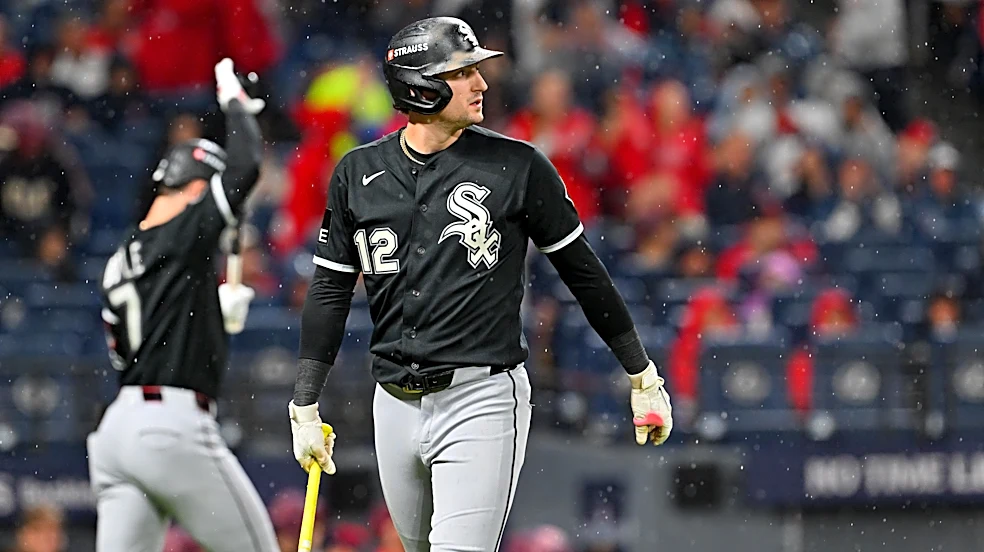





Colson Montgomery wasn’t about to change his swing.
Not when the Chicago White Sox shortstop was approaching a record no batter wants. Not when his strikeout total climbed past some of baseball’s most notorious free swingers. And certainly not when the same approach that produced all those swings and misses had also delivered 31 home runs.
The 24-year-old believed one swing could change a game. Shortening his stroke, even with two strikes, wasn’t part of his plan.
“I’m not a finished product by any
means,” Montgomery told MLB.com in September. “It’s one of those things you have to accept.”
By season’s end, Montgomery had struck out 227 times, surpassing Mark Reynolds’ previous major league record of 223 set in 2009. It was a dubious distinction in an otherwise memorable season that helped carry Chicago into October.
But Montgomery’s record was only part of a much larger story.
Across Major League Baseball, strikeouts have transformed from an outcome hitters once desperately tried to avoid into an increasingly accepted consequence of an offensive philosophy built around power, patience and hitting the ball in the air.
For the White Sox, that philosophy produced one of the American League’s most productive offenses.
It also helped bring their season to an abrupt end.
In five American League Division Series games against Cleveland, Chicago struck out 75 times, the most ever in a Division Series. The Guardians recorded 21 strikeouts in a 2-0 victory in Game 5, setting a major league record for a nine-inning game. Not a playoff record, but a record never matched in any nine-inning MLB game, ever.
The White Sox had gone from chasing a championship to chasing pitches they couldn’t hit.
THE PRICE OF POWER
Montgomery’s record-breaking season illustrated the complicated relationship between strikeouts and offensive production.
His 31 home runs and 87 RBIs made him a dangerous presence in Chicago’s lineup, even as his .197 batting average and 227 strikeouts demonstrated how difficult consistent contact had become.
For Montgomery, the solution wasn’t necessarily changing the mechanics of his swing. It was changing how he approached each opportunity.
“You get what you focus on,” Montgomery says. “I feel like if you sit there and you are focusing on striking out all the time, you are probably going to get more of that stuff.”
The reasoning reflects a broader philosophical shift in baseball.
Rather than simply trying to put the ball in play, many hitters prioritize pitches they can drive with authority. Modern hitting instruction emphasizes exit velocity, launch angle and swing decisions — the combination of recognizing a hittable pitch and delivering a swing capable of producing damage.
A fly ball hit at an optimal launch angle can clear the fence. A weak ground ball, even when successfully put into play, frequently becomes an out.
But the pursuit of harder contact can create a difficult trade-off. Hitters trying to elevate the baseball may develop swings with more upward movement, while pitchers increasingly attack with high-velocity fastballs, breaking pitches and changing speeds.
The result can be more home runs, but also more empty swings.
White Sox hitting coach Derek Shomon acknowledged the concern while explaining that the reasons behind strikeouts matter as much as the totals.
“I would be sitting here lying to you if I’m OK with strikeouts,” Shomon told MLB.com in September. “No one is.”
Shomon said the organization evaluates whether strikeouts result from chasing pitches outside the zone, missing hittable strikes or making poor decisions with two strikes.
The challenge is reducing those failures without eliminating the aggressive approach that made Chicago’s offense successful.
A CENTURY OF CHANGING EXPECTATIONS
For much of baseball history, striking out was relatively uncommon.
Hitters were expected to protect the plate, shorten their swings with two strikes and make pitchers rely on their defense. Contact was considered a fundamental part of offensive success.
That philosophy gradually changed as hitters and organizations began placing greater value on walks, extra-base hits and home runs.
Statistical analysis reinforced the importance of reaching base and hitting for power. Meanwhile, improvements in pitching velocity, pitch design and bullpen specialization made simply putting the ball in play increasingly difficult.
In 2026, major league teams averaged 8.38 strikeouts per game, compared with 8.36 in 2025, according to Baseball-Reference. Although the increase was small, the modern figures remain substantially higher than those of earlier generations.
The distinction is important: Baseball is not necessarily experiencing a new annual strikeout record, but it continues operating in an era in which a team striking out eight or nine times per game is ordinary.
For an individual hitter, that environment has changed the definition of an acceptable offensive performance.
A player can strike out 200 times and still provide significant value through walks and home runs.
For the White Sox, nobody embodied that contradiction more dramatically than Munetaka Murakami.
MURAKAMI’S DISAPPEARING CONTACT
Murakami’s first season in Chicago offered a striking example of how tremendous power can coexist with prolonged offensive struggles.
The Japanese slugger finished with 35 home runs, 77 RBIs and 92 walks, helping anchor a White Sox lineup that scored more runs than any other American League team.
But he also struck out 196 times in 454 at-bats, a staggering total for one of Chicago’s most important hitters.
His struggles became especially pronounced during August.
Murakami struck out 46 times that month while hitting five home runs. From August 5 through September 3, he recorded 45 strikeouts in 101 at-bats, meaning nearly 45% of those official at-bats ended without a ball being put into play.
By mid-September, the slump had deepened. Murakami was hitting .095 with 50 strikeouts in his previous 95 at-bats — more than half.
Yet he continued drawing walks, demonstrating that patience and the ability to make contact are not necessarily the same skill.
“There’s always good times and bad times throughout the season,” Murakami said through interpreter Kenzo Yagi in September. “It’s really important just to keep focusing on the approach every single day.”
The numbers raised a difficult question for Chicago: How much swing-and-miss can an offense withstand before its power becomes insufficient?
During the regular season, the answer appeared to be quite a lot.
In October, it was considerably less.
WHEN CONTACT BECOMES EVERYTHING
The White Sox entered the postseason with 776 runs, 211 home runs and an American League-leading 589 walks. Their offense was built to create opportunities, work counts and deliver game-changing swings.
Against Cleveland, however, those opportunities increasingly disappeared.
In Game 3 of the ALDS, seven Guardians pitchers combined for 19 strikeouts in a nine-inning game, then a postseason record. Three days later, Cleveland shattered that mark with 21 in Game 5, as Guardians starter Gavin Williams struck out 12 batters over 5 2/3 innings, carrying a no-hitter into the sixth.
Chicago finally threatened when Miguel Vargas drew a two-out walk to load the bases. Murakami stepped to the plate with an opportunity to change the game.
Instead, Cleveland reliever Erik Sabrowski struck him out on five pitches.
It was one of four strikeouts for Murakami that night. Andrew Benintendi also struck out four times.
Chicago finished the series with 75 strikeouts, an average of 15 per game. Cleveland’s pitchers surpassed the previous record for a five-game postseason series … by 11.
For White Sox manager Will Venable, the issue wasn’t simply hitters expanding the strike zone.
“I thought it was less about chase and more about being attacked in the zone and swing and miss in the zone,” Venable said after Game 5.
The difference is significant.
Plate discipline is frequently measured by whether hitters swing at pitches outside the strike zone. But a hitter can make the correct decision to swing at a strike and still fail to make contact.
Against Cleveland, Chicago’s inability to connect with pitches inside the zone became a defining problem. Venable acknowledged that the outcome ultimately came down to the most basic element of hitting: putting the ball in play.
For a team built around power, patience and offensive production, it was a painful reminder that none of those strengths matter when the bat never meets the baseball.
A DIFFERENT APPROACH TO TWO STRIKES?
The question facing Chicago heading into 2027 isn’t whether Montgomery and Murakami should abandon their power, but whether the White Sox can preserve that power while developing a more adaptable offensive approach.
Situational hitting becomes especially important with runners in scoring position, when a productive out, sacrifice fly or ground ball to the right side can help manufacture a run.
A strikeout provides no such opportunity.
With two strikes, some hitters shorten their swings, widen their stances or focus on making contact rather than producing maximum exit velocity. Others refuse to sacrifice the mechanics that generate their power.
Montgomery has made his position clear: His game is built around the possibility of changing the scoreboard with one swing, and he believes that ability is worth protecting.
Venable has supported that outlook, emphasizing Montgomery’s contributions rather than allowing his strikeout record to define his season. But Cleveland exposed the limitations of relying on damage without enough contact.
After the season-ending loss, Murakami acknowledged that the White Sox would need to learn from their first postseason experience together.
“We are still a very young team,” he said through Yagi. “We have to learn from our experience here and then bring that to next year.”
That education may begin with a deceptively simple lesson: Baseball’s modern offensive revolution has demonstrated the value of hitting the ball harder, higher and farther — but when a season comes down to one swing, sometimes the most valuable thing a hitter can do is simply make contact.