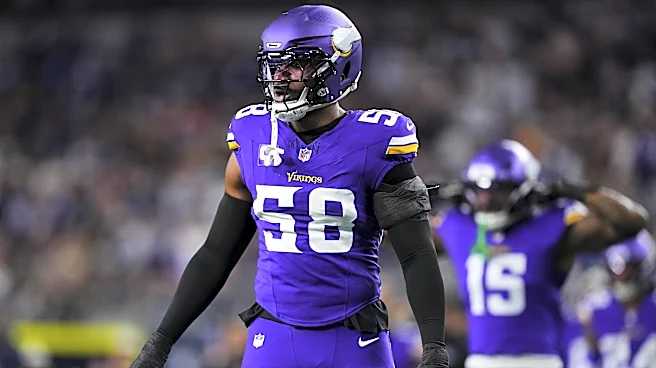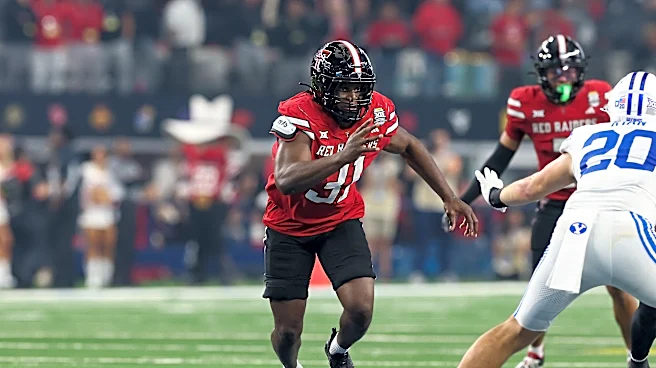



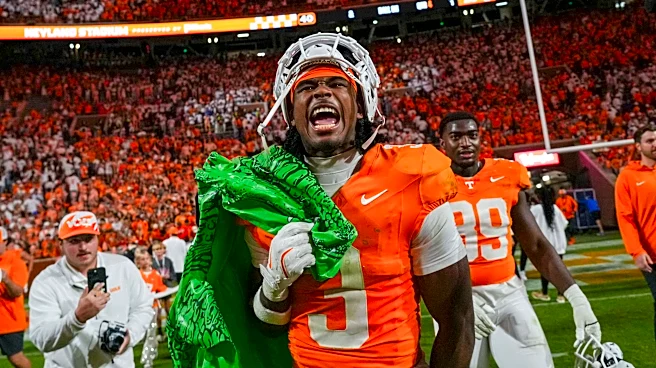

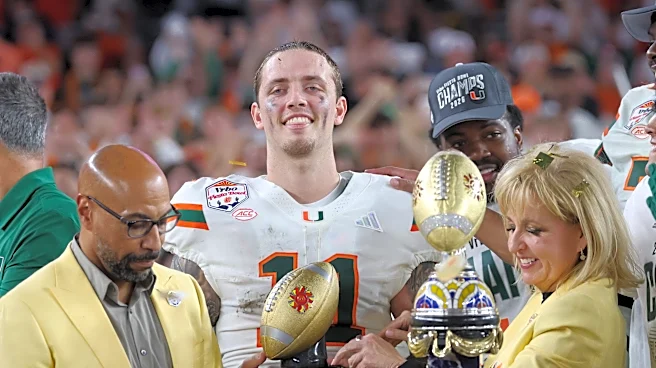
With two weeks left until the NFL Draft, from a Jets perspective the decision is starting to come into focus. Outside of a potential trade-down (which I wouldn’t rule out, though it feels highly unlikely) the Jets’ target list at pick No. 2 is beginning to firm up. While names like Carnell Tate, Sonny Styles, and Rueben Bain have been loosely mocked, Vegas points to two heavy favorites at No. 2: David Bailey and Arvell Reese. Everyone else carries an implied probability of less than 4% to be the pick.
Reese vs. Bailey has been debated ad nauseam for months now. With so little time remaining, I want to outline the Jets’ central dilemma and evaluate both players as objectively as possible.
The Background Comparison
Before diving into production, let’s take a high-level look at both prospects.
Let’s start with Reese. One of the most talked-about aspects of his profile (and a legitimate point of intrigue) is his age. Reese is a very young prospect (he turns 21 in August). A former four-star recruit, he was a high-level prospect throughout his entire high school career. Born and raised in Cleveland, Ohio, Reese drew major interest across college football as a senior, earning offers from more than 15 programs, including Michigan, Alabama, Penn State, Iowa, and USC, before ultimately committing to his home-state Ohio State Buckeyes.
After suffering a concussion as a freshman, Reese saw limited action, primarily on special teams, and did not record any stats. As a 19-year-old true sophomore, his role gradually increased as he played SAM linebacker. He was rarely used as a pass rusher (just 19 pass-rush snaps in 2024), but he held down a solid role on a championship-caliber defense. Reese truly broke onto the scene as a 20-year-old junior this past season, and by September, scouts were already enamored with his upside. Since then, he’s been widely viewed as a high-end first-round prospect and has consistently ranked as a consensus top 3–4 player on big boards for several months.
David Bailey, on the other hand, took a very different path to this point. Despite ultimately committing to his home-state Stanford Cardinal, Bailey was actually the higher-ranked recruit coming out of high school. As a senior, he was an All-American, the No. 2 player in California, and the No. 3 edge rusher in the 2022 class. He received offers from multiple Pac-12 programs: Stanford, UCLA, USC, Oregon State, Washington, as well as national powers like Oklahoma and Alabama.
Bailey has been on the field from the start. After two years of uneven play as a 19- and 20-year-old underclassman, he broke out in a major way during his junior season at Stanford, recording seven sacks across 364 snaps. That performance launched him into the transfer portal as one of the top available players. Texas Tech invested heavily to bring him in, and Bailey rewarded them by exploding up draft boards with a 15-sack season.
Bailey certainly has more game experience which some scouts would point to as an advantage in his profile. He’s also been used incredibly similar year over year. However, the one potential drawback with Bailey is his age—he’s a full two years older than Reese, turning 23 in late August. NFL decision makers love to take chances on the younger player.
The Athletic Comparison
Another key layer of context is how these two stack up purely as athletes. Looking at both size and testing helps frame what each player brings to the table physically.
Measurables & Testing
Arvell Reese
- 6’4”, 242 pounds
- 32 1/2” arms, 9 1/2” hands
- 4.46 40-yard dash
- 1.58 10-yard split
David Bailey
- 6’4”, 251 pounds
- 33 3/4” arms, 10 1/4” hands
- 4.50 40-yard dash
- 1.62 10-yard split
- 35” vertical jump
- 10’9” broad jump
What It Means
Both players tested extremely well at the combine, and any lingering concerns about their athleticism were largely put to rest.
Bailey, in particular, checked just about every box you’d want to see from a highly productive edge rusher. He has the length, the speed, and the explosion to match his on-field output. While Relative Athletic Score (RAS) isn’t a perfect metric, it’s still notable that his testing profile aligns with what teams typically look for at the position:
Reese didn’t test across the board in the same way, but what he did show was eye-opening. For a player who spends a significant amount of time as an off-ball linebacker, his speed is elite. His 4.46 in the 40 and especially the 1.58 10-yard split stand out as truly great marks.
For Bailey, it’s also worth noting that while he didn’t participate in the bench press, his reported strength numbers have been widely touted. A 405-pound bench, 550-pound squat, and a recorded top speed of 22.16 mph at 250 pounds is super exciting.
The Key Difference
Interestingly, Bailey often draws criticism for his play strength, but from a pure size standpoint, he’s actually the bigger player right now. He carries more weight, has longer arms, and already possesses a more NFL-ready frame for a traditional edge role. His measurements are also very close to what teams have historically seen from top-tier pass rushers.
Reese, meanwhile, brings a different kind of athletic profile. He’s lighter, faster, and more fluid in space—which shows up in how he’s been deployed.
That contrast in build and movement skills is a big part of what makes this evaluation so tricky.
The Film Profile
I watched a handful of Ohio State and Texas Tech games this year, and when I went back through both players, I did come away more impressed with one over the other.
The word that best describes David Bailey on film is explosive. His first step, from what I saw, might be the best in college football. There have been some effort concerns tied to his profile, but I had a hard time really seeing that on tape. If anything, his pass-rush reps can feel almost too violent and chaotic. He builds speed in a hurry and plays hard, but that urgency can lead to some ugly reps.
One of my bigger negatives with Bailey is his attention to detail in the RPO and run game. There are definitely snaps where he struggles with gap discipline, and while I think some of the criticism around his run defense is a bit exaggerated, the issues are still there on tape. I don’t want to go as far as calling him overzealous, but there are moments where things get sloppy. I will say though, I’d rather have someone be a bad run defender because of lack of awareness rather than not having the strength needed. I didn’t notice Bailey’s size or strength being an issue on that end, but maybe I’m in the minority. That said, his pass-rushing ability is, in my view, truly elite…and something we’ll dive into more.
Arvell Reese was a very different evaluation, largely because of how he was deployed. Matt Patricia used him extensively in a “Joker” role at Ohio State—a versatile defensive hybrid, typically aligned as a 3–4 outside linebacker or stand-up edge, designed to maximize both pass-rushing and coverage flexibility. For Jets fans, the easiest comparison is how the Patriots used Jamie Collins in his prime.
First and foremost, though, you have to remember: he’s raw. Reese is a 20-year-old with limited experience who was asked to handle multiple responsibilities. He even mentioned in a recent interview with ESPN’s Ben Solak that he didn’t spend meaningful time developing as a pass rusher at Ohio State, instead relying largely on instinct when rushing the passer.
When you lock in on Reese, the speed jumps off the screen, especially when he’s playing off-ball linebacker. He can fly sideline to sideline, and for a Power Five 20-year-old, he’s a strong, reliable tackler. When asked to rush, his first step is also impressive.
On the flip side, I was a bit disappointed with his coverage ability. I was hoping to see more flashes there, but right now he looks like a work in progress. That’s a concern, especially given the uncertainty around his long-term position. To me, the coverage struggles at times in the college level really put a damper on his floor at the NFL level. The other thing that was noticeable was that Reese clearly has the athletic tools to develop into a pass rusher at the next level. However, he doesn’t currently have the technical refinement that Bailey does. That makes him the riskier projection.
To me, Bailey gets the edge right now. But at the same time he probably should, given that he’s older and has more experience.
The Analytic Profile
Now let’s shift to a data-driven lens and look at how these two stack up purely from a production and efficiency standpoint. I’m using a few key metrics here: PRP, win rate, and their performance in true pass sets.
All Snaps
Win Rate
- David Bailey: 21.6%
- Arvell Reese: 13.0%
Pass Rush Productivity (PRP)
- David Bailey: 13.3
- Arvell Reese: 15.2
True Pass Sets
Win Rate
- David Bailey: 38.6%
- Arvell Reese: 27.3%
Pass Rush Productivity (PRP)
- David Bailey: 24.6
- Arvell Reese: 31.3
Run Snaps
Stop %
- David Bailey: 9.0%
- Arvell Reese: 6.4%
Missed Tackle %
- David Bailey: 6.1%
- Arvell Reese: 4.7%
What These Metrics Mean
PRP (Pass Rush Productivity) combines sacks, hits, and hurries relative to total pass-rush opportunities, giving a more complete picture of pressure generation beyond raw sack totals.
Win rate (specifically pass-rush win rate) measures how often a defender beats his blocker within 2.5 seconds, regardless of whether the play results in a sack, hit, or hurry. It’s one of the better indicators of true pass-rushing efficiency and often highlights dominant players who don’t always show up in the box score.
It’s also important to note that alignment can have a major impact on pressure production. Where a player lines up (and how often they’re put in advantageous situations) can skew traditional stats. Win rate helps cut through some of that noise by focusing on whether a player actually defeats their blocker, including filtering out unblocked rushers.
In this case, usage matters quite a bit. Bailey did take some snaps lined up directly over the tackle, but it was a relatively small portion of his workload. Reese, when he was deployed on the defensive line, was almost exclusively aligned outside the tackle, often in wider, more space-friendly rush angles.
Initial Takeaways
There’s a clear contrast in the data. Bailey consistently outperforms Reese in win rate, both across all snaps and in true pass sets, which lines up with the film in my opinion. He’s more technically refined and more consistently winning his reps.
Reese, however, posts higher PRP numbers in a smaller sample.
Even the run game metrics follow a similar pattern. Bailey shows up more often with stops (much to do with his positional alignment), while Reese is slightly cleaner as a tackler.
Overall Closing Thoughts
Full disclosure: I went into this expecting to land firmly on David Bailey over Arvell Reese. Bailey has been a favorite of mine for months, while the data-driven side of me has always been a bit skeptical of Reese. But after digging deeper into their backgrounds, I do think Reese is closer to Bailey than I initially gave him credit for.
That said, I still lean Bailey as things stand today.
Many film guys will disagree with me as this has been a polarizing debate in the film vs analytics community. But at pick No. 2, I’d rather side with the safer player. Especially given the Jets’ current situation, where the next one to two years are all about hitting on draft picks and building out a young core alongside Garrett Wilson, Olu Fashanu, and Armand Membou. Bailey checks a lot of those boxes. He has sustained statistical production over a two-year span, tested extremely well, and doesn’t raise any concerns from a size or physical profile standpoint. Most of his issues against the run (which have improved the older he has gotten) feel more like attention-to-detail problems than true physical limitations. He checks the boxes.
I completely understand the appeal of Reese, though. His versatility opens up a wide range of potential uses, and given his age and inexperience, it’s easy to envision a development curve where he grows into a true “jack-of-all-trades” type of defender. There’s a real argument that his upside exceeds Bailey’s because of that flexibility.
But for me, it ultimately comes down to risk tolerance. Taking an edge rusher at No. 2 with Reese’s limited pass-rush reps and production gives me pause. I almost wish he returned for one more season at Ohio State and played full-time as an Edge Rusher. That’s what Abdul Carter (who had an extremely similar usage profile to Reese) did at Penn State and he became one of the better pass-rushing prospects in recent memory. The upside is enticing, but the floor feels less certain. In this spot, I’d lean toward the more proven commodity.