

When the Nats made the MacKenzie Gore trade with the Rangers last offseason, Gavin Fien was seen as the headliner by most. He was the 12th overall pick in the 2025 draft, and was known as a well-rounded hitter. His defensive home was a bit of an unknown, but the bat was expected to carry the profile.
During the Spring Breakout prospect showcase we got to see that bat in full flow. Fien drove in five runs and collected three hits in a very impressive showing. He looked to be a bat on the rise and a player
who was about to become a fixture on top 100 prospect lists. However, his season did not end up being that smooth.
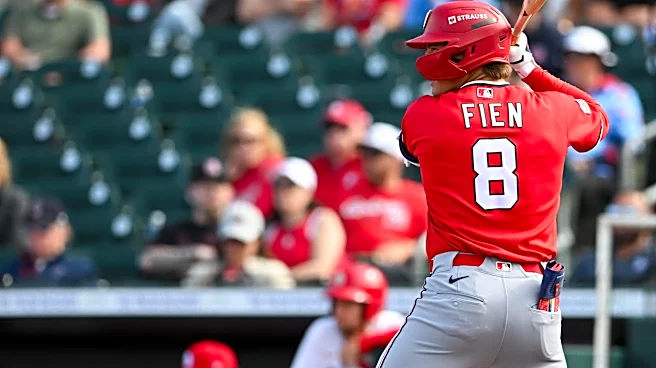
While Fien was seen as having a lot of offensive potential, his unorthodox swing concerned some scouts. There were times where Fien almost steps in the bucket on his swings. That swing was just fine against high school competition, but left him in a tough spot against professional breaking balls. Fien’s 26.5% strikeout rate in Low-A was higher than expected and his inability to hit spin was a big reason for that.
Another factor that complicated Fien’s season was an injury early in the year. Fien missed a month with a wrist injury in April and early May. That cost him valuable reps early in his first full season as a pro. It also resulted in him having to play catch up when he came back from the injury. In addition, wrist injuries can linger for hitters even when they come back.
Even with these troubles, it was not like Fien was terrible. He hit .242 with 10 homers, 52 RBI and a .738 OPS in Fredericksburg. Those numbers are underwhelming for a top 15 pick known for his bat, but it is not like Fien got totally overmatched. He had some big moments, most notably in June, where he hit .294 with 5 homers. It was not consistent enough, but we saw the flashes.
This is not quite an Elijah Green type situation, where his season was so concerning that fans need to panic. It was a tricky, but not terrible season for a 19 year old who was traded, had to learn a new position, got injured and was trying to make adjustments. I think we will see a better version of Fien in 2027.
It was just mentioned, but another big story for Fien was his position change. He was originally drafted as a shortstop, but was always seen as a better fit for third base. However, the Nats saw things differently and moved him to the outfield. Fien played all of his games at either right field or center field this season, meaning he is a full time outfielder now.
Despite looking slightly more athletic than initially expected, Fien’s long term home is likely to be in right rather than center. He is an average runner with a big arm, which fits right field very well. I have not dug into his defensive video, but it seems like he adapted fairly well to the move.
We saw Seaver King really struggle in his first year as a pro, before re-establishing himself last year. Fien is a candidate to do the same thing in 2027. He will need to clean some things up mechanically and improve against breaking balls, but at 19 years old, he has plenty of time.
It will be interesting to see where he starts the season. Honestly, I think that will tell us quite a bit about what the organization thinks of him. If he repeats Low-A again, it would mean there is still a lot of work to do. However, if he is trusted to start next year at High-A, I would be optimistic about the offseason tweaks he made.
This is probably the first time Gavin Fien has really failed in his baseball life, and calling his season a failure would be slightly harsh. He did not jump on to top 100 prospect lists like he was expected to, but there is still plenty of time for this to work out. It might be a slower burn, but I still buy into Gavin Fien’s talent. However, 2027 will be a very important year for him.