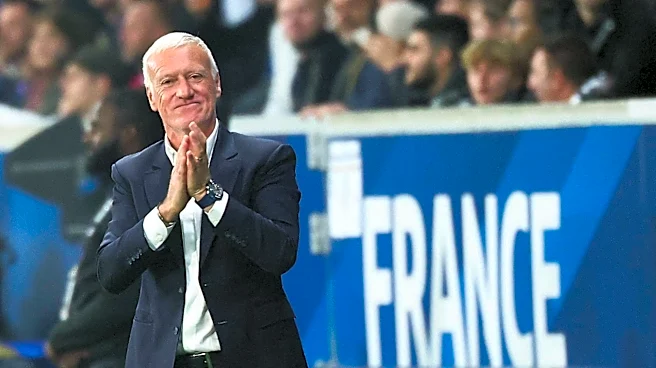




For more than a decade, Didier Deschamps has been the leading man on the touchline for modern French football. Calm under pressure, relentlessly pragmatic, and remarkably successful, Deschamps has guided France’s national football team through one of the most dominant eras in the country’s history. Yet despite already winning the World Cup as both a player and manager, the question entering another tournament cycle remains the same, can he do it again?
France continues to produce extraordinary talent
at every position, but talent alone has never guaranteed international success. What separates Deschamps from many elite international managers is his ability to blend personalities, tactics, and tournament experience into a cohesive group capable of surviving the emotional and tactical demands of a World Cup.
As a player and coach, he understands the French way
Few people in football understand the identity of the French national team better than Didier Deschamps. As captain of France’s 1998 World Cup-winning side and later as manager of the 2018 champions, he has experienced the pressure, expectation, and scrutiny surrounding the national team from every possible angle.
That matters enormously in a country where football is deeply connected to identity and emotion. France is consistently one of the most talented nations in world football, but it has also dealt with dressing room fractures, media controversy, and tournament collapses throughout its history. Deschamps understands that managing France is not simply about tactics—it is about maintaining balance within an incredibly diverse and high-profile squad.
His approach has often reflected the traditional strengths of French football: athleticism, defensive organization, adaptability, and devastating attacking transitions. Unlike managers obsessed with stylistic purity, Deschamps has never cared much about aesthetics if results are achieved. That mentality has occasionally drawn criticism from supporters who want more expansive football, but it has also produced extraordinary consistency in major tournaments.
France under Deschamps rarely beats itself. The team is usually disciplined, physically prepared, and emotionally resilient. Even when performances are not spectacular, they remain incredibly difficult to eliminate. In tournament football, that quality is invaluable.
Perhaps most importantly, Deschamps commands instant credibility within the French setup because he has lived every aspect of the experience himself. Players know he understands the pressure they face because he carried it as captain on the sport’s biggest stage.
A master of tactics and personalities
Deschamps is sometimes underrated tactically because his style lacks the complexity or flair associated with managers like Pep Guardiola or Thomas Tuchel. In reality, his tactical flexibility has been one of the key reasons France has remained consistently successful.
He adapts to tournaments exceptionally well. France can dominate physically, counterattack with pace, defend deep when necessary, or overwhelm opponents with individual brilliance. Deschamps rarely forces one rigid identity onto the squad. Instead, he builds systems that maximize the strengths of his best players.
That adaptability becomes especially important when managing elite personalities. France regularly enters tournaments with Ballon d’Or contenders, Champions League stars, and world-class depth across the pitch. Managing those egos can be just as difficult as solving tactical problems.
Deschamps excels in that area. He understands when to empower players, when to demand sacrifice, and when to simplify roles for the good of the team. During the 2018 World Cup, players like Kylian Mbappé thrived because the structure around them created freedom in the right moments. France did not need to dominate possession constantly because the balance of the squad allowed its stars to explode in transition.
That same formula nearly delivered another World Cup in 2022 despite injuries and instability entering the tournament. France remained tactically disciplined while still allowing its attacking players to decide matches.
International football is often about surviving moments of chaos, and few managers organize those moments better than Deschamps.
Can he do it again?
This is what makes France so fascinating entering another World Cup. The squad is once again loaded with elite talent, tournament experience, and depth that few countries can match. On paper, France should absolutely be considered one of the favorites.
But repeating success in international football is incredibly difficult. Opponents evolve, pressure increases, and eventually every great cycle faces questions about motivation and freshness. Deschamps has already achieved almost everything possible with France. Maintaining hunger after years of success can be one of the toughest challenges for any manager.
Still, there are strong reasons to believe France can make another deep run. Deschamps understands tournament football better than almost anyone managing internationally today. He knows how to pace a squad emotionally, how to navigate knockout matches, and how to keep France composed when pressure intensifies.
The biggest challenge may actually come from expectations. France is no longer an emerging contender — it is a standard bearer. Every opponent views beating France as a defining moment. Every tactical decision will be scrutinized heavily.
Yet Deschamps has spent years proving he thrives in exactly those conditions. He may not always produce the most entertaining football, but he consistently produces teams capable of winning the matches that matter most.
And in World Cup football, that is ultimately the only thing anyone remembers.
If you want more of this series, check out SBNation.com for the complete series.