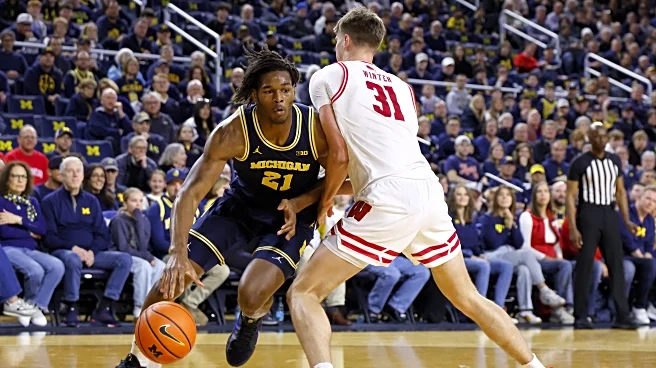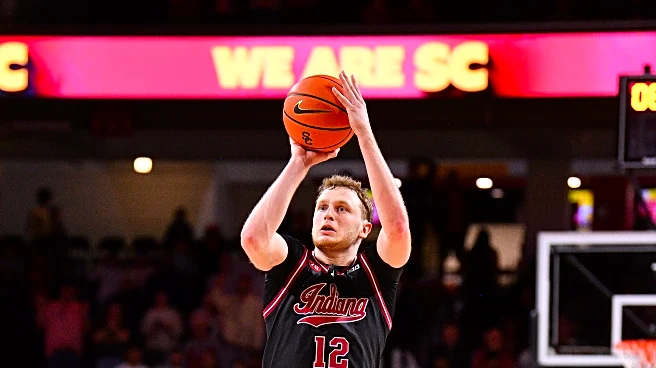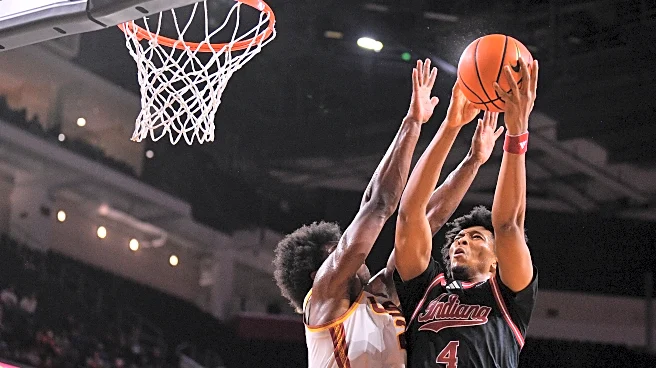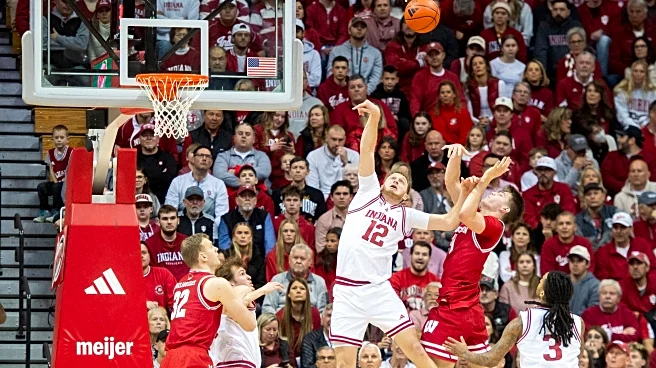

The Wisconsin Badgers fell just short in an overtime thriller against the Indiana Hoosiers, losing 78-77 thanks to free throws from Lamar Wilkerson with just two seconds remaining. The loss drops them
to 1-6 in Quad 1 games as the Badgers fall to 16-7 on the season and 8-4 in Big Ten play.
It was an ugly game early on, as Wisconsin just couldn’t manufacture any offense, relying too heavily on threes. But they found a way to keep things close and made a fervent comeback in the second half to send the game to overtime.
Chaos ensued over the last five minutes with a couple of questionable calls, but Wisconsin, holding the lead for much of overtime, fell short in its pursuit of an upset.
Here are three quick takeaways from Wisconsin’s overtime loss to Indiana on Saturday.
Top three stars
As games have been for the Badgers, it was Nick Boyd, John Blackwell, and Nolan Winter in charge on Saturday.
In the first half, Boyd and Blackwell had quite disappointing performances. Offensively, neither player could really get going. Boyd had 11 points on 4 of 11 from the field, including 3 of 4 from deep. But he really struggled in the paint in the first half and didn’t get to the free-throw line at all.
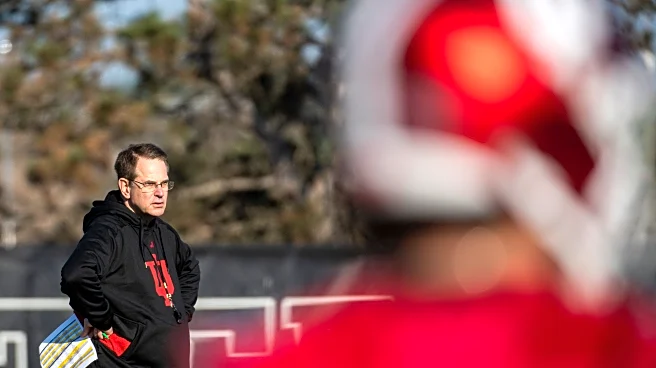
One key with Boyd has been trying to get him to play off two feet. Head coach Greg Gard has talked about this in regard to keeping Boyd under control with his elite speed. He didn’t play off two feet much on Saturday, which ended with him forcing tough looks over big men at the rim, playing out of control. If he goes off two feet more and changes speeds, he’s been able to make better decisions, be it a kickout or a better look at the rim. That wasn’t the case early in the first half.
Blackwell really couldn’t get going offensively either. He was a bit looser with his handle and was just 1 of 8 from the field, including 0 of 3 from three-point range. The shot selection from both inside the arc was also an issue. But it was things away from the offensive end that alarmed me more.
Boyd really struggled defensively to keep up with ball-handlers, getting beaten off the dribble a number of times by Conor Enright. His defense was a big issue for the Badgers early, as Indiana was eating off the rim and getting dribble penetration to set up great looks offensively. But his attentiveness felt off as well, as he struggled off the ball with the ball-screen actions, which gave Indiana great lanes off the catch and disrupted Wisconsin’s defense.
As for Blackwell, it felt like his energy level wasn’t as high early on. There were a couple of rebounds and loose balls that he didn’t go for, and it added to the physicality advantage for Indiana.
Winter was the key in the first half. He was the one playing hard on both ends, scoring 14 points on 6 of 7 shooting, while grabbing seven rebounds and contesting well at the rim.
In the second half, some of the issues defensively for the guards persisted early on, but we did see Wisconsin get better at running shooters off the three-point line. And Boyd and Blackwell finally got in a groove offensively.
Boyd was more careful with the ball, scoring eight points (albeit on seven shots), while dishing out two assists. Blackwell was the one who really brought Wisconsin back into the game, scoring 16 points on 6 of 8 shooting. He had a couple of bad turnovers still, but he was the catalyst offensively while the defense picked up the slack.
Winter maintained his activity on both ends, scoring eight points while really playing some good defense on the block, making it tougher for Indiana with contests. He was also the go-to guy in overtime with four of Wisconsin’s five points.
Wisconsin is heavily reliant on this trio, and the guards really struggled in the first half in a lot of ways. But they also brought the Badgers back in a very eventful game in the second half. Wisconsin just needs more consistency from that group in these big games.
Physicality
The biggest issue for the Badgers on Saturday was physicality. Wisconsin had been playing more physically in recent games, and it felt like this one would be another game to build off that, given that the Badgers had the size advantage.
Yes, Wisconsin got 14 offensive rebounds, but Indiana dominated the physicality in this matchup for most of the game. As mentioned above, there were issues defensively with the guards. There was too much dribble penetration, with Indiana getting to the rim at ease. Boyd’s struggles to defend on-ball and with the off-ball screens were a big issue early on.
Down low, I thought Aleksas Bieliauskas really struggled with his physicality after a good game against Ohio State last weekend. So it wasn’t much of a surprise that he played only three minutes in the second half and overtime.
Offensively, the Badgers needed to find a way to get more paint touches earlier in the game, either via dribble drives or actions to set up post touches with Nolan Winter. Shooting 19 threes in your first 30 shots when you have the size advantage is an issue, considering the quality of looks and the lack of makes.
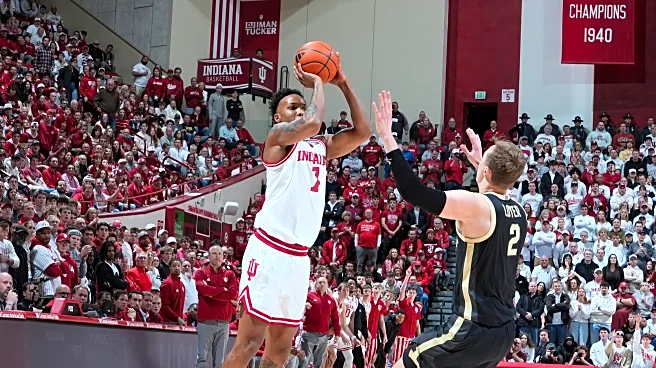
Indiana completely dominated the paint early on. 32 of their first 46 points were in the paint before Wisconsin started to shut that down. You saw some bully ball from center Sam Alexis and Tucker DeVries, and the Badgers’ switches didn’t help there either.
Wisconsin has to find a way, though, to be more physical without sacrificing much on the offensive end. They’ve lacked another consistent big in their frontcourt rotation to help Nolan Winter, and the guard play defensively has also been an issue this year.
Questionable calls
I’m not one to usually point at referee calls. When teams lose games, there’s a reason why and they need to play better. That’s the case with Wisconsin on Saturday as well.
But there were a number of questionable calls over the final minutes of the game where it felt consistency wasn’t there. First off, there was a lack of calls in the first half from officials, who elected to let the teams play things out. In the second half, that changed, with a lot more ticky-tack fouls being called, as there were 18 total fouls in the half.
Then, in overtime, Wisconsin fell victim to a couple of questionable calls. With the Badgers up 74-72 and under three minutes left, Nick Boyd appeared to get hit on his left arm by Sam Alexis on a drive, but there wasn’t a call on the play. Indiana came down the court, and Lamar Wilkerson missed a pair of contested layups, with Alexis getting the rebound after. However, he fell down after securing the board, which looked like a travel. There was a no call there, and Wilkerson was fouled by John Blackwell after getting the ball and attempting a shot.
Later, with Wisconsin up three points with 39 seconds left, Wilkerson drove for a layup, but was blocked by Nolan Winter. It seemed like Wilkerson went up and down with the ball, suggesting a jump ball should’ve been called, but there wasn’t a call there. Indiana called timeout, and Wilkerson got a layup coming out of the timeout to cut the lead to one.
Wisconsin had the ball up one, and Indiana needed to foul. The Badgers looked to dribble the clock out and take off as many seconds as possible, with Nick Boyd weaving through the defense after Wisconsin broke the press to get back out to the perimeter. There, he had contact with Indiana’s Conor Enright and was called for the offensive foul. Did Boyd extend his arm there? Yes. Was it worthy of an offensive foul with the contact? We’ve seen that action get played out as a no-call quite often. Enright did a good job selling the call, but that one was questionable as well.
It all boiled down to the final seconds, however, with Indiana having the ball with 15 seconds left down one point. Of course, the Hoosiers put the ball in Lamar Wilkerson’s hands, with John Blackwell picking him up on-ball after a few screens that led to switches. Blackwell played great defense, keeping up with Wilkerson as he tried to shift from side to side. There was contact as Wilkerson drove, but it didn’t seem like enough to warrant a foul. Blackwell started to fall back, and Wilkerson seemed out of control and losing his balance, but Blackwell was called for a fifth foul and was irate.
Of all the calls, that one was likely the most questionable and evidently the one with the biggest implications. Wilkerson sank both free throws, and the Badgers went home with a one-point loss.
Did Wisconsin lose because of the referees? No. There were several things they could’ve done better to get in the win column. But in such a close game, those questionable calls in the final minutes definitely weighed in at the end of the game.