





Empty beer cans and peanut shells littered the concrete slabs along the lower level, cups sat crushed in at the sides — barely recognizable from what they once were — and in some places your shoe clung a little longer than you wanted it to.
The grounds crew carefully ushered rakes over the unsettled dirt, coaxing the tiny rocks back into place. Only the faint echo of the crowd remained in the park as the evening settled into the empty seats.
“It feels like a place you shouldn’t be, somewhere you’ve
snuck into too late,” Noah Gerkey said, a student radio commentator for various Indiana University athletics. “You shouldn’t be here, but somehow you are.”
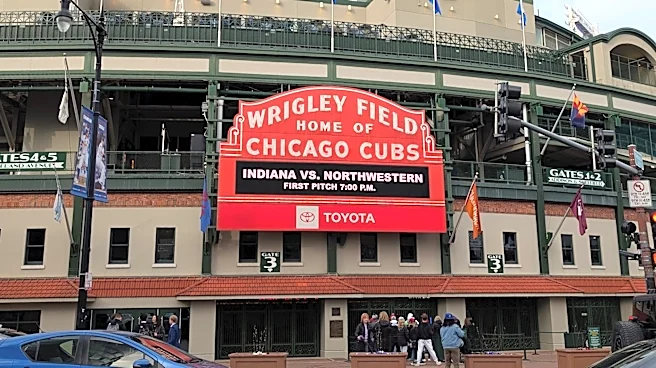
While footsteps pattered outside the walls of Wrigley Field, creating a sea of pinstripe jerseys and hollering chants, a reef of crimson and purple slowly began to filter into the Friendly Confines.
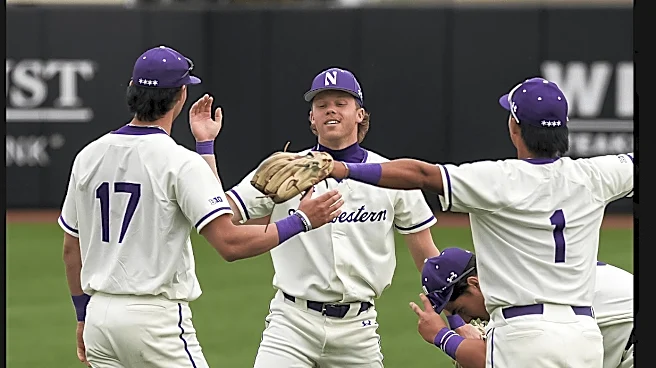
In the sixth edition of the ’Cats Classic, Northwestern Baseball faced Indiana on the first of May. It was a bitterly cold night — one you could feel in the back of your throat when taking a breath and lingered between your bones, yet fans still drifted beneath the glowing Marquee and through the green gates.
Once inside, the ballpark opened around them. For a program that averages 300 fans a game, the 2,451 headcount felt enormous. But as you craned your head across the trio of seating areas, the 41,649-seat capacity swallowed the illusion whole.
Tucked away in empty stretches of green seats were fans of all ages, bundled in layers and adorned in hats, some huddling together to evade the cold. Despite IU nesting over 200 miles away, both Hoosier and Wildcat fans scattered across the stadium in what neutral onlooker Eli Winter described as a “cordial environment.”
Having graduated from the University of Chicago, the alumnus said he “had no dog in this fight,” but he made the trek anyway. He had come at the invitation of a friend tied to Indiana, but stayed when she could no longer make it.
Even as snow started dusting the air, he sat alone, 25 rows behind home plate.
“This might be the only time in my life I’m able to watch baseball at Wrigley Field this close to the action,” he said. “I’m trying to make the most of it.”
And even if stripped from its usual frenzy, the ballpark continued to carry itself like a major league stage. Every crack of the bat prompted a thunderous response from the crowd, yowls bouncing off the barricaded upper decks before dissolving beneath the distant hum of the Red Line playing peek-a-boo with the bleachers — its lights briefly threading through the gaps before disappearing into the city beyond.
And within that wider noise, individual stories sat scattered across the seats.
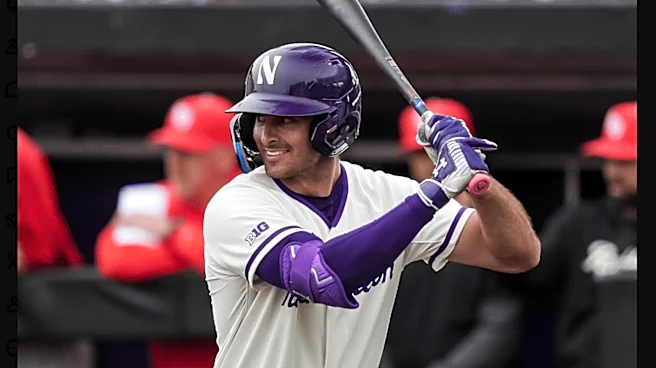
Jean Kaplan flew in from California. She made the long trip to see her son, Marty, play under the Wrigley lights once again. Having first seen him against the backdrop in 2023 as a first-year student, she now watched him return as a senior.
“It’s so exciting for the parents to see their kids in this environment,” she said. “I know Marty’s thrilled to be here.”
Above the ivy-lined walls, the scoreboard was still updated manually, those in charge stealing glances of the action below between each turn of the cards. The yellow glow of the Flower Moon washed over the stadium, softening the edges of the night.
Hands continued to disappear deeper into pockets, and various blankets pulled tighter across laps as the seventh inning stretched on and the crowd began to thin, people peeling away in small waves toward the exits.
Ushers leaned against railings, watching the final innings unfold after a long day, their decorated lanyards glistening in the lights while their breath curled into the frigid air. A child dragged a foam finger along the concrete steps on the walk back toward the concourse, her feet moving slower with each step toward the exit.
From deeper in the stands, chants of “hoo-hoo-hoo-Hoosiers” or “let’s go ’Cats” rose and broke apart, climbing toward the press box and into the night. Brief boos littered the crowd after various unwanted calls, and by the last batter, Indiana fans were on their feet, excitedly anticipating the game’s end.
“I’ve never seen the stadium this empty,” said Ian Plaskoff, who worked alongside Gerkey on the IU student-radio broadcast. “Though we still saw a lot of energy and made some memories that are surely going to live on forever.”
For three hours and eight minutes, players stepped into childhood dreams under major league lights; student reporters found themselves seated where the professionals normally are; and the seagulls got to enjoy the game up close, as dozens perched by the netting and kept watch from the distant bleacher seats.
When the game finally reached its conclusion, the stadium settled back into its quiet, as if nothing had interrupted it at all.