

What a difference a year can make. Unfortunately.
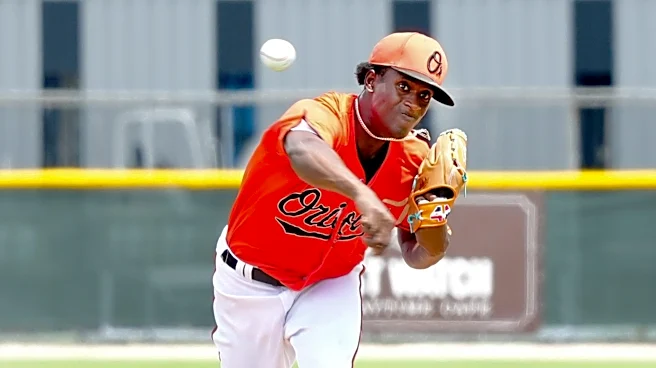
One year ago at this time, Esteban Mejia’s career was on a very different trajectory. The Dominican right-hander, a 2024 international signing, was coming off of an excellent first season stateside, one in which he flashed both dazzling results — a 2.45 ERA and 11.8 K/9 as an 18-year-old for Low-A Delmarva — and a jaw-dropping repertoire, headlined by a four-seam fastball that touched 102 mph, along with a devastating changeup and gyro-like slider.
On MLB Pipeline, he’d skyrocketed from an unranked prospect to #8 in the O’s system. Baseball America went even further, listing him as one of MLB’s 100 best prospects, with BA’s Josh Norris raving, “He produces outings that burrow in your brain and stay there for weeks.”
Sure, Mejia walked a few too many hitters, but what teenaged pitcher doesn’t? This kid was a star in the making, the Orioles’ fastest-rising and most electric pitching prospect, and 2026 was going to be his year to shine. As I wrote last October, “If 2025 was the year that Mejia broke out onto the prospect scene, 2026 could be the year that he rises to the very top of it.”
Oh, 2025 Paul. How young and naïve you were.
Mejia did not, as it turns out, rise to the very top of the prospect scene this year. In fact, when the updated lists are published, he may be nowhere to be found at all. His 2026 season was an unmitigated disaster, one that may have irreversibly wrecked his prospect status and left him scrambling to rebuild his nascent career.
Opening the season with a repeat engagement at Delmarva, things went off the rails for Mejia almost immediately. His first start was solid enough — six strikeouts, three walks, and one hit in 4.1 innings at Salem — but in his home debut a week later, he allowed five baserunners and three runs without getting out of the first inning.
Mejia was plagued by an inability to throw strikes, which reached a nadir on April 17 in Fredericksburg. In that game, Mejia issued an astounding eight walks — twice as many as he’d ever had in a single outing — in 2.1 innings of work. He threw twice as many balls (42) as strikes (21) and uncorked two wild pitches. In the first inning alone, he walked the first three batters, then plated two runs on a balk and a wild pitch, and walked the next two batters to force home another. Even for a pitcher with a career 5.4 BB/9 rate entering the season, this was a whole new level of wildness.
Mejia returned in his next start with a gem — four scoreless innings, eight strikeouts, just one walk — and it seemed like his Fredericksburg outing might’ve been a fluke. But then things continued to unravel. Over his next six starts, Meija struggled to an 8.83 ERA and walked 26 batters in 17.1 innings, including three outings of five or more walks.
By the end of June, Mejia was 15 games into his season and had yet to work five innings in any of them, carrying an 8.08 ERA and averaging more than 12 walks per nine innings. It should be said that Mejia averaged less than a hit per inning, so batters weren’t exactly smoking the ball when they put it in play, but they rightly decided that there was little reason to swing if the pitcher was just going to put them on base anyway. The Orioles had seen enough, and pulled Mejia off the roster for a month to place him on the development list, working on a specialized throwing program with the right-hander to try to get his control back on track.
I keep revisiting Josh Norris’s remark about Mejia’s outings that “burrow in your brain.” Sadly, there were plenty of those in 2026, and this time that’s not a compliment.
The most brain-burrowing of those outings came in back-to-back starts on July 29 and Aug. 4, after Mejia’s return to the Shorebirds’ active roster. In those two outings combined, Mejia faced 11 batters. He retired none of them. The first outing, against Hickory, went single, single, hit by pitch, single, double, single, wild pitch, walk. The second outing, once again versus his nemesis Fredericksburg, lasted four batters. All four were walks, and all four came around to score, inflating Mejia’s ERA to 10.20.
Good news was hard to come by for Mejia in 2026. Even when it looked like he was briefly getting his act together in mid-August, tossing three straight scoreless outings with only three walks in 8.1 innings, he came unglued in his final two. He walked all three batters he faced in an Aug. 27 outing against — you guessed it — Fredericksburg, then was torched for six runs in 1.2 innings in his season finale Sept. 6, the fourth time he’d given up six or more runs.
You may want to avert your eyes as I present Mejia’s full 2026 season stats. He was 0-9 with a 9.80 ERA, and he issued 70 walks (and six HBP for good measure) in 52.1 IP, for an average of 12.0 walks per nine innings. Twelve! To call it a dismal season would be an understatement. For a pitcher who was primed for a breakout to fall apart instead was a tough pill to swallow for Mejia and the Orioles.
As I cautioned in last year’s Mejia post (if I may once again be tacky and quote myself): “He’s a long way from MLB, and there’s a whole lot that could go wrong on his journey up the minor league ladder. Baseball history is littered with prospects who dominated at the lower levels but hit a wall once the competition got tougher, stalling out their careers without ever getting a sniff of the majors.”
It’s safe to say that something went wrong for Mejia. A lot of things. As quickly as his stock exploded in 2025, it imploded in 2026. And if it’s ever going to return, it’ll require a heck of a lot of hard work and perhaps a complete mechanical overhaul on Mejia’s part. The Orioles’ development staff has a long offseason ahead trying to figure out how things went so haywire for the young righty and what, if anything, can help him get back on track in 2027. Throwing strikes, of course, is priority number one, but that’s easier said than done.
At 19 years old, Esteban Mejia’s baseball story isn’t finished yet. It just got a lot more complicated.