

Quarterback
*Starters in Bold
Jacob Knuth: Snaps – 75 – Comp – 26/41 (63.4%) – Yds – 194 – Td – 1 – Rush
– 6 – Yds – 41 – Td – 1Grade: C-
Grade (with curve): A
I don’t think you can ask much more from Knuth than what he gave you. He got the team in and out of the huddle, remained calm in the pocket, kept the ball relatively safe, and made a couple of nice throws into tight windows. Even though he came into the game with a gimpy ankle, which he then aggravated a couple of times during the game, he led the team rushing
(which is also a huge problem).
He was accurate in the short passing game and was respectable at throwing mid-range passes, but was 0-for-2 on deep balls. The thing I was concerned about happening happened. Arizona State didn’t respect Knuth’s ability to throw it downfield. They made Kansas State play offense in a 15-yard box, and no one could make a play and break something long. A 7.5 yards-per-reception tells the story of this game for Knuth. For some perspective, Kansas State averaged 14.5 yards-per-reception last week against Kansas and 11.4 yards-per-reception vs. Houston. Knuth completed passes, but the receivers did little beyond getting tackled or falling down after the catch. To be fair, none of the 3-starters are known for their YAC.
This was a perfectly fine, even good, performance from Knuth. He didn’t get the outcome he wanted, but quarterback play wasn’t the problem. He gave the team a chance to win.
Running Back
- Rodney Fields: Snaps – 21 – Att – 10 – Yds – 36 (3.6 YPA)
- Joe Jackson: Snaps – 35 – Att – 9 – Yds – 17 (1.9 YPA)
- Jay Harris: Snaps – 19 – ATT – 3 – Yds – 8 (2.7 YPA)
Grade: D
This grade feels somewhat unfair. Arizona State stacked the box, attacked the line of scrimmage, and made it clear Kansas State would need to win the game with their backup quarterback’s arm. The running backs had 22 chances to make a play, and aside from Rodney Fields breaking off a 31-yard run, no one did anything out of the ordinary to help the backup quarterback and outnumbered offensive line. This is a wild stat, but as I mentioned above, Fields broke off a game-long 31-yard run; he finished the game with 36 yards…on 10 carries…one of which went 31 yards.
Jackson performs best when he can reach the second level with minimal friction. He never reached the second level in this one. Arizona State kept shooting safeties and linebackers into the backfield, and he couldn’t find the corner on outside runs; I’m not sure he ever managed to turn his shoulders downfield.
The coaching staff even decided to dust off Jay Harris to see if his more direct running style could find anything. It turns out it doesn’t matter how hard you run; running hard into a brick wall still doesn’t get the job done.
Arizona State sold out to stop the run. They swarmed the ball with no concern for any type of play-action passing game. The offense needed someone to make a play in this group, and outside of the one spark of life from Fields, they ran for about what each play was blocked for…which wasn’t much.
Wide Receiver
- Josh Manning: Snaps – 75 – Targets – 10 – Rec – 7 – Yds – 57
- Jaron Tibbs: Snaps – 75 – Targets – 13 – Rec – 9 – Yds – 57 – Td – 1
- Derrick Salley Jr.: Snaps – 56- Targets – 10 – Rec – 6 – Yds – 63
Grade: C
Here’s the problem with playing this trio of receivers, even though they’re clearly the best 3 on the roster: none of them will do much after the catch. This group combined for 12 first-down receptions, which was great, but they only gained 84 yards after the catch on 22 receptions. That’s an average of 3.2 yards per reception. That’s pretty much catching the ball and falling forward. Salley Jr.‘s 20-yard reception was the best this group could come up with on Saturday.
My issue with grading them too harshly is that you should expect that from this group of jumbo receivers. Tibbs is probably the best after the catch, but he’s better at bouncing off tacklers and continuing downfield, and not making guys miss in the open field for big gains. Too low a grade feels like I’d be penalizing a groundhog for not being able to fly (a saying I just came up with).
This coaching staff brought in two slot receivers, and it looks like they missed on both.
Tight End
- Linkon Cure: Snaps – 59 – Targets – 6 – Rec – 3 – Yds – 21
- Oliver Miller: Snaps – 18 – No Stats
- Lawson McGraw: Snaps – 13 – No Stats
Grade: D
Cure is in a tough spot. Kansas State needs him to be a more physical blocker, but that’s not his game. He gets where he’s supposed to go and gives it the old college try, but he’s a huge step down from both Will Anciaux and Garrett Oakley. He was more active in the passing game this week but couldn’t get anything going downfield and dropped another pass. I don’t think this is a lack of effort or talent, but I’m starting to question his feel for the game. Some guys know how to get open, Garrett Oakley, for example; Cure isn’t one of those guys. He’s still a work in progress as a football player, even with his prodigious athletic ability.
Freshman offensive lineman Oliver Miller continues to moonlight at tight end and, according to PFF, was the team’s best run blocker by a wide margin. If I’m not mistaken, he was involved in the long run that Fields popped as a backside puller. The problem with playing Miller at tight end is that while you get an extra blocker, it’s a bit of a tip to the opposing defensive coordinator when he checks into the game. It’s hard to get outside when the defense can split their safeties and send an extra body into both alleys.
At the end of the day, this offense desperately needs playmakers. Linkon Cure gets paid to be a playmaker, and he’s not making plays. He’s not the only one suffering from this issue, but I’m guessing he’s among the highest-paid in that group. I’m still hoping that this season’s struggle will pay off down the road.
Offensive Line
Left Tackle
Ryan Howard: Snaps – 75
Left Guard
Tanner Morely: Snaps – 75
Center
Dylan Villarouel: Snaps – 75
Right Guard
Charlie Adams: Snaps – 75
Right Tackle
Gus Hawkins: Snaps – 75
Grade: D
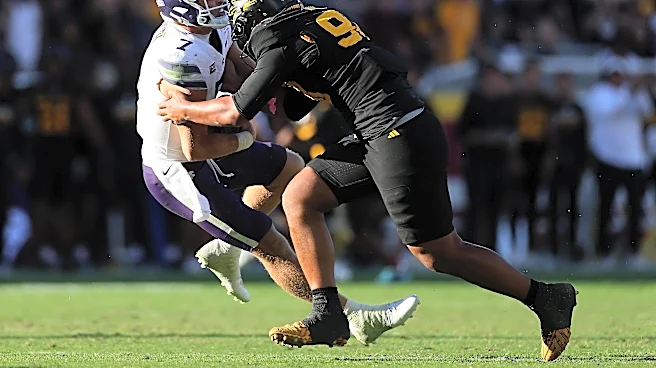
Ryan Howard had the first really rough day of his career against Arizona State. He gave up a team-high 5 pressures, including 2 sacks and 1 quarterback hit. Kansas State’s offense found itself in too many obvious passing downs, and when they knew the pass was coming, they isolated Howard and beat him with speed around the edge and pressure right in his face. He’s still the best 3rd-string left tackle in the nation, but he looked like a 3rd-stringer on Saturday.
Right guard Charlie Adams was also an issue. He allowed 4 pressures, including 2 hits and a sack, and got flagged for holding. Adams, like Howard, has been a good story, coming out of nowhere to earn a starting spot, but it’s probably time to look at other options on the roster. He’s good in the gap run scheme as a puller, but his shortcomings in the zone run game and pass protection are hard to overcome. I wouldn’t mind either Chase Duarte or Keiton Jones getting another look next week.
The other three offensive linemen were fine in pass protection. Adams and Howard allowed 9 of Arizona State’s 10 pressures but couldn’t get anything going in the run game. Arizona State clearly wanted to challenge Jacob Knuth to win this game with his arm and flooded the line of scrimmage. The line wasn’t strong enough to push straight ahead, and they weren’t agile enough to get outside and pick off safeties and linebackers. The defense wasn’t afraid of getting beat over the top and turned that into a numerical advantage at the line of scrimmage.
I keep reminding myself that this is still an incredibly green group of linemen. They will keep improving, but Kansas State needed them to be better in this game.