






Welcome back to Episode 2 of our series connecting the Phoenix Suns and the FIFA World Cup. Last time, we explored the franchise’s origins: from its first steps to its first moments of glory, and the players who laid the foundations of one of the NBA’s most iconic franchises. Today, we’re traveling back once again to dive into a pivotal decade in Suns history: The 1980s.
1982: A Franchise Stuck in Limbo
In 1982, the Suns were coming off a stretch where they had flirted with greatness without ever truly establishing themselves among
the league’s elite. Their 46-36 record reflected a solid, competitive team that simply couldn’t take the next step. Phoenix was good — sometimes very good — but rarely spectacular. It was the story of the franchise at the time: three consecutive trips to the Conference Semifinals ended in three straight eliminations, despite posting the two best regular-season records in franchise history (55 and 57 wins).
On the floor, the team still revolved around its star duo: Dennis Johnson and Alvan Adams. Johnson remained Phoenix’s go-to scorer, an elegant, smooth offensive weapon capable of catching fire at any moment. Adams, meanwhile, continued to redefine the center position with his intelligence and creativity, orchestrating the offense from the high post. Averaging 4.5 assists per game as a center was almost unheard of at the time.

The Suns reached the playoffs once again but were swept out of the Conference Semifinals by Kareem Abdul-Jabbar, Magic Johnson, and the Lakers. Another frustrating ending, perfectly symbolizing a team trapped in basketball’s gray area: too good to collapse, not quite good enough to contend, yet consistently among the league’s strongest regular-season teams.
Meanwhile, the 1982 FIFA World Cup in Spain marked a turning point in football history. It was the first tournament to feature 24 teams, the first to introduce a second group stage, and one of the most emotionally memorable World Cups ever.
It featured Zico, Falcão, and Sócrates’ legendary Brazil side — widely regarded as one of the greatest teams never to win the World Cup. It also showcased Paolo Rossi’s Italy, which went from struggling in the group stage to lifting the trophy after an incredible run.
And then there was France – West Germany in Seville: a heartbreaking semifinal that became one of football’s greatest classics. France would have to wait two more years before winning its first major international trophy at Euro 1984.

The tournament was also remembered for one of football’s biggest scandals: West Germany vs. Austria. With the result benefiting both teams, they effectively eliminated Algeria despite Algeria’s remarkable campaign. The infamous “Disgrace of Gijón” remains one of the darkest moments in World Cup history.
1986: Rock Bottom
By 1986, the Suns were living through one of their darkest chapters in franchise history.
The decline had been gradual. Key veterans had left over the previous years (Robinson, Johnson), while Alvan Adams was no longer the player he once was. Head coach John MacLeod appeared to be losing control of the locker room, and Phoenix’s record kept getting worse season after season. After nearly a decade of consistent success, the Suns would miss the playoffs for three straight seasons.

Their 32-50 record summed up a miserable campaign that was plagued by injuries, internal tension, and a year later, the franchise would be shaken by a major scandal involving players connected to illegal drugs and sports gambling. It became one of the controversies that damaged the NBA’s reputation during the decade.
On the court, Walter Davis remained the face of the franchise, but he was largely on his own. Larry Nance was the other bright spot: an explosive power forward, elite defender, and one of the league’s most spectacular finishers above the rim. Around them, however, the roster lacked depth, stability, talent, and direction.
The Suns predictably missed the playoffs and entered a forced rebuilding phase. The organization needed to rebuild not only its roster, but also its identity and public image. Funny how, regardless of the era, history always seems to repeat itself in one way or another…
Meanwhile, the 1986 FIFA World Cup in Mexico belonged to one man: Diego Maradona.

His tournament was nothing short of legendary. The Goal of the Century. The Hand of God. Complete domination from start to finish. Argentina captured its second World Cup title behind a player who transcended football itself to become one of the greatest sporting icons of all time.
A legendary World Cup. Maradona’s World Cup.
1990: The Rebirth Begins
1990 marked a turning point for the Suns. After years of struggling, Phoenix was finally back. Their 54-28 record reflected a team that had undergone a complete transformation over the previous two seasons — ambitious, exciting, and ready to become one of the Western Conference’s top contenders throughout the decade.
The reason? A brilliantly executed rebuild, a front office making all the right moves, and above all, the arrival of head coach Cotton Fitzsimmons, who completely changed the franchise’s trajectory.
On the court, Phoenix featured one of the league’s deepest and most balanced rosters with their backcourt, wing, and paint talent.
Kevin Johnson led the backcourt alongside the reliable Jeff Hornacek, while Dan Majerle provided a major spark off the bench. Johnson earned an All-Star selection, All-NBA Second Team honors, and posted the best playmaking season of his career: 11.4 assists per game, a 3.16 assist-to-turnover ratio, a 44% assist percentage, and just a 15.6% turnover rate. He also delivered several unforgettable performances, including games with over 20 assists, multiple 40-point outings, and two triple-doubles.

Off the bench, Eddie Johnson finished third in Sixth Man of the Year voting after averaging 17 points and four rebounds per game, bringing instant scoring and physicality on the wing.
Then there was Tom Chambers, Phoenix’s undisputed star, entering the new decade. He averaged 27 points and seven rebounds per game, finished in the Top 10 of MVP voting, earned another All-Star selection, and was All-NBA Second Team. His explosiveness, elite finishing ability, and devastating transition game made him one of the league’s most dangerous forwards.
Meanwhile, the 1990 FIFA World Cup in Italy became one of the most defensive tournaments in football history. Only 115 goals in 52 matches, a cautious style of play that would force FIFA to change certain rules, including banning goalkeepers from picking up a deliberate back-pass from a teammate with their hands, in order to make the game more attacking.

Goals were scarce, tension was everywhere, but the tournament had a unique charm: unforgettable Italian atmospheres, iconic jerseys, and some of the game’s biggest stars.
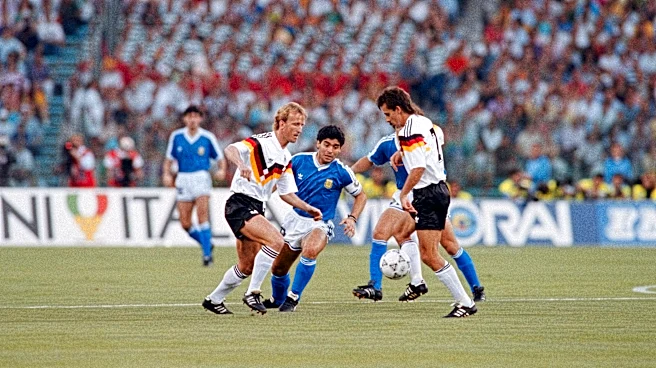
Matthäus, Vollër and Kohler led West Germany to its third World Cup title, while a battered Diego Maradona somehow carried Argentina all the way back to the final.
A gritty, contrasting World Cup that helped shape modern football.
The decades keep passing, and yet the story often feels familiar. Phoenix is still a young franchise by NBA standards, but it continues to make a strong impression. The championship still isn’t there, but the level certainly is. The cycles come and go, and each rebuild is carefully managed, allowing the team to remain competitive year after year. The future looks bright… Or does it? We’ll find out in Episode 3