




It has been eight weeks.
Eight weeks of typing, deleting, retyping. Eight weeks of scrolling through game logs late at night and rewatching innings I already know the outcome of, hoping they’ll look different the second time around.
Eight weeks since I started writing this column.
There have been highs and lows, all culminating in frustration. I’ve seen what this team can do, and I’ve seen what individual players can do. Why am I still questioning its ability to win?
Truthfully, I don’t know what the
rest of the year looks like for the Wildcats. When they reach the Big Ten Tournament, they’re staring down teams like Oregon, Nebraska, Washington and UCLA. A postseason berth is out of reach unless they face that gauntlet head-on or go 13-2 in the next 15 games.
I might be getting ahead of myself, but it’s worth considering at this point in the season. What’s happening now still translates later, and, frankly, it’s always linked together.
Letting the wheels fall off
This team can never close a game out.
The contest on Sunday may have heightened my emotions, sure, but trust me when I say it’s not new. Northwestern, as it stands now, gives me no reason to believe it can shut the door and hang up the welcome mat.
Across the dozens of innings in which the Wildcats have held a lead this season, they’ve allowed 61 runs. They consistently let teams hang around, and sometimes that comes back to bite them.
In 19 games where the purple and white have started with runs on the board, they have lost six of them while allowing 41 runs in the overtaking process.
In the rest of those 13 games, 20 runs have been scored while the ’Cats maintain their lead.
This is a combination of many interconnected things, so I can’t point to just one problem. Pitchers aren’t dealing how they should, the infield is failing to make plays and sometimes there are just good hits. More often, I find it’s the first two.
There have been six games in a row with at least one error, and five runs scored directly from those plays, with three more tacked on if you count the home run in game three that could have been prevented if the error was a clean play for three outs.
NU is up to 53 errors on the season, six away from its grand total from last year. There have been eight games with no errors thus far; every other has up to five. Unfortunately, this shows a pattern of mistakes rather than an occasional bad game.
When you combine this with inconsistent pitching that cannot overpower hitters, it becomes hard to close games as innings fall apart. Extra outs turn into runs, and games slip away.
Who’s on deck?
Something needs to be done about the pitching situation.
You have Marina Mason, yes, and when she’s locked in, she’s everything Northwestern needs. With a 3.03 K/BB ratio topped off with 97 strikeouts, she hits spots and forces balls to the ground. This weekend, she threw her third complete-game shutout and already has a no-hitter to her name.
Mason is only a first-year, and her potential is undeniable, but it is unfair to rely on her for every game, every batter and every win. So, when she needs a break, who will get the job done? When she falters, who do the Wildcats have then?
So far, there haven’t been good answers to these questions.
As a case study, I’ll present three games to you.
In game two of the Oregon series, Emma Blea gave up two earned runs in three innings. Signe Dohse came in to finish the game and gave up a run of her own, though unearned, and Riley Grudzielanek was able to close out the seventh, but not before allowing a lone hit. Northwestern lost the game 4-0.
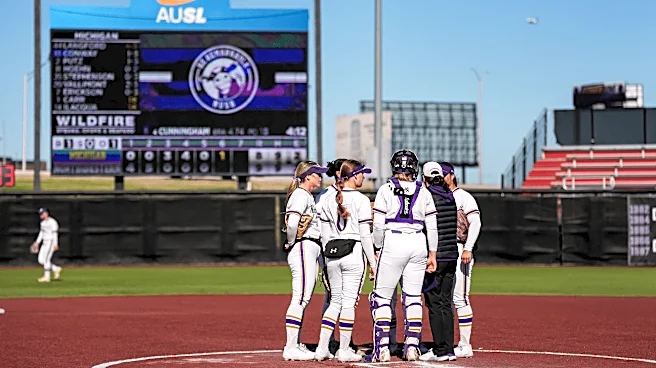
A week later, in game two of the Michigan series, Grudzilanek started the game by giving three earned runs and four hits in 1.1 innings. Shortly after, Blea went in for damage control and gave up six earned runs in the four innings following her teammates’ start. Northwestern lost this game 9-5.
Game three saw Mason falter, and although Cunningham controlled it for a bit, a double and a triple brought another run in from the Wolverines offense. After Mason reentered and then got replaced yet again, this time by Dohse, the redshirt-sophomore surrendered three RBI.
This case study highlights the lack of depth behind Mason and the uphill battle the team faces when she’s not at her best.
Further to my point, below are the season comparisons across the five pitchers in terms of earned run average (ERA), extra-base hits allowed (EBH%) and extra-base hits allowed per seven innings pitched (EBH/7).

As you can see, Mason leads in all categories but extra base hits allowed, which is why I calculated EBH/7 for some perspective. The first-year has double the innings of anyone else, so she’ll naturally have some more to her name.
Can the power of Mason’s pitch also be worked on and limited? Totally, yes, and I’m not claiming her as perfect. Rather, she’s the closest thing the team has to control. This makes it harder to pull her even when she’s struggling, because maybe she’ll just find a way out of it. Why would you risk putting in someone else?
When you don’t trust your next option, you start asking too much of your first one. Unless the Northwestern pitchers find their groove, the team will continue surviving the long innings and then flipping to find magic in the box offensively.
Which, so far, isn’t working either.
Pressure makes diamonds — or it makes outs
To make this point, I will establish one fact: this weekend, when Northwestern’s leadoff got on base, it scored 61.43% of the time. Only once did the ’Cats put runs on the board without the leadoff batter getting on, and surprisingly, that was with two outs in game three.
In a perfect world, NU would have its first batter reach base every inning, but this is simply not a reality. This weekend, leadoff batters were out in play 40% of the time, struck out 20% of the time, got a hit 15% of the time, and got some form of a walk 25% of the time.
This is an overall 60/40 ratio of outs to baserunners. This is unfortunate. Not only is the leadoff option unreliable at the moment, but consistent leadoff production is also unrealistic over the long term. So now, effective offenses must generate runs in less favorable situations
Michigan had four two-out rallies that culminated in nine runs this weekend. The ’Cats had one such rally, albeit a productive one that yielded five runs. The difference this weekend wasn’t necessarily the volume of hits, but the timing and execution of them.
With two outs, hitters recorded hits 24% of the time and walks another 24%, but nearly half of plate appearances (48%) still resulted in outs in play. While the low strikeout rate (4%) suggests balls are being put in play, they are not translating into sustained pressure or run production.
Sunday’s game provided a clear picture. Despite holding a significant lead, the Wildcats failed to score across five consecutive innings, managing only five baserunners and three hits in that span. The inability to extend innings or manufacture insurance runs allowed momentum to dissipate.
At this point, the trend is difficult to dismiss as variance. Northwestern’s offense is overly dependent on ideal conditions, and it consistently underperforms in the very situations that define resilient, high-level teams.
The future
There are four more conference series with three individual opponents scheduled between them, including Northwestern’s next game against DePaul on Wednesday. At this point, each game is a must-win.
It is frustrating to come here every week and feel like the same story is being told in slightly different ways. The numbers and opponent changes, but missed opportunities stay the same.
Maybe I’m overreacting, and in five weeks I’ll breathe a sigh of relief. Softball does have a way of evening itself out because, after all, it is largely a game of chance.
But for now, I stay tense and a little baffled, still searching for the right way to describe a team that feels both capable and incomplete at the same time. Because when people ask me how good Northwestern is this year, there isn’t a clear answer.
There is only this: They’re good enough to build a 9-0 lead. And inconsistent enough to lose it.