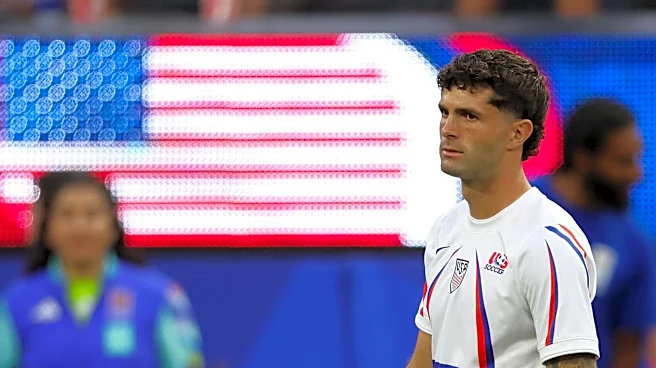






As the men’s European soccer season lurches forward, Americans overseas have their sights set on continuing with momentum from last season, getting a new start, taking a step forward, and other worthy motivational factors. While many are set to take the field, the most prominent USMNT star is focused on recovering from injury. Christian Pulisic is coming off of a World Cup showing marked by disappointment and a struggle to find the form that bestowed the Captain America honorific upon him.
Going into
the World Cup at 27 years old, Pulisic was in his prime and the story being told leading up to the tournament was one of hype, expectation, and being a hero. There was good reason for it, Pulisic has played at the highest level of any American male soccer player in history. Chelsea would not have won the Champions League without him in 2021, his “man in the mirror” goal against Mexico in a dos-a-cero 2021 World Cup qualifier is burned into the history of one of the great rivalries in the sport, and his play in the 2022 World Cup saw him provide two assists and score the goal against Iran that put the USA through in the group. When he struggled with Chelsea he moved to AC Milan and settled into the groove of being a key player in a Serie A contender.
For a decade Pulisic has been the player that USMNT fans have been waiting for. A young phenom breaking through on a hot team with an innovative manager playing fun, attacking soccer. He stepped forward during a time when a player like him was most needed. The promise for a better future of the Jurgen Klinsmann era was being held back by players that simply were not able to make that vision a reality. Bruce Arena tried to recapture the magic of a team that nobody expected and nearly made a World Cup semi-final but in his return, he failed to do that in the worst way imaginable.
In stepped Pulisic who became not only the model for young USMNT players who followed, he also became the hero destined to put American men’s soccer on par or above the rest of the world – where it belonged. Up until Pulisic, American soccer relied less on technical acumen and more on work ethic, athleticism, and winning when the team had no business competing. There were moments where the USA played spoiler, yet it was clear that American soccer would need to build the system to catch up.
The best teams in the world had built the sport into one that was the most successful and most beautiful when played as a collective. The Netherlands had Total Football where players shifted positions across the field and completely reimagined how a group could play as one. Brazil’s jogo bonito blended with the Corinthians Democracy ethos to create a national identity and quiet rebellion on the field in the 1982 World Cup. Gegenpressing and Tiki-Taka required all eleven players sharing a brain to move across the pitch to make the simple look easy. The USMNT was clearly a long way from implementing the culture and systems that brought those styles into being, but if one player stepped up, surely all of that would fall into place.
At least, that’s a very intoxicating story to tell a nation of individuals trying to overcome decades of refined tactical evolution in a sport where one player cannot succeed without the collective. Pulisic looked like the hero to do that, he answered the questions that the USMNT, fans, and the media needed to be answered: Could the USA produce top players? Can the USMNT compete against the top teams in the world and look like they belong doing it? Has American soccer arrived?
Captain America responded to all of those questions with a yes. Before ever playing in a World Cup, CP10 was deemed the player that the nation had been waiting for. A decade after starting his career, this hero stepped onto the biggest stage in the world and struggled with injury, struggled with form, struggled with bad games, confidence, and expectations. When he was needed most he fell painfully short. That doesn’t fit the bill of a hero, certainly not the American hero who was going to prove to the world that America was exceptional in soccer also.
It feels good to hear a simple story of glory and heroism, one man saves the day is simple, short, and satisfyingly uncomplicated. A story like: “A face, a fleet, a war, a man, a thought, a trick—a trick to break the walls of Troy and burn it screaming to the ground” gives needed reassurance that good beats evil. Behind that is a story that needs three hours to unspool the messy truth that flawed humans stuck in systems they can’t escape fighting inconceivable enemies are doing their best while blundering, proving loyalty with betrayal, inflicting pain on comrades, and might really be the monsters they fear in the darkness. Pulisic might not feature in a myth of good vs. evil, but the complexity of his story and feats he’s accomplished are no less captivating.
In the aftermath of the World Cup, the Captain America myth is faltering in the cold light of day. Pulisic isn’t some hero who was going to fix the ultimate collective sport as an individual and beat the world. That sounds tragic, but that fall is met with a bright reality. Christian Pulisic will step forward into the next chapter of his career without an alter ego that said he needed to be everything – everything other than the best male soccer player to wear the Stars and Stripes.