
NBA history spans 80 seasons, and as CelticsBlog readers well know, the Boston Celtics have won a league-high 18 championships. This month, we are recapping each of those title years.
“Boston is dead! Boston is dead !”
The winning streak ended in 1967. The eight-peat would not be extended. It seemed like the Philadelphia 76ers had emphatically ended the Boston dynasty – but in 1968 the Celtics would have something to say about that.
Red Auerbach had retired from coaching after the 1966 championship
and was succeeded by Bill Russell, who took on the role of player-coach. That dual responsibility is unheard of today, but it wasn’t uncommon in the first three decades of the NBA. The league has seen 40 player-coaches, the last one being – fun fact – the Celtics’ Dave Cowens, who had a 27-41 record after coach Satch Sanders was fired a month into the 1978-79 season.
During 1966-67, Boston and Philly were two giants at the top. The Celtics posted a 60-21 record, which in most years would lead the league, but the 76ers set a league record at 68-13.
Boston beat New York 3-1 in the first-round best-of-five series, then faced Philly, which had surrounded Wilt Chamberlain with the best supporting cast of his career. The Celtics had won the season series, 5-4, but the inspired Sixers took a 3-0 lead in their playoff matchup. Celtics pride delivered a Game 4 win, but Game 5 in Philly let loose emotions that had been building for a decade. The Sixers ran wild, 140-116, and the crowd chanted “Boston is dead!”
John Havlicek’s response: “We’re only dead until October.”
The 1967-68 regular season
Coaching presented a learning curve for Bill Russell, especially as he had no assistant coach (no team did at that time). Fortunately, his roster was filled with veteran players who could help out while Russell was on the court (which he was for roughly 40 minutes per game). Besides all that, Russell was trying to fill the shoes of the most successful coach in basketball, and perhaps all of sports.
Now with one season under his belt, Russell looked to start winning again in 1967-68. There had been some roster changes.
- Russell’s longtime teammate, K.C. Jones, had retired – one of the few Celtics to do so without a ring. But K.C. did have the distinction of being the first player to win as many as eight titles without a loss (Havlicek and Sanders would eventually match that 8-0 mark).
- A still-new Celtic was Bailey Howell, a seven-year veteran acquired the year before for seven-footer Mel Counts. Howell was a 6-foot-7 forward who’d played with Detroit and Baltimore (now the Washington Wizards), a six-time All-Star, strong rebounder and dependable scorer who rarely missed a game. This turned out to be one of Auerbach’s best-ever deals.
- Another new man was Wayne “The Wall” Embry, also called “Wide Wayne” by radio announcer Johnny Most. Embry was a five-time All-Star in Cincinnati who could set a mean pick and was perfect for the backup center role. A third-round pick was all the Celtics gave up in the deal.
The roster was a good mix of young veterans and older guys. They started the season winning nine of their first 10 and finished 54-28 for second place in the East, eight games behind the Sixers.
Eastern playoffs
This was all that mattered this season: the chance to prove they weren’t done. Boston took on the Detroit Pistons in round one and managed to lose Game 3 at home, falling behind 2-1. Detroit was led by Dave Bing, who’d been Rookie of the Year in 1967, and now was the league scoring leader.
Coach Russell adjusted by moving John Havlicek from sixth man to the starting five, which helped Boston close out the series with three straight wins. Hondo scored 35 in Game 4 on the road, and the Celtics blew the game open with an 80-50 second-half margin. Bailey Howell had 30 points in Game 5 and Havlicek 31 in Game 6 to wrap it up.
Now for the Sixers, who were without injured starting forward Billy Cunningham. Game 1 was played the night after the assassination of Dr. Martin Luther King. The teams were offered the opportunity to delay the series for a period of mourning. They decided to play the first game, then pause for five days. Understandably, their minds and hearts weren’t totally involved in Game 1, but Havlicek had 35 and Sam Jones 28 as Boston made a nine-point halftime lead stand up, 127-118.
Philly regrouped and won the next three games, two of them in Boston. Veteran guard Hal Greer led all scorers with 31 and 28 points in Games 3 and 4, respectively. The situation stoked fears that the Celtics were headed for a repeat of last year. Moreover, no NBA team had come back from a 3-1 deficit.

The Game 5 crowd at Philadelphia was ready to bury Boston again, but Sam Jones wasn’t giving up. His vintage 37-point performance kept the Celts alive, 122-104. Havlicek joined him with a near triple-double, 29/9/10. Boston pulled away in the second half after trailing by one at halftime. In Game 6, Greer was on fire with 40 points, but his teammate Chamberlain was not, shooting 6 of 21 from the field and 8 of 22 at the line. Havlicek, Howell and Jones combined for 70 points in Boston’s 114-106 win, and the series was 3-3.
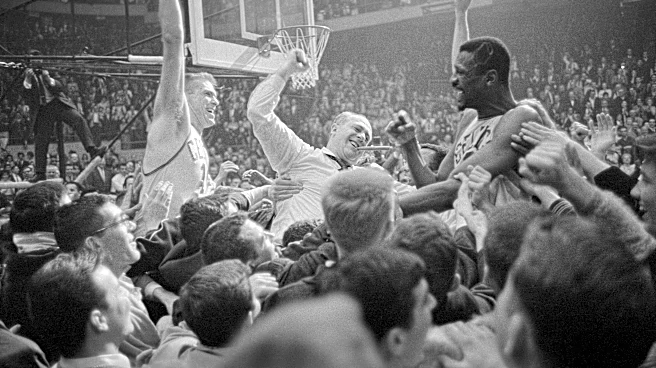
Game 7 in Philly was close much of the way, with Boston protecting a small lead into the fourth quarter. Guard Wally Jones rallied the Sixers to within four, and later big forward Luke Jackson scored to put them ahead by two with eight minutes left. Havlicek led the Celtics on a 14-7 run over the next five minutes, restoring their lead at 93-88. The Sixers fought back to within three, but in the final seconds Russell blocked forward Chet Walker’s layup. Boston had pulled off the upset, 100-96, and the first-ever comeback from down 3-1.
Boston shot 47.6% from the floor in Game 7 while holding the Sixers to 35.2%. Jones led the Celtics with 22 points while Russell posted 12 points, 26 boards, 5 assists and, according to the Boston Globe game report, unofficially 10 blocks.
Russell said it was the most satisfying victory of his career. Satch Sanders revealed that the pick-and-roll play was the catalyst for the comeback from 3-1.
“We kept running it over and over, again and again…. and Philadelphia just couldn’t deal with it…It forced Wilt into a switching situation and he sort of refused. And when he did switch, he had problems with Sam or Havlicek.”
Chamberlain’s stats were mystifying: 14 points, 4 of 9 field goals, 6 of 15 free throws. He attempted just two shots in the second half. After averaging 24 points in the regular season, that lack of aggression plus missing nine free throws in a four-point loss just didn’t cut it.
In the end, the Celtics were the opposite of dead. They had risen and were heading back to the NBA Finals to meet the Los Angeles Lakers for the sixth time.
NBA Finals
The Celtics were worn down after the Sixers series, and the Lakers were rested, not having the drama in the West that the Cs had in the East. There was a risk of letdown for Boston, as well. Nevertheless, Boston won Game 1 on the parquet, 107-101. The Celtics had a 59-40 second half after trailing at halftime. Then the Lakers, as they always seemed to do in the Finals, regrouped and won Game 2. But the Celtics, as was their habit, won Game 3 in LA and went home tied 2-2.
Turning point
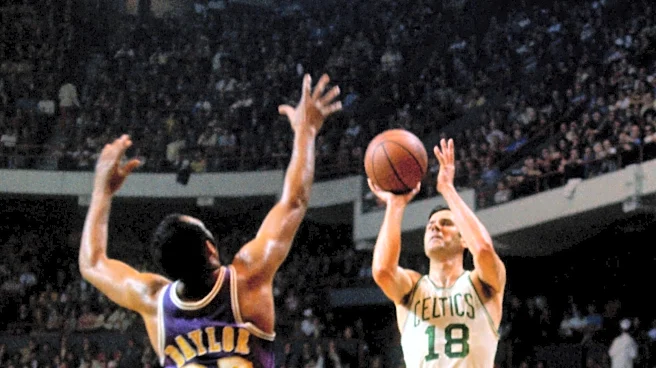
Most of the pivotal Game 5 looked good for the Celtics, who compiled a 30-18 margin in the third quarter and led by 14 with one quarter to go. However, LA rallied to tie, forcing overtime. With 56 seconds left in the OT, Havlicek hit a corner jumper for a two-point lead. Next, Elgin Baylor drove to the rim looking for the tying hoop and got a good look over Don Nelson, but Russell brought the help defense and swatted the shot away.
A Nelson free throw pushed the lead to three. LA was unable to score again and Boston had a 3-2 series lead.
It wasn’t over until…
The Celtics were determined to avoid a Game 7. They made that clear by winning the Game 6 first half, 70-50. The Lakers had no answer.
The heroes we needed
- Havlicek was now a full-fledged All-NBA star. He scored a massive 40 points in the closeout Game 6 and for the series led Boston in scoring (27.3) and assists (6.7) per game.
- Bailey Howell scored 30 in Game 6. He averaged 21.0 points during the series, second behind Havlicek.
- Don Nelson was the hero of Game 5, scoring 26 on 11 of 20 shooting with 12 rebounds and four assists in 43 minutes.
Notable facts and stats
- Russell became the first black coach to win a championship.
- Boston closed out all three series on the road.
- Reserve guard Tom Thacker won a ring this season with Boston. He already had won an NCAA title with the University of Cincinnati, and when he was on the 1968 ABA champion Indiana Pacers, he became he answer to a trivia question.
- Howell was acquired in a straight-up trade for Mel Counts, who was now the Lakers’ center.
- Nelson was signed by Boston after the Lakers had cut him three years before.
In summary
The Boston Celtics dynasty was revived and flourishing, with 10 banners. Bill Russell got the player-coach job done on both fronts, including playing and winning a Game 7 on the road for the first time. Celtics pride helped them persevere and win against enormous odds. And the Sixers, who a year ago some were calling the greatest team ever, learned how difficult it was to repeat.
Banner Years continues Monday with a review of the 1968-69 season and the road to winning Banner 11.