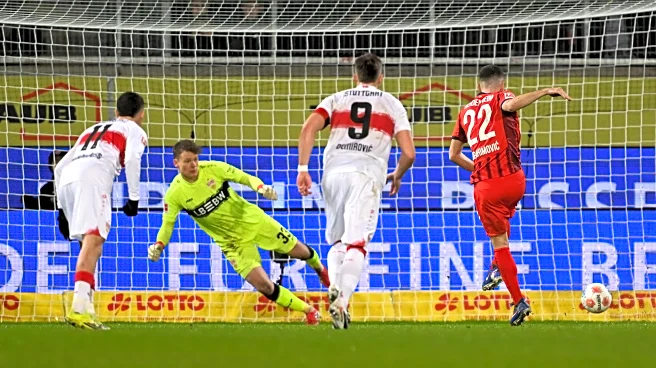


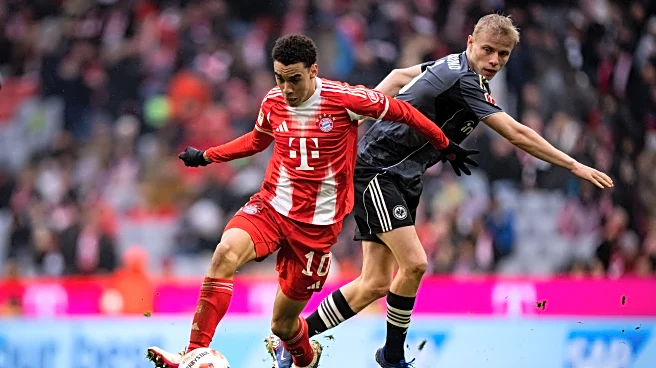

When it comes to statistics, Ray Hudson’s legendary Lionel Messi commentary comes to mind: “It’s not about the statistics,” he cries. However, this season, the statistics paint a different picture—a picture that is hard to ignore. A picture of domestic and European dominance that has been near to unbeatable. A picture of ruthless, record-breaking attack. The picture is Bayern Munich, and Vincent Kompany is the artist behind it all.
While Bayern’s defense hasn’t been bad, it’s their attack in particular
that has been drawing the attention of the footballing world. Die Rekordmeister are currently on track to break the 54-year-old Bundesliga record of 101 goals in a single season. In fact, at this rate, Vincent Kompany’s Bayern side are on track to demolish the record having already scored 85 goals after just 23 games. Scary numbers.
To get a better understanding of how Bayern’s scoring prowess compares to Europe’s top performing sides, Flashscore.com created a graphic comparing the highest league goal difference across Europe’s top five leagues.
Bayern have a 22 goal gap to Barcelona, their nearest competition, and have almost doubled the likes of Real Madrid and PSG’s goal difference. Although, comparing goal difference across leagues is not a fair reflection of a team’s performance on the pitch. Why? Firstly, most teams across Europe have played a different amount of games. A team who has played more games, would be more likely to score more goals, skewing the goal difference slightly. Secondly, goal difference doesn’t take into account fluke goals. Some teams get lucky and score a number of goals that, in all likelihood, should have been kept out—again, skewing the goal difference. Thirdly, in a similar vein to fluke goals, it doesn’t factor in defensive luck or over performance. A team’s goalkeeper could be having the season of their life, keeping out a number of goals that would have been scored on any other day. Or perhaps, a defense lucks out due to poor finishing. In both scenarios, goal difference can be skewed as more goals should have been scored. Therefore, goal difference alone isn’t enough to say with certainty how well a team is performing. The number of games, lucky goals and poor finishing can all taint how a side’s performance is perceived on paper and on the field. So then what is a better metric to use, and does Bayern still come out on top?
To measure a team’s performance, Expected Goal Difference per 90 minutes (xGD/90) is a much more accurate metric. One obtains xGD by subtracting a team’s Expected Goals Against per 90 minutes (xGA/90) from Expected Goals per 90 minutes (xG/90). The reason xG and xGA paint a more accurate picture is simple: it measures the quality of chances teams create and concede based on factors like distance, angle, body part, defensive pressure and even the type of pass received, that ultimately measure the probability of an attempt resulting in a goal. A 35 yard shot that takes a deflection into the back of the net counts the same as an open goal tap-in using goal difference. xG distinguishes between the luck and likelihood, then assigns a value between zero and one to determine how probable the goal was.
So now that we’ve established a metric that is a more accurate reflection of a team’s performance, does Bayern still come out on top?
Here are the xGD/90 results for the same teams:
- Bayern = 2.01
- Inter Milan = 1.67
- Barcelona = 1.52
- Arsenal = 1.25
- PSG = 1.24
- Real Madrid = 1.21
Using the updated metrics, removing flukes, fluff, and fumbles, Bayern are still a country mile ahead—confirmation of just how dominant they have been, not just in the Bundesliga, but across Europe’s top five leagues.
At the end of the day, maybe Ray Hudson is still right. Maybe it’s not about the statistics. After all, football isn’t played on a piece of paper with a scientific calculator and a pencil. It’s played on a football pitch where the immeasurable and intangible often produce the only metric that matters: the numbers on the scoreboard come the end of the 90 minutes.