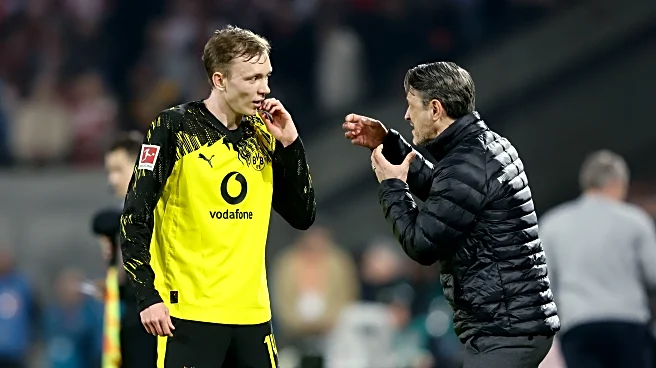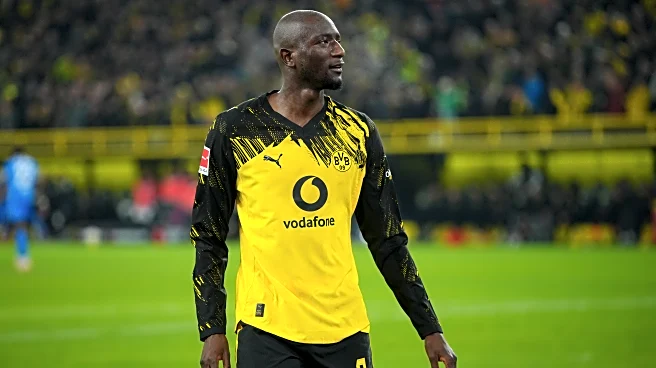


Serhou Guirassy is without a doubt one of the most talented attackers in European football at the moment. In his first season with Borussia Dortmund, Guirassy scored 21 goals in the Bundesliga and was joint top scorer in the Champions League, tied with Barcelona winger Raphinha on 13 goals. Despite BVB’s underperformance last season, the Guinean striker was a beacon of hope. Niko Kovač even called Guirassy Dortmund’s “life insurance”.
Last summer, rumors began circulating that massive clubs like Barcelona,
Paris Saint-Germain and Manchester United were interested in Dortmund’s star striker. Despite the interest from abroad, Guirassy stayed in Dortmund for the 2025/26 season, and he continued his hot form to kick off the season. Then, he hit a 45 day goal drought. Even after breaking the drought, Guirassy’s goalscoring remained sporadic.
It took until Matchday 20 for Guirassy to return to his old ways, netting a brace against Heidenheim, one from the penalty spot. Since then, he hasn’t looked back. The question still remains though: what caused this dip in form, and is Guirassy really back to his best?
Debut Season Success
Before we can look at what went wrong this season, we need to take a look at last season to find out why the Guinean center-forward is so lethal in front of goal. At 187cm (6’1), Guirassy is a dangerous aerial threat, but he is also a highly efficient shooter and poacher in the box. Last season, Serhou took 3.11 shots per 90 for 0.68 non-penalty expected goals per 90 (npxG/90). On average, he scored 0.73 goals every game. A closer inspection of the Guinean’s shot map last season shows how prolific he was in and around the penalty box. Guirassy’s fingerprints were all over the final few touches of almost every goal Dortmund scored last season.
Guirassy was surrounded by creators like Pascal Groß, Julian Brandt and Jamie Gittens who loved to link up in tight spaces with the center-forward and provide pinpoint accurate crosses. The short pass attack form complimented Guirassy’s strengths well, allowing him to get involved in build up play, move around defenders, then get into dangerous areas to finish chances. He didn’t have to rely on bursts of pace like Karim Adeyemi or intricate dribbling like Gittens, instead using his positional and scoring instinct. Serhou’s real superpower is constantly being in the right place at the right time and being able to score in almost any situation inside the box. This combination of spatial awareness and inventive finishes makes Guirassy a world class poacher, and it helped him score 34 goals in the Bundesliga last season.
Sophomore Strife
The club was keen to build on the attack and put last season’s struggles behind them, bringing in midfield reinforcements in Carney Chukwuemeka and Jobe Bellingham. The club also signed Portuguese forward Fabio Silva, who sporting director Sebastian Kehl stated would add versatility and flexibility to the attack. Silva’s limited minutes early in the season suggested Kovač saw him as a backup to Guirassy but the signing nonetheless added pressure to the starting striker role.
Guirassy didn’t seem phased by this, though, as he was the joint top scorer at the Club World Cup and started the 2025/26 season scoring five goals in just four games. He was seemingly on track to surpass Dortmund’s record for longest consecutive scoring streak across all competitions which was held by Aubameyang at eight consecutive games.
The first cracks in Guirassy’s output would appear in Dortmund’s first Champions League game against Juventus. While Guirassy was hunting for his record-tying goal, he won his team a crucial penalty in the 74th minute. However, despite having won the spot kick, Niko Kovač elected for Algerian defender Ramy Bensebaini to take the penalty. Guirassy was visibly upset with this decision, guarding the ball and arguing with his teammates until eventually relenting. Guirassy would go on to be scoreless, ending his streak. This game marked the first signs of distress in Guirassy’s season, and in the following game against Mainz on September 27th, he suffered a thigh injury during the warmup which forced him to miss the match and even saw him rested by his national team during the international break in early October.
Suffice it to say, since Turin, bad luck followed Guirassy. He reversed his earlier seven game goal streak by going the next seven games goalless, with only a thigh injury to show for it.

In the 25 games that followed the Juventus clash, Guirassy scored just five goals. Fabio Silva started to put in more impressive performances, leading to him being brought on more consistently for the Guinean, and the goalscoring duties were more evenly distributed between players like Maximilian Beier, Karim Adeyemi, and Felix Nmecha.
Under Kovač’s management, this makes sense. Nuri Şahin emphasized attacking down the middle of the field, while using wingers as secondary options to recycle the ball in his 4-2-3-1. Guirassy thrived in this role as he would be provided with a steady stream of chances from a variety of outlets. Even after Kovač took charge in early February last season, he would still regularly use Şahin’s 4-2-3-1.
However in Kovač’s preferred 3-4-2-1, different positions are responsible to creating the attack. As Kovač is primarily a defense-first coach, using the flanks to progress the ball upfield creates an extra layer of safety in cases of lost possession, compared to losing the ball in central positions. Dortmund’s new tactics encourage the wingbacks to progress the ball into the attacking third, while central midfielders recycle the ball and provide opportunistic runs around the edge of the box. With the three center-halves providing defensive solidity and being key distributors of the ball in possession, Dortmund look to create chances through wingbacks cutting the ball into (attacking) midfielders and set pieces. With Kovač providing an additional two attacking midfielders alongside Guirassy, the striker is now more insulated in the box and given less freedom to operate. Knowing Guirassy has an elite positional awareness, further saturating the box with black and yellow jerseys directly impacts Guirassy’s ability to find dangerous areas and passing lanes.
Resurrecting a Star
On January 24th, Die Schwarzgelben faced off against Union Berlin at home. With Bayern having lost to Augsburg on the same matchday, pressure was on Dortmund to close the gap with the league leaders. Kovač decided to experiment with the starting 11, using Silva as an attacking midfielder, rather than as a Guirassy replacement; the first time the two had started together. This was not an impetuous decision on Kovač’s part. Silva’s strong work ethic on both sides of the ball allowed Guirassy to stay higher up the field in his preferred areas. This was a change for Guirassy. During his goal drought, he could be seen dropping deep into the midfield to get involved in plays. This Silva-Guirassy connection was what directly led to BVB’s first goal. In transition, the two exchanged quick passes before Silva played the ball into space for Guirassy to run onto, winning a penalty in the process. Guirassy didn’t get on the scoresheet, but he had a positive impact on the game.
The next match saw a poor team performance against Inter, but Guirassy’s resurgence was confirmed against Heidenheim on Matchday 20. Dortmund’s striker lined up with Adeyemi and Brandt adjacent to him but this time with Couto as a wingback rather than Ryerson. This attack-minded change on the flanks forced one of the two central midfielders to stay deeper in attacks, giving Guirassy more territory in the center of the pitch. The center-forward would go on to bag a brace in a matter of seconds, only missing out on a hattrick due to a missed penalty. Beyond the goals, Guirassy finished the game with the most touches in the box compared to any other player and had a higher share of the ball compared to all other attacking players in the game.
The next five games saw Guirassy getting four goals with only one being a penalty kick. One explanation for this uptick in productivity could be the service the striker received. In Dortmund’s 4-0 win against Mainz, Julian Ryerson’s crossing was on fire. He tripled his season-average of two successful crosses, providing six. Three of Ryerson’s assists came off set pieces, including two to Guirassy.

This once again highlights that Guirassy needs an entourage to play to his strengths. Serhou has a clear advantage in the air, and Ryerson looking to cross the ball into the box is reminiscent of what Pascal Groß offered Dortmund’s star striker. Fabio Silva doing the grunt work allows Guirassy to stay in his preferred positions on the field, which enables the Guinean to receive the ball where he has the advantage. Guirassy needs creators like Brandt to create link up plays within the final third or wing players such as Ryerson looking to engage Guirassy in the air. This removes the responsibility of Guirassy having to be his own chance creator and scorer.
In Dortmund’s new system under Kovač, a lot of goalscoring comes from set plays, instead of Guirassy putting the final touches on most attacking sequences. To reactivate Guirassy, Dortmund needs to surround him with playmakers and workhorses that allow him to focus on what he’s best at. With Guirassy’s attacking instinct, it’s no doubt that his scoring prowess will come back.