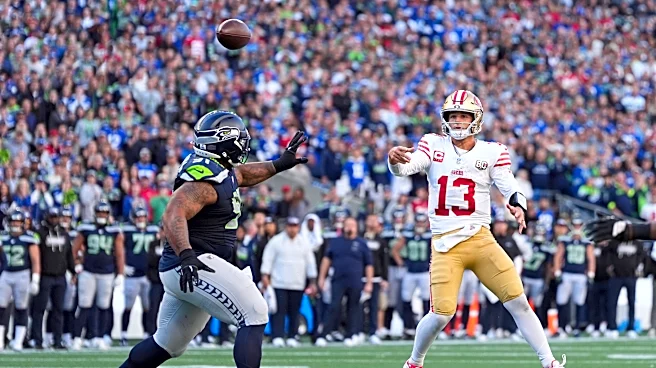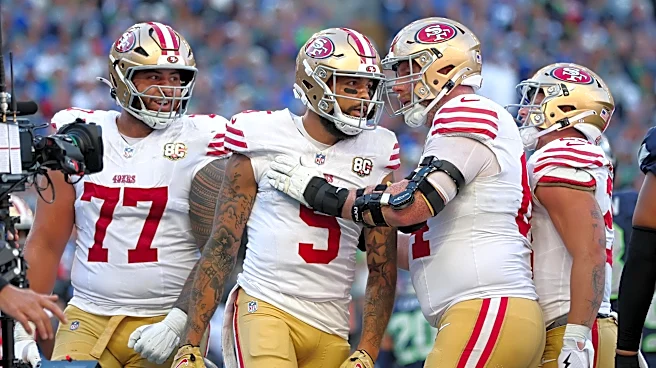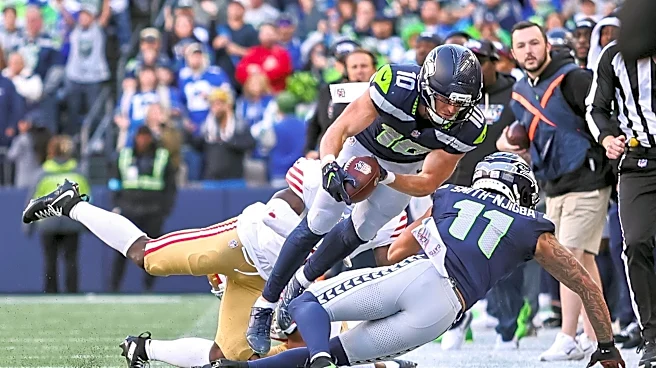



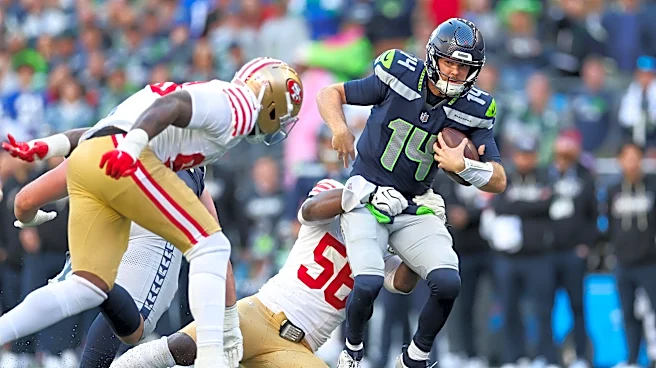

The Seahawks’ 32–29 loss to the San Francisco 49ers was painful precisely because Seattle did enough to make a victory feel possible. Despite committing four turnovers and repeatedly putting themselves in difficult situations, the Seahawks remained in the game until the final moments. There were stretches when the defense delivered, Jaxon Smith-Njigba continued to look like one of the NFL’s best receivers, and Seattle found ways to overcome its own mistakes. But every time the team appeared ready
to take control, another self-inflicted wound made the comeback more difficult.
The San Francisco 49ers turned Seattle’s four turnovers into 21 points, including a defensive touchdown just before halftime. That is the difference between competing with an undefeated divisional rival and actually beating one. The Seahawks showed enough talent to win this game, but their execution repeatedly failed them. The offensive line struggled to protect Sam Darnold and establish the running game, the quarterback made costly decisions, and the defense could not consistently contain San Francisco’s most dangerous offensive weapon when the game was on the line.
This was not a game in which Seattle was outclassed. It was a game the Seahawks repeatedly made harder for themselves. That makes the loss even more frustrating, particularly with the NFC West race already becoming more complicated.
The Good
Jaxon Smith-Njigba is incredible
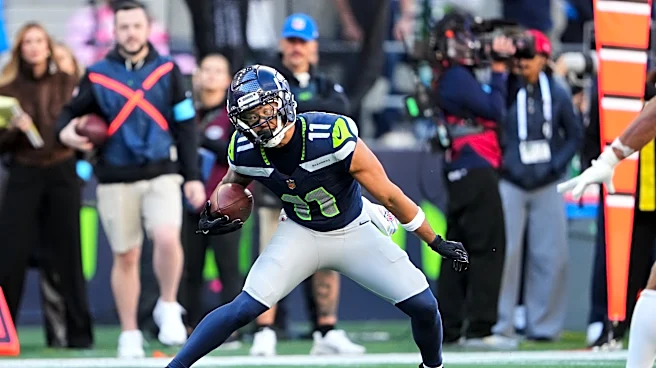
Jaxon Smith-Njigba continues to be the foundation of Seattle’s passing attack. Through five games, he has recorded 37 receptions for 583 yards and seven touchdowns, leading the league in receiving yards at this point in the season. Against San Francisco, he caught five passes for 102 yards and a touchdown, accounting for approximately 52% of the Seahawks’ 195 passing yards. His production is remarkable, but the larger concern is just how heavily Seattle has come to depend on him.
The play above shows the play in which JSN injured his ankle. Brian Fleury uses a two-tight-end package to isolate Smith-Njigba and Cooper Kupp against two defensive backs once Niners reacted loading the front. Kupp, one of the NFL’s best blocking receivers, only needs to establish the initial block to give JSN enough space to accelerate into his one-on-one matchup. Once Smith-Njigba hits that second gear, the defensive back has little chance of stopping him immediately, and the receiver generates substantial yards after the catch. The play also illustrates how Fleury can use personnel and alignment to create favorable matchups without needing a complicated route concept.
San Francisco prioritizes defending the first-down marker, leaving a significant amount of space between the second and third levels of the defense. JSN’s route holds the deep safety, who must respect the possibility of being beaten vertically. Smith-Njigba recognizes the open space, settles into the window, catches the ball and breaks multiple tackles to bring it toward midfield. It is a simple concept executed exceptionally well, with the receiver understanding exactly where the defense has conceded space.
What an incredible release. Deommodore Lenoir is still trying to find Smith-Njigba after the receiver defeats his initial attempt to establish contact. Lenoir cannot disrupt the release, leaving JSN with the leverage advantage. If Darnold had pulled the trigger sooner, the result could have been even more damaging for San Francisco. The separation is already there; the quarterback just needs to recognize it and deliver the football on time.
This is another example of Fleury finding ways to protect WR’s release. Kupp’s route occupies the coverage and helps to hide Smith-Njigba’s intentions, giving the receiver an opportunity to attack the defense. JSN gets another touchdown, this time after suffering the ankle injury, while also escaping Fred Warner and generating additional yards after the catch. It is an outstanding individual play and a reminder of how much Seattle’s offense can accomplish when its best players are put in positions to succeed.
The concern is not JSN’s production. It is the lack of comparable involvement from the rest of the receiving corps. Seattle cannot expect him to carry this much of the passing game indefinitely, particularly when opponents can increasingly build their coverage plans around taking away No. 11.
Byron Murphy II delivered a dominant performance
Byron Murphy II was arguably Seattle’s best defensive player against San Francisco. He finished with six tackles, two sacks and seven quarterback pressures, tying his career high in pressures for a single game. His two sacks were particularly significant because the 49ers had not allowed a sack through their first four games of the season. Murphy now has three sacks through five games in 2026, following a seven-sack campaign in 2025.
With Leonard Williams not at full strength, Seattle needed Murphy to take on a larger role against one of the league’s strongest rushing attacks. He responded with his most impactful performance of the season, consistently creating problems for the offensive line and making plays against both the run and the pass.
This was the first sack 49ers OL had surrendered all season. Murphy initially aligns in the A-gap, reading Christian McCaffrey and remaining prepared to make the tackle if the play develops as a run. Once he recognizes the pass, he attacks toward the outside gap before working back inside, keeping the offensive lineman off balance throughout the rep. The combination of patience, lateral quickness and relentless effort allows him to reach Purdy. Murphy does not win because of one move; he keeps working until the blocker runs out of answers.
The life of San Francisco’s No. 75 was not getting any easier. Murphy appears to combine a swipe and rip move, using his hands to clear the guard’s contact before bringing his arm through to escape the block. The guard cannot maintain leverage or recover in time, and Murphy gets another sack.
Murphy’s impact extended beyond the pass rush. This run stop forces San Francisco to settle for a field goal, leaving Seattle with a chance to tie the game or take the lead. Murphy’s first step is exceptionally quick laterally, preventing the left guard from establishing a solid block. He penetrates into the backfield and helps finish a crucial tackle for loss. In a game decided by a handful of plays, this was one of the defensive stops that kept Seattle alive.
This might have been Murphy’s most impressive play of the afternoon. He absorbs the double-team, delaying the blockers and preventing them from immediately reaching the second level. He then manages to account for both gaps as McCaffrey tries to find a running lane. When the back cuts inside, Murphy is there. When McCaffrey tries to bounce outside, Murphy is there again. That ability to withstand double-teams while maintaining gap integrity is exactly what Seattle needs from its interior defensive line.
The Bad
The offensive line remains a major problem
San Francisco entered the game without Nick Bosa, yet its defense still managed to sack Darnold five times. The 49ers generated pressure despite missing their premier edge rusher, and Seattle’s offensive line struggled to provide consistent protection. The problems were not limited to passing situations, either. The Seahawks also had difficulty creating movement in the running game, leaving their backs with too few clean opportunities to gain yards.
This is not a problem that can be pinned on one player. Nobody on the line has been consistently reliable across every assignment. Charles Cross remains the unit’s strongest performer, while Abe Lucas has struggled badly, including on multiple reps against San Francisco. The interior has also been inconsistent, and the lack of cohesion is becoming increasingly difficult to overlook.
Seattle’s luck is so bad that even a successful rep comes with a catch. Lucas executes an excellent run block here, helping create the space the offense needs, but he steps on the right guard’s foot before the play develops, sending his teammate to the ground. It is an unfortunate sequence that illustrates the lack of coordination across the line. Jokes aside, Seattle cannot afford these kinds of breakdowns, especially when the running game is already struggling to generate consistent production.
Lucas expects the edge defender to attack outside, and Beau Stephens appears to make the same assumption. When the right guard turns his attention toward the defensive tackle, the edge rusher attacks inside. Lucas has no answer for the move, while Stephens attempts to help but cannot prevent the pressure from developing. Darnold is forced to scramble for his life rather than operate from a clean pocket.
There are just too many execution errors. Lucas appears to expect first-contact help from Stephens, but that assistance never arrives. Lucas is beaten inside and ends up colliding with Grey Zabel, who is pulling across the formation from the opposite side. Rather than creating an advantage, the combination of missed assignments and poor spacing leaves multiple blockers in the wrong position. These are the kinds of breakdowns that make it difficult for an offense to establish any rhythm.
The offensive line is costing Seattle potential points. Darnold fakes the pass to Rashid Shaheed while JSN develops his route downfield. Smith-Njigba appears to have an opportunity for a significant gain, but Zabel allows the defender to penetrate too quickly. The pressure reaches Darnold before he can deliver the ball, resulting in another sack. The play is particularly frustrating because the route concept appears to be developing well. The protection does not hold up long enough for the quarterback to take advantage.
If the previous play cost Seattle a hypothetical scoring opportunity, this one resulted in a direct and devastating consequence. There is plenty of blame to go around: a questionable play call, poor execution from the running back and a failure by the offensive line to handle the defensive front. I do not believe kneeling the ball would necessarily have ended the half, given San Francisco’s remaining timeouts. The bigger issue is the decision to run wide zone in that situation rather than choosing a more conservative inside run.
Haynes fails to make the initial contact needed to slow the defensive lineman in a zone scheme and give Sundell time to arrive. The penetration disrupts the play before it can develop, and Holani fails to secure the football. San Francisco recovers the fumble and returns it for a defensive touchdown, turning a poor offensive sequence into one of the most damaging plays of the game.
Even when the blocking scheme is largely executed correctly, Seattle still finds a way to make a mistake. Lucas and Stephens sell their blocks on No. 55 before moving to the second level, setting up Grey Zabel’s trap block. The design works, and the initial execution creates an opportunity for a good gain. Unfortunately, Sundell is called for holding, wiping out one of the offense’s few successful rushing plays. It is another example of how penalties and execution errors continue to undermine otherwise promising concepts.
Another recurring problem since Week 1 is the offensive line’s inability to generate movement at the point of attack. Even when Seattle uses double-teams, the blockers often fail to displace defenders physically. That makes life unnecessarily difficult for the running backs, who are frequently asked to create something out of a play that has already broken down. No running back can consistently overcome a lack of space, poor leverage and defenders penetrating into the backfield. The problem has to be addressed at the line of scrimmage.
Sam Darnold is out of rhythm
Darnold’s performance against San Francisco was another reminder that Seattle’s quarterback situation remains a concern. He has thrown five interceptions this season and is 1–2 since returning in Week 3, with his only victory in that span coming against the winless Chargers. Against the 49ers, he completed 18 of 29 passes for 195 yards, one touchdown and two interceptions, while also taking five sacks.
The issues extend beyond the turnovers. Darnold has held the ball too long, failed to move efficiently through his progressions and made decisions that exposed the offense to unnecessary risk. According to ESPN Research, his average time to throw since returning in Week 3 is 3.25 seconds, the longest among 31 qualifying quarterbacks. His average last season was 2.86 seconds, which ranked 21st.
Darnold reiterated that he wants to get the ball out faster and be more decisive. That is the right diagnosis, but the correction needs to show up on the field. The offensive line deserves its share of the blame, but Darnold has also missed opportunities to get the ball out before the pressure arrives.
Darnold takes too long to transition between reads. It is difficult to understand why he becomes so fixated on Shaheed here. The receiver runs toward the safety with a bad route, and Darnold still decides that forcing the throw is a worthwhile option. Shaheed manages to prevent the play from becoming a disaster, but the quarterback overlooks better opportunities elsewhere. Horton and Kupp are open on the opposite side of the formation.
The questionable decisions continue. Darnold somehow escapes the initial pressure, something he managed to do on several occasions during the game. But escaping pressure is only useful if the quarterback makes a sound decision afterward. Look at where he throws the ball: AJ Barner is facing away from the quarterback and has to turn back toward the pass. The ball hangs in the air, creating an opportunity for a potential interception. Darnold should recognize that the play has broken down and throw the ball away rather than expose the offense to another turnover.
The first interception comes on Darnold’s opening pass of the game. The ball is thrown too far inside, giving the cornerback an easy opportunity to make the play. There is little margin for error on this throw, and Darnold places the ball in precisely the wrong spot. It is an awful start for an offense that desperately needed to avoid giving San Francisco short fields.
Darnold’s first pass of the second half is another example of a decision that comes too late. Following the motion, Arroyo gets matched up against a cornerback and breaks inside, gaining the leverage advantage. The throw should be available before the defender can recover. Instead, Darnold takes too long to make the decision, allowing the cornerback to close the window and cut off the passing lane. The opportunity is there, but the quarterback’s hesitation eliminates it.
This was one of the plays that could have decided the game. JSN runs an excellent route, leaving the cornerback trailing and creating the separation needed to make the catch. However, Smith-Njigba runs an out route while Darnold appears to anticipate a corner route. JSN attempts to adjust to the ball but cannot complete the reception, and the drop becomes extremely costly. On almost any other day, JSN probably makes this catch. That does not make the missed opportunity any less significant, but it should not overshadow how well he played for most of the afternoon.
On the decisive possession, Darnold makes another mistake. Kupp is available, but the quarterback hesitates and waits for the route to develop. The pressure arrives, forcing Darnold to move and buy additional time. By the time he finally releases the ball, Kupp has lost the space he needs to make a play. The opportunity has disappeared because the quarterback failed to anticipate when and where the throw needed to be made.
The defense still needs adjustments
Seattle’s defense had several strong moments, particularly from Murphy and the interior defensive line. However, the unit remains short of the standard it established last season. There are still issues that need to be addressed, especially against the run and when the defensive line cannot generate pressure from the edge.
The defense should not shoulder the same level of blame as the offense for this loss. Four turnovers and 21 points allowed directly off those mistakes are an enormous burden. Still, the final drive exposed some weaknesses that Seattle cannot afford to ignore as the schedule becomes more demanding.
One of the biggest concerns is the running game allowed by the defense. Seattle has surrendered 502 rushing yards through five games, an average of 100.4 per contest. That is a increase from the 91 yards per game the defense allowed last season.
The problem is particularly damaging when combined with the offense’s inability to sustain drives. Extended possessions and repeated short fields put additional pressure on the defense, and the final drive against San Francisco was a clear example. The 49ers gained 37 rushing yards on that possession, repeatedly moving the ball while Seattle struggled to maintain its gaps. Leonard Williams and Murphy were displaced in ways that were unusual for this defensive front, allowing San Francisco to keep the drive alive and ultimately take the lead. Seattle’s defense needs to be better at the point of attack, but the offense also has to stop putting it in difficult situations.
Seattle has also struggled to generate consistent pressure from its edge defenders. The interior rush was productive against San Francisco, with Murphy accounting for two of the Seahawks’ three sacks, but the outside rush did not consistently force Purdy to move off his spot. With the edge rotation lacking its usual impact, the quarterback had opportunities to remain comfortable in the pocket and find his receivers.
This becomes especially problematic in a critical situation. The pressure does not arrive in time, and Purdy can access Mike Evans without being forced into a difficult throw. Seattle cannot rely on its interior defenders to carry the entire pass rush. The edge group needs to win more consistently, particularly on obvious passing downs and late in games when the defense has to prevent an opponent from sustaining a drive.
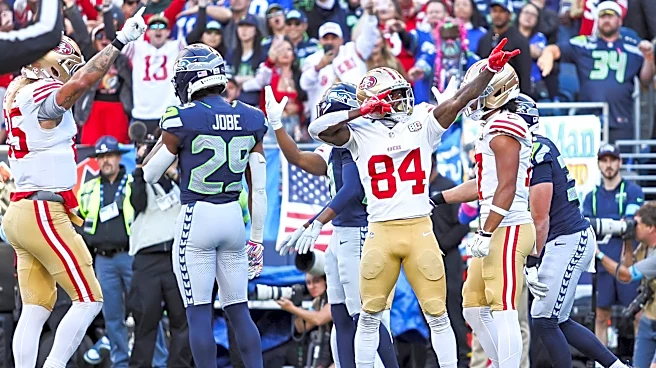
Speaking of Evans, his matchup against Josh Jobe was a problem from the beginning. Evans finished with seven receptions for 113 yards and a touchdown, repeatedly taking advantage of the physical and technical mismatch. Given the difference in size and playing style, it was predictable that San Francisco would look to isolate Evans against Jobe. The question was how Seattle would respond once that matchup became a clear advantage for the offense.
Mike Macdonald did not find a consistent adjustment. On this play, Seattle shows two safeties deep, but Julian Love is operating with a poach responsibility, reading the trips side of the formation. That means Love cannot abandon his assignment to help Jobe without compromising the coverage rules elsewhere. Jobe is still left in man coverage against Evans, and he loses at the release without being able to recover.
The issue persisted throughout the game. Evans won with speed, strength, route technique and positioning. He was able to create separation on short routes and attack downfield, leaving Jobe without a reliable answer. The defensive staff needed to find a way to change the picture, whether through more deliberate safety help, different leverage or a coverage adjustment that prevented San Francisco from repeatedly exploiting the same matchup. Instead, the 49ers continued to go back to a favorable situation.
Brian Fleury needs to improve
Fleury deserves credit for some of the creative concepts that have helped Seattle’s offense function this season. However, the game against San Francisco exposed significant limitations in the play-calling, particularly in the running game, on third down and in the distribution of targets.
Seattle’s scoring drives were helped by short fields following turnovers, while the offense struggled to sustain long possessions. The team also remains too dependent on JSN in the passing game. Horton did not receive a target and played a limited role, Shaheed caught only two passes, and Arroyo had just his second target of the season. There are too many weapons being left out of the offense for Seattle to remain this predictable.
Fleury needs to find ways to involve the other receivers without sacrificing Smith-Njigba’s production. That does not mean forcing the ball to every player to distribute targets evenly. It means creating concepts that make the defense defend the entire formation, giving Darnold clear reads and making it harder for opponents to focus on a single receiver.
The running game remains anemic, and Fleury has not found enough ways to help it. That affects more than the rushing production itself. Seattle’s inability to establish the run also limits the effectiveness of play-action, a fundamental component of the offense. On this play, the edge defender never appears concerned about the possibility of a handoff and immediately attacks the quarterback. Darnold is still able to find a good passing opportunity, but the defensive reaction illustrates the problem: Seattle has not given opponents enough reason to respect the run.
Late in the game, with the running game still failing to threaten the defense, Fleury calls a fake counter that is poorly executed. Sundell and Saubert pull across the formation, but Wilson never appears to check the A-gap. The defender again shows little concern about the possibility of a run and immediately pursues Darnold, who escapes the pressure and manages to find a good passing option.
The offense’s third-down performance remains a major concern. Seattle has converted just 29.8% of its third downs this season, ranking 31st in the league. The problems are particularly evident in the red zone, where the offense has struggled to create separation and turn promising drives into touchdowns.
Look at the routes when Darnold reaches the top of his dropback. There is little creativity in the distribution of the receivers. Multiple routes stop around the first-down marker, giving the defense straightforward coverage assignments without forcing defenders to navigate conflicting routes or difficult leverage decisions. There is no clear attempt to create a natural opening through route combinations, and the quarterback is left with few easy answers.
That is the difference between settling for a field goal and scoring a touchdown. Seattle needs more variety, better spacing and concepts that create separation when the offense has to convert in high-leverage situations. The talent is there, but the design has to give that talent a better chance to succeed.
Final Thoughts
This loss makes Seattle’s path to the NFC West title considerably more difficult. San Francisco moves to 5–0 and gains an important divisional advantage, while the Seahawks fall to 3–2 with two conference losses already on their record. The 49ers also have a more favorable stretch of games ahead, while Seattle is about to face a demanding three-game sequence that will test the team’s ability to correct its problems quickly.
There were legitimate positives against San Francisco. JSN remains an elite weapon, Murphy showed that he can be a difference-maker on the defensive line, and the defense had stretches in which it made life difficult for one of the league’s best teams. Those performances should not be dismissed simply because the final result was a loss. Seattle has talent on both sides of the ball.
But talent alone is not enough. The offensive line needs to become more consistent, Darnold must make quicker and better decisions, Fleury needs to improve the running game and find ways to involve the rest of the offense, and the defense must find solutions to its problems against the run and on the edge. These are not minor details that can be ignored until later in the season. They are issues that have already cost Seattle games.
Seattle showed that it can compete with San Francisco. Now it has to prove that it can finish the job.
Go Hawks!