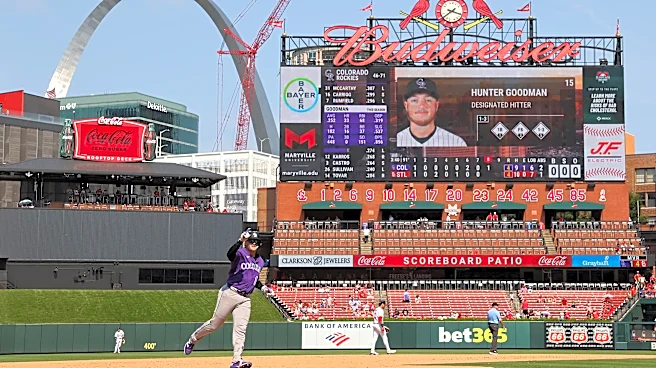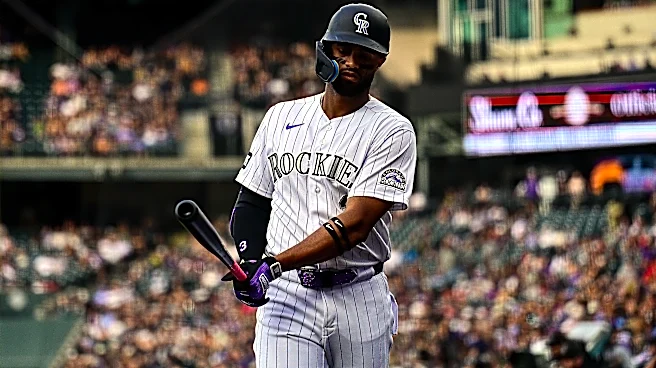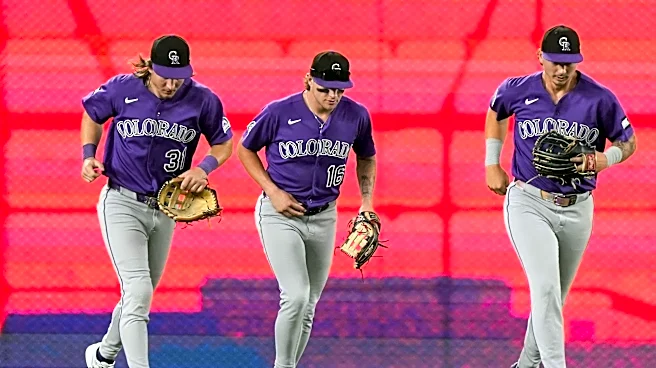



The Rockies entered the season with a fairly clear picture of their outfield. Jake McCarthy was expected to spend most of his time in left, Brenton Doyle was the established center fielder, Jordan Beck was in right, and Mickey Moniak was the fourth outfielder.
It has not played out that cleanly.
Injuries, performance, and roster movement have pushed a much longer list of players into the outfield, and the Rockies have remained a below-average defensive team overall even as the numbers have improved
from 2025.
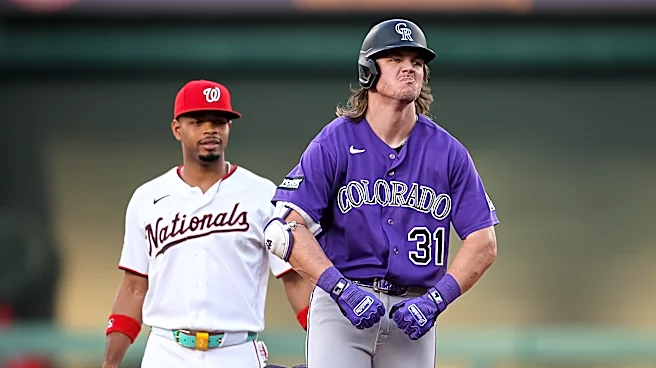
A smaller group has still handled most of the innings, and their defensive profiles look very different. McCarthy brings elite speed and a weak arm. Troy Johnston gets moving quickly off contact but gives ground back with his burst and inefficient routes. Moniak runs well without producing much range value. Beck has a fairly balanced defensive profile.
Then there is Cole Carrigg, whose overall collection of tools may be the most complete of the group — even if he is still learning how to turn them into consistent major-league defense.
What has emerged is an outfield made up of several very different defensive profiles.
Different players, different paths to the ball
Statcast breaks an outfielder’s first three seconds into three components. Reaction measures how much ground he covers in the first 1.5 seconds, Burst measures the next 1.5 seconds, and Route accounts for how efficiently that movement takes him in the correct direction. Those components combine into a Jump score, while OAA measures how many outs a defender adds or loses based on the difficulty of his opportunities.
None of these numbers is definitive on its own, especially in smaller samples. Together, though, they give us a useful way to see how differently Colorado’s outfielders are getting to — or not getting to — the same result.
Statcast data through games of Aug. 27. Jump components are calculated from qualifying 2+ Star opportunities. OAA shown here is each player’s overall season OAA, not the separate OAA total displayed on Statcast’s Jump leaderboard.
McCarthy is probably the easiest place to see why speed alone does not describe an outfielder.
His 29.9 ft/sec sprint speed ranks in the 99th percentile, and his reaction is excellent at +2.0 feet. His +0.8 feet of burst gives him another advantage.
His route, however, checks in at -1.6 feet.
McCarthy is fast enough, and reacts quickly enough, to produce positive range results despite some inefficient routes. The end result is still +1.2 feet of total Jump and +2 OAA.
That profile also helps explain why left field has made sense for him. By midseason, the Rockies were already using McCarthy there regularly, allowing his speed to play while asking less of his arm.
Moniak presents another variation.
His 28.3 ft/sec sprint speed ranks in the 77th percentile, but his season-long range results have been fairly ordinary. His route number, however, is a modest positive at +0.4 feet.
On a deep drive by Brady House, Moniak takes a clean path all the way back to the warning track and finishes the play against the wall.
Tyler Freeman faced a similar challenge on a Nick Gonzales drive. The ball also carried to the track, but Freeman could not close on it before it reached the wall.
His 27.7 ft/sec sprint speed is slightly above average, but both his reaction and burst are below average. His total Jump sits at -1.2 feet, and his season OAA is -8.
Johnston is where the components start pulling much harder against one another.
He owns the best reaction score of the group by a wide margin at +4.8 feet.
Then most of it disappears.
His burst is -1.6 feet and his route is -3.9 feet. In other words, Johnston gets moving quickly, but that movement does not consistently take him efficiently toward the ball.
Beck is less extreme in either direction. His reaction, burst and route are all positive, producing +1.1 feet of total Jump, while his season OAA sits at -1.
There is not much unusual about the profile. He has generally looked like a capable corner outfielder without one defensive tool separating him from the group.
Zac Veen is the notable omission from the table. His 58 outfield innings are not enough to give us a meaningful sample in these specific metrics, but there has still been plenty to see. Veen brings above-average speed, and both his arm and his defense have passed the eye test in his limited major-league work. At the very least, he has looked like a more natural outfield defender than Johnston or Freeman.
The arm changes the picture
Once the ball is fielded, the defensive profile changes again.
Carrigg has a 97.1 mph arm, ranking in the 99th percentile, and has produced positive Arm Value.
McCarthy is at the other end of the spectrum. His 79.7 mph arm ranks in the 18th percentile, and his -3 Arm Value is among the weaker marks in the group.
McCarthy’s range provides value, but his throwing does not.
Two similar plays provide a useful visual of the difference.
On May 31, Jung Hoo Lee lined a single into center with a runner on second. McCarthy fielded it, but the runner scored.
A similar situation played out with Carrigg in center on July 21. Luis García Jr. lined a single into center with James Wood on second. Wood stopped at third.
The plays are not identical. Depth, runner speed, game situation, and coaching all matter. But they show how an arm can influence a play without producing an assist.
Moniak and Beck offer another useful contrast. Moniak’s 82.2 mph arm strength is below average, yet his Arm Value is positive. Beck goes the other direction. His 88.5 mph arm is comfortably above average, but his Arm Value sits at -2. That difference reflects what happens on the play — including how well an outfielder controls runners — not just how hard he throws.
Just as sprint speed does not automatically determine range, throwing velocity does not automatically determine throwing value.
Carrigg has the most interesting combination
Carrigg’s +1.8 feet of total Jump leads the group, driven mostly by a strong +1.3 feet of burst.
Pair that with 87th-percentile sprint speed and a 99th-percentile arm, and there is a lot to work with.
Doyle provides a useful point of comparison. He won Gold Gloves in 2023 and 2024 despite below-average reaction numbers in both seasons. His burst and routes were positive, and the overall package produced outs.
Carrigg has his own version of that package. The tools are already there. What remains uneven is the execution.
He has played center field extensively throughout his minor-league career, including 245 games over four seasons. He is not learning center field from scratch.
He is learning how to play it at the major-league level, and that process is happening in real time.
On Aug. 21, Chase DeLauter drove a ball 347 feet to center. Carrigg moved toward it but never appeared to get a clean visual, and the ball dropped for a single.
It was not an isolated instance. Five days later, on José Tena’s drive to center, Carrigg again appeared to lose the ball before McCarthy came over from left to field it after it dropped.
His aggressiveness on balls that get down can work both ways, too.
On Nick Kurtz’s June 14 double, Carrigg charged hard to cut the ball off but took too tight an angle. The ball got past him and reached the wall as the run scored.
Later in that same game, Jonah Heim hit another ball into center. This time Carrigg cut it off cleanly, got the ball back to the infield quickly and hit Willi Castro as the relay man. Castro’s throw home completed the play.
Same tools, different execution.
That is where Carrigg is right now. The speed plays. The burst plays. The arm is already an elite major-league tool. There have also been missed reads, bad angles, and plays that remind you he is still figuring out how all of it works together against major-league hitters.
Putting it all together
There is enough in Carrigg’s profile to keep giving him run in center.
That also gives the rest of the outfield a little more definition. McCarthy can continue spending the majority of his time in left, where his speed remains an asset and his arm is less exposed. Moniak can continue moving around the outfield depending on matchups and need.
Veen gives them another athletic option as his role grows, while Beck provides a steady right-handed corner option. Johnston remains in the mix, but his defensive profile is much more uneven than either of those players.
Carrigg does not have to be a finished center fielder for that arrangement to make sense. He already has the speed, burst, and arm for the position, and the execution is still developing in real time.
Each player brings a different defensive profile, and plenty of it is still developing. But as the Rockies head toward 2027, the shape of the outfield defense is becoming clearer.
On the farm
Triple-A: Albuquerque Isotopes 5, Round Rock Express 3
The Albuquerque Isotopes (55-65) rallied late for a 5-3 win over the Round Rock Express (62-68) on Friday night, scoring four times over the final two innings.
Albuquerque trailed 1-0 before Roc Riggio tied the game with an RBI single in the fourth, and Charlie Condon gave the Isotopes a 2-1 lead with a two-out RBI double in the fifth. Round Rock answered in the bottom half and moved back in front on Cam Cauley’s solo homer in the seventh.
The Isotopes responded immediately. Braxton Fulford doubled to open the eighth and Riggio followed with a two-run homer to put Albuquerque ahead 4-3. Riggio added another RBI single in the ninth for some insurance.
Riggio led the offense by going 3-for-4 with a homer and four RBI. Fulford also had three hits and scored a run, while Condon reached four times, going 2-for-3 with a double, two walks, a run and an RBI.
Jack Mahoney allowed two runs on four hits over five innings, striking out three. Evan Shawver followed with a scoreless sixth before Andrew Baker allowed the Cauley homer in the seventh but still earned the win. Parker Mushinski and Blas Castaño combined to finish the eighth, and Castaño worked a clean ninth for his first save.
Double-A: Hartford Yard Goats 8, New Hampshire Fisher Cats 4
The Hartford Yard Goats (59-64) piled up five doubles and 14 total hits while doing most of their damage with two outs in an 8-4 win over the New Hampshire Fisher Cats (56-66) on Friday night.
Hartford struck first in the third when Andy Perez doubled, moved to third on a wild pitch and scored on a two-out single from Roynier Hernandez. New Hampshire answered with four runs against Connor Staine in the fourth, but the Yard Goats immediately began working their way back. Perez brought home Cole Messina with a groundout in the fifth before Hernandez delivered another two-out RBI single, and Messina tied the game at 4-4 with a two-out single in the sixth.
The breakthrough came with two outs in the seventh. Perez and Hernandez were aboard when Jack O’Dowd ripped a two-run double to left to put Hartford ahead 6-4, and Zach Kokoska followed with an RBI double of his own. Dyan Jorge added another two-out RBI single in the ninth for the final run. Seven of Hartford’s eight runs came with two outs.
Hernandez led the offense by going 3-for-4 with a walk, two runs and two RBI. Messina also collected three hits and drove in a run, while Kokoska reached four times with two hits and two walks, stole two bases and drove in a run. O’Dowd went 2-for-5 and supplied the biggest swing with his go-ahead two-run double.
Staine allowed four earned runs on six hits and four walks over five innings, striking out four. Sam Weatherly worked around two walks in a scoreless sixth to earn the win, Nathan Blasick somehow navigated four walks over two scoreless innings, and Fidel Ulloa issued another walk in the ninth before finishing off the victory. Hartford pitching issued 11 walks altogether but held New Hampshire to just six hits and no runs over the final five innings.
High-A: Vancouver Canadians 15, Spokane Indians 14 (10 innings)
The Spokane Indians (55-68) nearly erased a nine-run deficit before dropping a heartbreaker, 15-14, to the Vancouver Canadians (60-64) in 10 innings on Friday.
Vancouver erupted for eight runs against Lebarron Johnson Jr. in the second and added five more in the fourth to take a 13-4 lead. Spokane kept answering. Parker Coddou hit a two-run homer in the third, Clayton Gray went deep in the fifth, and the Indians added five runs in the seventh. Ethan Hedges supplied the biggest swing with a three-run double before Tanner Thach singled him home to pull Spokane within one.
Roldy Brito then tied the game with a two-out RBI double in the eighth, and Spokane took a 14-13 lead in the 10th when Alan Espinal scored on a wild pitch. But Vancouver tied it on a Coddou throwing error in the bottom half before Austin Smith scored the winning run with two outs on a balk by Justin Loer.
Every Spokane hitter had at least one hit. Hedges led the way with two doubles, a walk and three RBI, while Coddou had two hits, including his homer, scored three times and drove in two. Gray also had two hits, two runs and two RBI.
Johnson allowed eight earned runs on seven hits over two innings, and Isaiah Coupet surrendered four more in 1.2 innings. The bullpen stabilized things from there, with Grif Hughes allowing one run over 3.1 innings and Case Williams throwing two scoreless before the two unearned runs in the 10th.
Single-A: Fresno Grizzlies 7, Inland Empire 66ers 5
The Fresno Grizzlies (67-57) erased an early four-run deficit with a late surge, scoring five times over the final three innings to beat the Inland Empire 66ers (57-67), 7-5, on Friday night.
Inland Empire jumped ahead with three runs in the first and another in the fourth before Fresno finally broke through in the fifth. Jack Natili hit a two-run homer to cut the deficit to 4-2, and Ronny Ugarte added a solo shot in the seventh to make it a one-run game.
The Grizzlies then took over in the eighth. Cort MacDonald walked, Wilder Dalis singled and Cristian Arguelles tied the game with an RBI double. Daniel Jackson followed with a two-run single to put Fresno ahead 6-4, and another run scored on a passed ball later in the inning. Inland Empire pushed across one run in the ninth, but Fresno held on.
Jackson finished 2-for-4 with two RBI, while Ugarte went 2-for-4 with two runs and his second homer of the season. Natili drove in two with his third homer, and Dalis added two hits and a walk.
Angel Jimenez allowed four runs, three earned, over five innings while striking out nine. Ethan Cole took over from there and was excellent, allowing one unearned run over four innings with six strikeouts to earn the win.
The key for Rumfield’s rookie success? Sticking with his daily ‘vision board’ | MLB.com
TJ Rumfield’s steady rookie season has been built around a simple approach at the plate and an unusual daily routine away from it. The first baseman writes down one takeaway from each day in a notebook — his personal “vision board” — helping him stay focused on controlling the strike zone rather than chasing power, an approach that has him among the NL’s rookie leaders in average, on-base percentage and OPS.
Rockies Lineup Against Braves Reflects Changing Offensive Roles | SI.com
Connor Norby’s strong start with the Rockies has created a case for moving him higher in the order as Colorado evaluates its young core down the stretch. Wesley Dixon argues that giving Norby more opportunities near the top — while easing Cole Carrigg into a lower spot — could help the Rockies learn more about how both players fit into the 2027 lineup.
Purple Row After Dark: Predict the Rockies record in the final stretch | purplerow.com
Renee Dechert asks Purple Row readers to make their own call on the Rockies’ final stretch and whether Colorado can avoid another 100-loss season. With nine series remaining, head to the comments, predict how many games the Rockies will win the rest of the way and tell us where those wins are coming from.
Join the conversation!
Sign up for a user account and get:
- Fewer ads
- Create community posts
- Comment on articles, community posts
- Rec comments, community posts
- New, improved notifications system!
Please keep in mind ourPurple Row Community Guidelines when you’re commenting. Thanks!