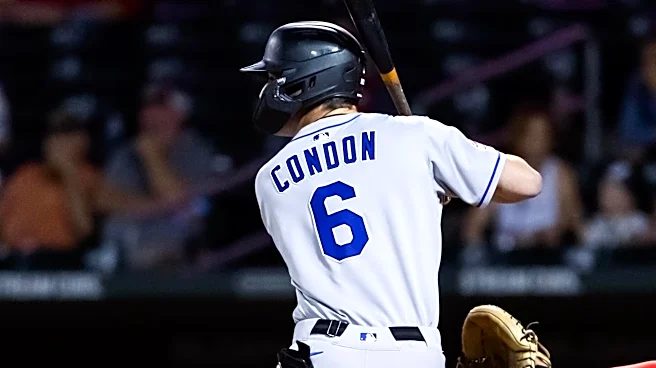

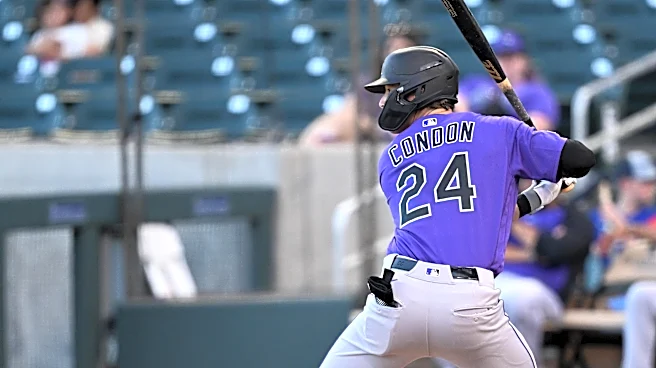
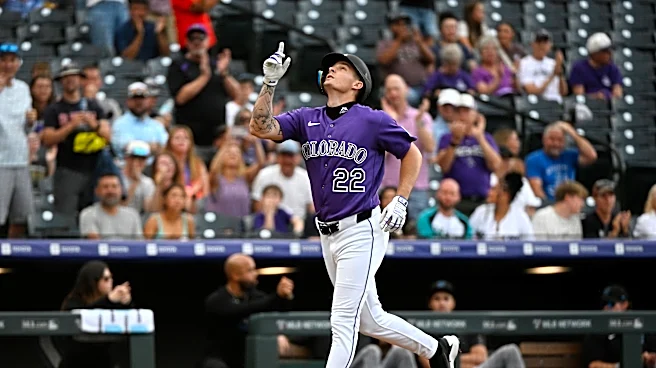


Charlie Condon (No. 1 PuRP) will tell you the adjustment was not dramatic.
In Eli Whitney’s Weekly Pebble Report, the Rockies’ top prospect described his midseason surge in fairly modest terms. There were some tweaks with his “load and gather,” a growing comfort in his swing, and a better ability to stay within himself instead of trying to force damage early in counts.
Condon’s June was not subtle: The power finally arrived. The question is whether the surge is being supported by something more than
a hot stretch.
Across 22 games in June, Condon slugged .778 with nine home runs and 30 RBI. That surge pushed his full-season line to .296/.419/.612 with a 1.033 OPS, 20 home runs and a 145 wRC+. For a player selected third overall in 2024 largely because of his offensive ceiling, a surge of that magnitude carries weight. This is the production the Rockies were waiting to see.
The production is the headline. The process underneath it is what makes the breakout worth taking seriously.
The approach was already there
Condon’s underlying data does not simply show a hitter who got hot. It shows a hitter whose selectivity, damage and swing-and-miss are beginning to interact in a more encouraging way. Even so, there is still risk in his profile, and it does not make his eventual transition to Denver automatic. It does, however, give real analytical context to what Condon told Eli: He is trusting the swing more, getting deeper into counts with more confidence, and doing a better job punishing mistakes.
The plate discipline is the easiest place to start. Condon has walked at a 14.6% clip while chasing only 18.0% of pitches outside the zone. That is the foundation of the profile. He is not expanding the zone to get to his power, and for a hitter with Condon’s raw strength, that matters.
The key is that this was not a brand-new approach. Condon was already patient earlier in the season. What changed is that the patience has started producing damage.
Making patience more dangerous

The rolling data shows the shape of the adjustment: Condon’s expected slugging and hard-hit rate have climbed while his swing rate has drifted down and his whiff rate has backed off its rougher midseason peak. He is not chasing power by simply swinging more. He is doing more damage while becoming more selective.
Condon’s quote about chase is useful because discipline is not just refusal. It is confidence. His best stretch has not come from abandoning patience. It has come from making patience more dangerous.
The damage matters because the approach still gives pitchers a path. Condon’s overall swing rate sits at 39.7%. His zone-swing rate is 62.8%. His zone-contact rate is 79.9%, and his whiff rate is 28.4%. If the damage is not there, pitchers have every reason to attack him in the zone, steal early-count strikes and trust the swing-and-miss to show up before he hurts them.
That is what makes the recent stretch important. Condon controls the zone well, but he also gives pitchers a reason to believe they can enter it. The more he punishes mistakes when they do, the harder it becomes for that plan to survive.
Patience comes with risk. A low chase rate is a strength, but MLB pitchers do not have to live outside the zone if a hitter is willing to take strikes. Against Condon, the plan may be less about getting him to chase immediately and more about stealing early-count strikes, getting ahead and using spin to finish the at-bat.
The secondary-pitch question is more complicated
Condon is already punishing fastballs. Against four-seamers, he has produced a .417 xwOBA, .421 xSLG, +11.1 Run Value (RV) and a 61.1% hard-hit rate. That matters because MLB pitchers are unlikely to build their plan around simply challenging him with fastballs in the zone. The next test is how well they can use breaking balls and offspeed pitches to keep him from getting to that damage.
The slider results show why the question is not as simple as “Can he hit spin?” Condon has a .628 xSLG and +7.3 RV against sliders, so the damage is real. But the 38.9% whiff rate means pitchers still have a reason to keep testing him there.
The margins are thinner elsewhere. Against sweepers and changeups, Condon has still produced positive run value, but the expected slugging is more modest — .370 xSLG against sweepers and .386 xSLG against changeups — while the whiff rates sit above 37% on both pitch types.
Fastballs are getting punished. Sliders are dangerous both ways. Sweepers and changeups look more like the pressure points MLB pitchers may try to exploit. Run value says the overall results have worked in Triple-A. Expected slugging and whiff rate show where those results could be tested by better execution.
This is where the pitch-type table reaches its limit. It can show the pressure points, but it cannot show the progression of the at-bat. For Condon, that progression is the point: the same patient foundation that was producing walks and playable contact in April is now creating chances to do damage.
The progress shows up pitch by pitch
In April against Sacramento, Condon was already showing the approach. He was working counts, taking walks and forcing pitchers to execute, but the contact was not consistently changing the way pitchers had to attack him. Against Carson Whisenhunt, he walked in a six-pitch plate appearance, later doubled on an 83.3 mph changeup in a seven-pitch at-bat, and added a 101.0 mph sacrifice fly in a five-pitch plate appearance. The approach was competitive, but the double was a 94.6 mph ground ball at a 5-degree launch angle — useful contact, not the kind of impact that forces pitchers to rethink the plan.
That is the important baseline. Condon was not trying to become patient. He already was patient. The question was whether that approach would start producing enough damage.
The July 1 matchup against Marco Gonzales showed the later version.
Condon’s first at-bat against Gonzales was a six-pitch triple. Gonzales started him with a cutter for a called strike, then mixed a cutter, another cutter, a four-seam fastball and a changeup. Condon stayed in the at-bat, ran the count full and drove an 86.8 mph cutter for a 390-foot triple at 95.2 mph off the bat.
Then came the ambush. In the third inning, Gonzales opened the next plate appearance with an 80.9 mph changeup, and Condon hit it 103.5 mph at a 31-degree launch angle for a 397-foot home run. That at-bat lasted one pitch.
His third look at Gonzales showed the fuller version of the progress. In a six-pitch plate appearance, Gonzales changed speeds and shapes: cutter, fastball, curveball, cutter, changeup, fastball. Condon fouled off the first cutter, took a fastball off the plate, took a curveball below the zone, fouled off another cutter, then took a changeup to run the count full.
The sixth pitch was a 90.1 mph four-seam fastball. Condon hit it 101.8 mph at a 26-degree launch angle for a 385-foot home run.

That is the difference. The April version was taking pitches and working counts. The July version is doing that while turning the eventual mistake into damage.
The July 2 double against Ryan Lobus added a breaking-ball example without needing as much space. In a six-pitch plate appearance, Condon took two sweepers for balls, watched two more sweepers land for called strikes, took a fastball to run the count full, then drove an 81.2 mph sweeper 108.9 mph for a double. It was a deep count, it was spin, and it was loud contact.

Condon can miss breaking balls and off-speed, but he can also hurt them. The next test is whether more advanced pitchers can separate his selectivity from his damage often enough to keep him from changing the game.
The question has changed
At this point, the more interesting question is whether Triple-A can keep sharpening the test. Condon is walking, not chasing, doing damage, adjusting deeper in counts and forcing pitchers to pay when they come into the zone. The remaining question is whether the balance of patience and impact holds against big-league spin, better sequencing and pitchers with better command of how to attack him.
That does not make the call-up decision simple, and it does not guarantee an easy first month in Denver. But Condon has moved beyond simple prospect hype. The power everyone was waiting on has arrived, and it is showing up without him abandoning the strike-zone control that made the profile so interesting in the first place.
Condon looks ready for the next test, and increasingly, that test looks like one that may have to come at the big-league level.
Whether that happens next week, next month or later in the season is up to the Rockies.
On the Farm
Triple-A: Albuquerque Isotopes 8, Round Rock Express 2
The Albuquerque Isotopes (44-41) used early offense, late insurance, and a strong start from Keegan Thompson to handle the Round Rock Express (37-48) in an 8-2 win on Friday night.
Brenton Doyle got Albuquerque moving with a one-out solo homer to left-center field in the first inning. Doyle’s first AAA home run of the year traveled 356 feet with a 96.9 mph exit velocity. He finished 2-for-5 with the homer, his second double, and two RBI.
The Isotopes added on in the second inning with three straight two-out RBI doubles. Adael Amador drove in Drew Avans with his 10th double of the season, Doyle followed with a double to score Amador, and Sterlin Thompson added his seventh double to bring in Doyle. Amador went 2-for-4 with a walk, an RBI, and a run scored, pushing his OPS to .768.
Albuquerque put the game away late. Jordan Beck opened the eighth with his second home run of the season, sending an outer-edge changeup to left-center for a 355-foot homer. Beck later added an RBI single in the ninth and finished 2-for-5 with two RBI, bringing his season OPS to .879. Bryant Betancourt added an RBI single in the eighth and finished 2-for-5 with his first AAA stolen base.
Keegan Thompson worked five scoreless innings, allowing three hits and three walks with five strikeouts. He improved to 2-4 and lowered his ERA to 4.04. His biggest outs came with runners on, including strikeouts to end both the third and fourth innings. Domingo Acevedo covered the final four innings, allowing two unearned runs on two hits with three strikeouts to earn his first save.
The Isotopes finished with 15 hits, went 6-for-13 with runners in scoring position, and produced five two-out RBI. Round Rock managed five hits and went 1-for-6 with runners in scoring position.
Double-A: Somerset Patriots 5, Hartford Yard Goats 3
The Somerset Patriots (42-37) held off a late push from the Hartford Yard Goats (42-36) in a 5-3 win on Friday night.
Hartford had the baserunners to make this one look different, but missed chances shaped the loss. The Yard Goats finished with eight hits, drew eight walks, and went just 2-for-13 with runners in scoring position while leaving 11 on base.
Jack O’Dowd stayed hot in his first week at Double-A. O’Dowd started at catcher and went 2-for-4 with a walk, his second double, and an RBI. Through his first four Double-A games, he is hitting .375/.444/.875 with a 1.319 OPS.
Roc Riggio also reached three times, going 2-for-4 with a walk and his 19th double of the season. Riggio now has an .837 OPS. Dyan Jorge added an RBI single and a walk, while Andy Perez drove in a run during Hartford’s ninth-inning push.
The pitching split was sharp. Stu Flesland III opened with two scoreless innings, and Michael Prosecky followed with a clean third, but Fisher Jameson allowed all of Somerset’s damage after taking over following a rain delay. Jameson gave up five runs on five hits, three walks, and two home runs over four innings, raising his ERA to 9.26.
Hartford got one run back in the fifth, then made Somerset work in the ninth. Mike Antico singled, Jorge walked, and Perez singled home Antico to cut the deficit to 5-2. O’Dowd then brought in Jorge on a force-out, but Aidan Longwell lined out to end the game with the tying run still at the plate.
High-A: Spokane Indians 4, Hillsboro Hops 2
The Spokane Indians (38-41) scored early and got enough pitching to beat the Hillsboro Hops (38-41) in a 4-2 win on Friday night.
Spokane built its lead in the first two innings. Tommy Hopfe opened the game with a single, Roynier Hernandez walked, and Ethan Hedges drove in Hopfe with a single to left. Jacob Humphrey followed with his 12th double of the season, bringing in Hernandez and Hedges to give the Indians a 3-0 lead.
Hopfe helped set the table again in the second with his 15th double of the season, and Hedges brought him home with another RBI single. Hopfe finished 2-for-5 with two runs scored and carries an .846 OPS on the season. Hernandez reached four times, going 1-for-2 with three walks and a run scored, raising his season OPS to .850.
Hedges and Humphrey drove the offense. Hedges went 2-for-5 with two RBI, giving him 42 on the season, while Humphrey went 1-for-3 with a walk, his 12th double, and two RBI to push his season total to 28. Spokane finished 3-for-8 with runners in scoring position.
Bryson Hammer gave the Indians a strong start, allowing one run on two hits and two walks over five innings. He struck out seven, improved to 4-6, and now owns a 5.26 ERA. Hunter Mann followed with three innings of one-run ball, allowing three hits and striking out one. Nathan Blasick handled the ninth with two strikeouts to earn his sixth save and lower his ERA to 3.20.
Single-A: Fresno Grizzlies 10, Ontario Tower Buzzers 9
The Fresno Grizzlies (43-36) kept answering and eventually walked off the Ontario Tower Buzzers (41-38) in a 10-9 win on Friday night.
Fresno trailed 2-0 after the top of the first, but Roldy Brito and Wilder Dalis helped erase it right away. Brito singled in the bottom half, and Dalis drove him in with his 11th double of the season. Jesus Freitez followed with an RBI single to tie the game at 2-2.
Brito was in the middle of everything for Fresno. He went 4-for-4 with a walk, a run scored, and two doubles, pushing his season line to a .322 average and .872 OPS. Dalis also had a big night, going 2-for-5 with his 11th double, his sixth home run, two RBI, and two runs scored. He now has an .832 OPS.
The Grizzlies kept climbing back after Ontario built leads of 6-3, 8-5, and 9-6. Cameron Nelson hit his fourth home run of the season in the fourth, a two-run shot that cut the deficit to 6-5. Dalis homered in the fifth, and Jeremy Ciriaco added his second home run in the sixth to make it 9-7.
Fresno tied it in the seventh without needing a big swing. Freitez singled, Ashly Andujar was hit by a pitch, Ciriaco walked, and Yeiker Reyes brought in Freitez with a sacrifice fly.
The ninth inning was messy, but Fresno took advantage. Reyes singled, Nelson walked, and Brito walked to load the bases with two outs. Luis Mendez was then hit by a pitch, forcing in Reyes for the walk-off run.
Fresno rarely had a clean inning on the mound, but Dylan Crooks struck out one in a perfect ninth inning to earn the win.
AP looks at Hunter Goodman’s season through both sides of the ABS system. Goodman’s power has already made him one of the Rockies’ clearest All-Star cases, but his value has extended behind the plate, too, where his strike-zone feel has translated into one of the better challenge records among catchers. It is another reminder that with Goodman it is not just about the home runs — it is also about how much more complete his profile has become.
With the draft just a week away, MLB.com’s latest mock has the Rockies going back to the college position-player pool at No. 10, targeting an outfielder whose profile is built more around the hit tool and plate discipline than pure power. There is still some pitching intrigue here, though, with at least one college arm mentioned as a possible fit if Colorado decides to chase upside on the mound instead.
Kevin Henry looks at why TJ Rumfield’s rookie season still has not fully broken through nationally despite the production. Rumfield has now won back-to-back NL Rookie of the Month honors, and the underlying case is strong: he leads qualified NL rookies in several major offensive categories, including average, on-base percentage, slugging, OPS, and hits. The question is whether voters will look past the Rockies’ record, the Coors Field factor, and the lower defensive spotlight that comes with playing first base.
Join the conversation!
Sign up for a user account and get:
- Fewer ads
- Create community posts
- Comment on articles, community posts
- Rec comments, community posts
- New, improved notifications system!
Please keep in mind our Purple Row Community Guidelines when you’re commenting. Thanks!