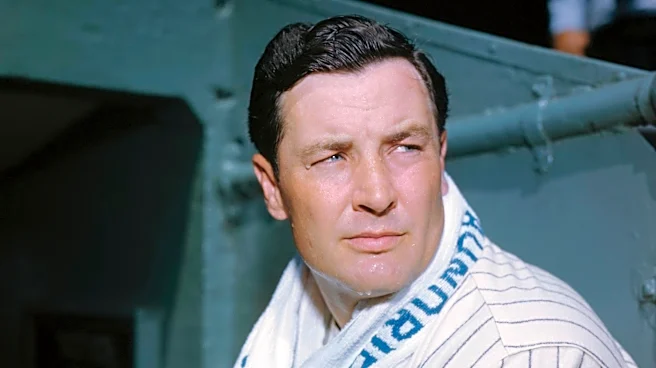




In a career that almost never happened after a car accident in his youth nearly cost him his leg, Joe Page’s left arm eventually guided him to the Bronx and championship glory. The journey to get there started in Pennsylvania coal country and would eventually return to the area.
Joseph Francis Page
Born: October 28, 1917 (Cherry Valley, PA)
Died: April 21, 1980 (Latrobe, PA)
Yankees Tenure: 1944-1950
Page grew up in Springdale, outside of Pittsburgh. The eldest of seven siblings, he spent his youth
working as a breaker boy sorting coal at the mine where his father worked. With his primary focus elsewhere, Page was not much of a prospect on the diamond during his school years. Then, in 1936, a car accident left him with a compound fracture in his leg and out of sports for a couple of years.
Bulking up while working in the mines during this hiatus helped the lefty add a few extra ticks to his fastball and develop a desire to get away from the coal mines. Seeing his left arm as a ticket out, Page started playing amateur baseball in Pittsburgh. He played for several years before finally impressing Yankees scouts enough to sign with the organization in 1940.
Page then worked his way through the farm system. He started with the Butler Yankees in the Pennsylvania State Association. The following year, he was assigned to the Augusta Tigers in Georgia. In 1942, Page found himself on the doorstep of the big leagues with the Newark Bears, the Yankees’ top farm team. He remained in Newark for the 1943 season, posting a 14-5 record across 28 appearances.
The leg injury that almost cost him his career before it started might very well have been what saved it and got him his big break. Due to the injury, Page was classified as 4-F and was ineligible for the military draft during World War II. In April 1944, the Yankees called him up to the big leagues.

Making an immediate impact, Page won five of his first six decisions. The rookie was selected to the All-Star team, but he came back down to earth as the Yankees faded late in the season. Page ended the year back in Newark, finishing his major league debut with a 5-7 record and a 4.56 ERA across 16 starts and three relief appearances.
The Yankees were without Page to start the 1945 season as he dealt with a sore arm. Returning from the injury, the lefty was mainly utilized out of the bullpen before moving back into the rotation in September. In 20 games, Page went 6-3 with a 2.82 ERA. Manager Joe McCarthy continued to clash with Page over his lack of focus and partying, which had been concerns since his rookie season.
McCarthy and Page kept locking horns until the manager’s exit early in the 1946 season. Page continued to bounce between the rotation and the bullpen, starting 17 games and pitching in 14 more in relief. Across 136 innings, he posted a 3.57 ERA while finishing with a 9-8 record.
Page was moved to the bullpen ahead of the 1947 season. Manager Bucky Harris called on him 56 times, and Page responded with a 14-8 record and a 2.48 ERA. Retroactively, he would be credited with 17 saves while tossing 141.1 innings and setting a then-American League record with 14 wins in relief. Becoming a true relief ace, Page was dubbed the Fireman because he often came into games to put out the other team’s rally. Making his second All-Star team was a bonus, as was helping the Yankees reach the World Series. Page pitched 13 innings across four games on the biggest stage, including the final four innings of Game 7, helping the Yankees take down the Brooklyn Dodgers in that decisive seventh game.
The Fireman kept things rolling to start the 1948 season, leading the league with 55 appearances and making his third All-Star team. However, both Page and the Yankees struggled after the break, and the club missed out on a chance to repeat as World Series champions. Page finished the year with a 7-8 record and a 4.26 ERA.
New skipper Casey Stengel was able to right the ship in 1949. Page posted a 13-8 record and a 2.59 ERA to go along with 27 saves. That was 17 more saves than the next closest individual reliever in the American League and at least eight more than any other AL team. His outstanding season earned him third place in the MVP voting. For a reliever in that era, that kind of recognition was rare. The Yankees took down the Dodgers again in the World Series, this time in five games. Page earned the inaugural Babe Ruth Award as the World Series MVP after winning a game and recording another stellar appearance that would have been a save in the Fall Classic.
Page received the biggest salary ever given to a reliever ahead of the 1950 season, but this marked the beginning of the end. After hurting his hip in May, he struggled all season, posting a 5.04 ERA across 37 appearances. The club opted to leave the veteran off the roster as the Yankees faced the Phillies in the World Series. The guys were able to get it done without him, sweeping their way to another championship.
Before the 1951 season, Page injured his arm. He started the year in the minors trying to work his way back to the big leagues, but the Yankees released him on May 16th. Page kept grinding, and several years later, he briefly made it back to the majors with the Pirates in 1954.

After retiring from baseball, Page managed a couple of bars in Pennsylvania and became a regular at Old-Timers’ Day. Known for his cheerfulness, partying, and close friendship with Joe DiMaggio, Page remained a fan favorite. His final career line included a 57-49 record, 3.53 ERA, 790 innings pitched, 76 saves, and a 7.3 WAR.
Happy birthday, Joe!
See more of the “Yankees Birthday of the Day” series here.