
The backup catcher is a fickle creature. Outside of an occasional opportunity to warm up pitchers in between innings, or perhaps to enter in the late innings after their manager mercifully pinch-ran for the starting backstop, they might only be seen once a week when they draw a start. Like a backup quarterback in the NFL, they can range from promising youngsters to sage veterans but invariably fade into the background as long as the starter is healthy.
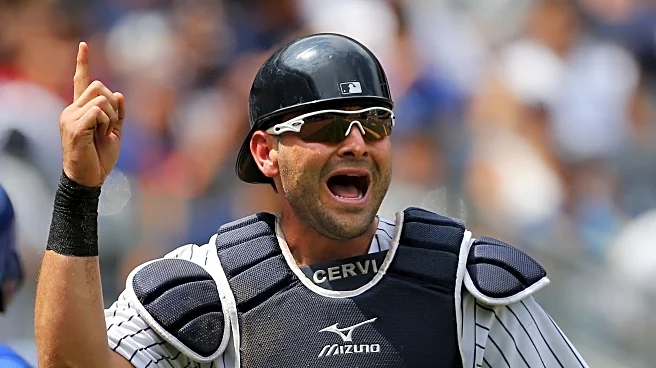
Well, nearly invariably. Francisco Cervelli couldn’t
fade into the background if he tried.
Francisco Cervelli
Born: March 6, 1986 (Valencia, Venezuela)
Yankees Tenure: 2008-14
Francisco Cervelli was born in Venezuela to an Italian father and Venezuelan mother. “The economy was good in Venezuela in the ‘60s or ‘70s,” Cervelli said of his father’s family’s emigration. “It was really good, so they just tried to make a new life.” He grew up playing middle infield and pitching, but the Yankees saw a future catcher in his build when they signed him as a 16-year-old. “I love it,” he would later say of his transition to catching. “I feel like I was born to do it. I just didn’t know before.”
Cervelli quickly worked his way through the Yankees’ system, appearing in only 21 games at Double-A (and none at Triple-A) before briefly getting the call to the Show in 2008. That offseason, he began to make a name for himself around the game as the catcher for a surprisingly potent Team Italy in the World Baseball Classic. After an upset 6-2 victory over Canada in the first round, Team Italy’s skipper — no less a source than Hall of Fame backstop Mike Piazza — raved about the youngster.
“He’s so talented back there, you can’t say enough,” he told the press. “His enthusiasm from the start of the game was just sky-high. He hustled. He’s got an amazing arm. I’m jealous — in a good way — because I see a player with a great future ahead of him.” This opportunity to face big-league competition with high stakes made an impression on Cervelli. “It helped me,” Cervelli said the following season. “How to call important games, how to concentrate hitter by hitter, pitch by pitch, everything.”
In 2009, with veteran catchers Jorge Posada and José Molina both missing time to injury, the 23-year-old once again found himself with the Yankees for large swaths of the season. He displayed a proficient hit tool, batting .298 in 101 plate appearances, and on June 24, 2009 in Atlanta, his first career homer helped light a spark for the club, which was in a slump and had just been addressed rather pointedly by GM Brian Cashman in a closed-door meeting.
Cervelli displayed a knack for both the physical and mental sides of his position, earning quick acclaim for his defense. “I think he receives the ball well, I think he blocks the ball well, I think he throws the ball well,” his manager, Joe Girardi, said. “He’s very mobile back there, so on bunts and slow-hit balls, he’s able to do that. I think he works very well with the pitchers. From a technical standpoint, there’s not a whole lot more to do.”
Cervelli ended up making the Yankees’ postseason roster but, with both Posada and Molina healthy, he drew no starts. Still, in a season that was characterized by the renegade exuberance of newcomers like Nick Swisher and A.J. Burnett, the passionate catcher emerged as a fixture in postgame pie celebrations and a key source of energy on the bench — also chiming in with one of the many walk-offs.
The following spring, Cervelli suffered a concussion. It was his second in four months and, by his own accounting, he had already taken at least 10 blows to the head over the course of his career. He was fatalistic about concerns around the repeated head trauma. “I think that things are going to happen, they’re going to happen, and that’s it,” Cervelli said. “I have to understand that and keep playing baseball. That’s my opinion.” As a concession to concerns around his concussion history, he began wearing the larger S100 batting helmet with a flap which would become soon standard but which earned him some David Wright-esque chiding at the time as “Gazoo” in reference to the Flintstones character.
Cervelli would stick in the bigs in 2010 and, by the end of the year, became A.J. Burnett’s personal catcher, an arrangement that would continue into the postseason. The future looked bright for the talented two-way catcher, particularly after the Yankees moved Posada to DH full-time, opening a possible path to increased playing time. But, after breaking his foot in the spring, Cervelli would cede reps to the just-signed Russell Martin, who ended up an All-Star while his backup was limited to 43 games.
With the team seeking more depth at catcher in 2012, the Yankees traded for Chris Stewart before the season and sent the 26-year-old Cervelli down to Triple-A. Cervelli reportedly exited the meeting in which he was informed of the demotion with red and watery eyes. “I don’t understand their reason,” Cervelli said. “I think you have to ask [GM Brian] Cashman or somebody else. Maybe they think the other guy is better than me right now.” The controversial decision to sideline the popular Cervelli was not only hard on him. “This was as tough as I’ve had to do,” Girardi said of breaking the news to Cervelli. He’d appear in only three games with the Yankees in what amounted to a lost season, made only more difficult by the fact that the Triple-A team didn’t really have a consistent home that year due to ballpark construction in the Scranton area. Cervelli was essentially on a season-long road trip.
Despite this setback, the spirited Cervelli would not relent. In 2013, with Martin gone, he won the starting job and slashed an impressive .269/.377/.500 through the season’s first month. Once again, it appeared his time had come. And, once again, injuries dashed those hopes. After that first month, he broke his hand on a foul tip behind the plate and then suffered an elbow injury during the recovery. Worse, Cervelli was caught up in the Biogenesis PED investigation that more famously ensnared Alex Rodriguez; the catcher was suspended for 50 games, officially ending his season.
Cervelli reported to spring training with a clean slate in 2014, firmly knowing his role as a backup to free-agent signing Brian McCann. He appeared in just 49 games but hit .301 with a 127 OPS+, easily his best showing yet among his four 100-PA seasons to date.
That offseason, Cervelli was traded to the Pirates for lefty reliever Justin Wilson. By the time he departed the team that had signed him as a teenager, he was the organization’s longest-tenured player. In his new uniform, Cervelli finally stayed healthy long enough to realize his potential, slashing .295/.370/.401 in 130 games and finishing second to Buster Posey among all catchers with 5.9 fWAR with a talented Pirates squad that won 98 games and a Wild Card spot (the Bucs’ most recent playoff appearance).
Extended on a rare eight-figure deal by Pirates standards, Cervelli would spend parts of four more seasons in Pittsburgh, remaining largely effective while healthy. Following brief stints in Atlanta and Miami, the 34-year-old was forced to retire after his seventh concussion at the MLB level alone. Cervelli has since gone into coaching, including succeeding Piazza as Team Italy’s manager in the upcoming World Baseball Classic.
While Francisco Cervelli never stayed healthy long enough to become the Yankees’ true starting catcher, what could have been should not take away what he provided. Cervelli was a reliable contributor on both sides of the ball whose passion for the game shone through every time he took the field, providing energy and verve to veteran squads throughout his time in New York.
See more of the “Yankees Birthday of the Day” series here.