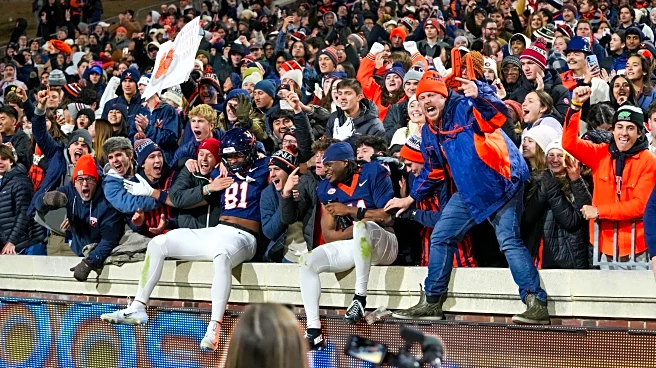

A first-ever spot in the College Football Playoff awaits the Virginia Cavaliers if they can beat Duke on Saturday night in Charlotte, N.C. But that isn’t the only historic achievement on the line. Virginia football,
playing in the ACC Championship Game for just the second time, will also be vying for its first-ever outright ACC Championship.
The Cavaliers were twice ACC Co-Champions under head coach George Welsh in 1989 and 1995, back when the conference’s membership was in the single digits, and there was no conference championship game.
A seven-team conference at its founding in 1953, the ACC didn’t consist of 12 teams until adding Miami and Virginia Tech in 2004 and Boston College in 2005, the number required to host a championship game. Henceforth, the conference has hosted a championship game rather than naming a champion, or co-champions, solely based on conference record, as was done before 2005, including Virginia’s two co-champion seasons in 1989 and 1995.
The Cavaliers did not reach the ACC Championship Game until 2019, when they lost 62-17 to Clemson. Tony Elliott was the offensive coordinator of the Tigers that year as they won their fifth of six straight ACC titles. Elliott now returns to Charlotte, this time as the head coach of the Cavaliers, in hopes of securing Virginia’s first outright ACC title.
Let’s take a deep dive into Virginia’s ACC Championship history and how this year’s team stacks up alongside the two Welsh-led ACC Co-Champions.
1989 Virginia Cavaliers: 10-3 (6-1 ACC)
After finishing the 1988 season 7-4 overall and 5-2 in the ACC, good for second place in the conference, the Cavaliers began their 1989 campaign with a 36-13 loss to No. 2 Notre Dame, the reigning consensus national champions.
The Cavaliers bounced back with a road upset of No. 12 Penn State, 14-6, for the first of four straight wins. Virginia then suffered its only ACC loss of the year, 34-20, at No. 15 Clemson before rattling off three consecutive home wins over North Carolina, Wake Forest, and Louisville.
The Cavaliers were then ranked in the AP poll for the first time that season at No. 24. In its subsequent games, Virginia beat No. 18 NC State on the road before knocking off rivals Virginia Tech and Maryland to end the regular season.
Virginia (10-2) and Duke (8-3) both finished ACC play at 6-1. Head-to-head results were not used as a tiebreaker, so the Cavaliers and Blue Devils were deemed ACC Co-Champions. It’s worth noting Virginia’s dominant 49-28 victory over Duke earlier in the year.
Fun Fact: Neither Virginia (No. 18) nor Duke (unranked) finished the year as the top-ranked ACC team despite sharing the conference title. Clemson (No. 12) held that honor courtesy of a 10-2 record that featured three top-20 wins but two losses to unranked ACC teams.
Postseason: Ranked No. 15, UVA faced No. 11 Illinois in the Florida Citrus Bowl in Orlando, Fla., but lost 31-21 to miss out on a potential 11-win season.
The Cavaliers were ranked No. 18 in the final AP poll.
1995 Virginia Cavaliers: 9-4 (7-1 ACC)
Coming off a 9-3 season in 1994, in which the Cavaliers finished the year ranked No. 15, Virginia had the opportunity to achieve consecutive nine-win seasons for the first time in program history.
Ranked No. 17 to begin the year, Virginia suffered an 18-17 loss to No. 14 Michigan. The Cavaliers rebounded with five straight wins, including a 29-24 defeat of No. 23 NC State on the road. The ‘Hoos rose up to No. 9 in the country before losing at unranked North Carolina. After a win over Duke, Virginia would falter for the third time that season, a 17-16 loss at No. 16 Texas.
Then, Bobby Bowden and No. 2 Florida State came to town. The Cavaliers led by as many as 12 points in the second half, but the Seminoles would not go away. With four seconds left and Virginia leading by five, FSU opted for a direct snap to running back Warrick Dunn from about six yards out. The Cavaliers stopped him just inches shy of the end zone to pull off the upset.
Virginia managed a 21-18 win at Maryland the following week to finish ACC play 7-1. The Cavaliers then lost at home, 36-29, to Virginia Tech, concluding the regular season at 8-4. The push for a second consecutive nine-win season was extended to bowl season.
Fun Fact: Upon joining the ACC in 1992, Florida State won its first 29 conference games before Virginia’s upset of the No. 2-ranked Seminoles on Nov. 2, 1995.
Postseason: Ranked No. 18, Virginia defeated unranked Georgia 34-27 in the Peach Bowl in Atlanta, Ga., to secure consecutive nine-win seasons for the first time in program history.
The Cavaliers were ranked No. 16 in the final AP poll.
2025 Virginia Cavaliers: 10-2 (7-1 ACC)
Unlike the aforementioned George Welsh-led ACC Co-Champions of 1989 and 1995, this year’s team was not preceded by a team with a winning record or really any track record of winning whatsoever.
Virginia has not finished a season above .500 since 2019, when Bronco Mendenhall led the Cavaliers to appearances in the ACC Championship Game and the Orange Bowl. Tony Elliott had yet to produce a six-win team through three seasons and was 6-17 in ACC play.
A season like Virginia has had was well beyond the realm of expectations for those outside the program, even with a schedule that was viewed as among the easiest in the Power Four. Apparently, quarterback Chandler Morris knew better than just about anyone what this year’s team could accomplish, particularly those who voted Virginia 14th in the ACC’s preseason media poll. Last January, he said, “I didn’t come all the way to Virginia as a Texas boy to win five, six games. I want to win the conference championship.”
With the help of much-improved resources that helped an offseason roster overhaul, Elliott has turned a 5-7 team from a year ago into a 10-2 team that has an opportunity to achieve two program firsts, an outright ACC title and a spot in the College Football Playoff. After a rollercoaster of a regular season, the Cavaliers just have to beat Duke on Saturday to achieve both.
The season began with a dominant 48-7 win over Coastal Carolina, followed by a devastating down-to-the-wire 35-31 loss at NC State. Following a 55-16 win over William and Mary and a 48-20 win versus Stanford, the Cavaliers beat a then-top-10 team in Florida State in double overtime.
The following week, they went to Louisville and won another overtime thriller, 30-27. They won three more nail-biters after that – 22-20 over Washington State, 17-16 in overtime at North Carolina, and 31-21 at California – to complete a seven-game winning streak and rank as high as No. 12 in the AP poll.
After a frustrating 16-9 loss to Wake Forest in which Morris was injured in the first half and did not return, the Cavaliers bounced back with a dominant 34-17 win at Duke, led by a 300-yard passing performance by Morris.
And then they overcame the demons of more than two decades’ worth of UVA teams by beating rival Virginia Tech for just the third time since 1999, smashing the Hokies 27-7 in Charlottesville.
Now, they face that same Duke team they beat 34-17 on the road only three weeks prior, and with everything on the line: the program’s first-ever 11-win season, first-ever outright ACC title, and first-ever College Football Playoff appearance.
Fun Fact: Virginia has won nine of its past 10 meetings with Duke, including this year’s regular-season matchup.
Postseason: No. 18 Virginia faces Duke for the ACC Championship. A win for UVA cements a place in the College Football Playoff, almost certainly as the No. 11 seed. A loss will eliminate them from playoff contention and reduce the season’s end to a far less enticing bowl game.
The Cavaliers are ranked No. 17 in the latest College Football Playoff Rankings and No. 16 in the AP poll.