
Just in case you thought that Fiorentina’s men’s team was the only bunch of blundering doofuses at the club, the brass reminded you that there’s incompetence spilling out of the team and into the surroundings
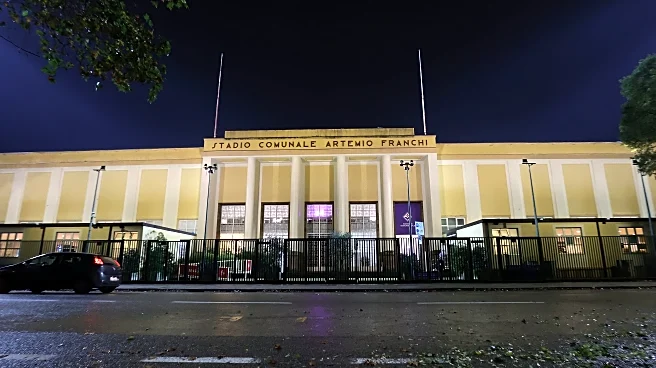
now. Is this about the Stadio Artemio Franchi? Hahaha yeah of course it is. Do you know exactly what’s coming even without reading the news? Keep smiling and maybe those tears won’t fall.
The news is that Florence mayor Sara Funaro announced that the construction has been delayed for the 62nd time by my count. She cited a €60 million shortfall in funds that has prevented the authorities from getting all the contracts signed for the requisite work despite the €205 already committed to the project. This is nothing new, of course; the plan has always a line item of “various and sundry costs, stuff, y’know—~€50 million—????” and this merely continues the proud tradition.
The upshot is that Funaro now warns that the deadline for finding that pesky missing money is July of 2027. That, of course, will slow down the actual work on the project, pushing the date of completion to the summer of 2029, although she also believes that the Curva Fiesole will be ready by next season, the club’s 100th. The overall goal remains to finish the whole shebang in time for the 2032 Euros, but this newest forecast throws all that into serious question, even if the city allows round-the-clock construction to make up time.
While the smooth-brained may point to the typical Italian bureaucracy that’s prevented any work on the stadium since the days of the Della Valle, you and I have wrinkly, wrinkly brains that are above such simple explanations. No, my friend, we know the truth, and it goes far deeper than any modern government. We must dig deeper. Literally.
Think about every book or movie featuring a haunted structure. The whole point is that they’re stuck in a specific moment in time; in Poltergeist, for example, it’s no coincidence that Carol Anne speaks to the static (i.e. something not moving) in the TV. A haunted structure resists change, whether that’s a new resident or any improvements. Given the Franchi’s track record, a supernatural explanation is as good as any.
The Franchi, by the way, is no stranger to inexplicable phenomena. The 1954 UFO sighting is probably the most famous, but I propose that ghosts, not extraterrestrials, were responsible. Sure, the official explanation is that either anti-radar aircraft technology (“chaffs”) or ballooning spiders were responsible, but that’s just a little too convenient. It’s exactly what They would want you to think.
The reason I think it’s ghosts is that Florence has a history that stretches way, way back. Which is likelier: that aliens popped up over the Franchi for a moment or that some remnant of human consciousness, triggered by the regional tensions of Firenze vs Pistoia, leaked out into our dimension, manifesting itself in a manner unintelligible to the average person?
What ghosts, then? The first confirmed deaths I’ve found at the Franchi (then named the Giovanni Berta after the local fascist leader who created Fiorentina) occurred when 5 young men who’d dodged the draft were shot dead by the Torre di Maratona in 1944 by the fascist authorities. It’s a horrible episode now marked by a small memorial at the stadium, but I think this goes back farther.
Long before the Romans were running the show in Italy, the Etruscans ruled Tuscany. Nobody’s exactly sure who they were, where they came from, what their culture looked like, or even how their language worked, but they were the dominant power in central Italy for a few centuries. Probably a loose confederation of city-states more than a centrally-administered empire, they were linked by shared economic and religious interests.
That latter point is key here. The Etruscans built elaborate funeral structures for the elite stratum of society. What about all the other Etruscans, though? The blue collar, everyday workers? The ones who didn’t get fancy houses and haunting, beautiful sarcophagi? They had to go somewhere when they died. And my working conjecture is that they went into a graveyard situated at what we now call Viale Mandredo Fanti, 4, 50137 Firenze.
If we accept this conjecture, we have to go back to the Franchi’s original construction. There were a few minor delays, a few kerfuffles about funding and permits, but Pier Luigi Nervi got this thing done almost without a hitch. Those who wish to work on the stadium need to revisit his methodology. Not his architectural practices, of course, but his more arcane ones.
What I’m saying is that Nervi was some sort of sorcerer, capable of speaking with those Etruscans who occupied his chosen building site. I don’t know how he reached an understanding with them that allowed him to speed through the construction, what rites and rituals he performed to protect his project and even encourage its completion, but that’s the direction Fiorentina’s research ought to take.
Nervi’s family, I’d bet, has an inkling that his work required a treaty with those ancient Etruscans. Sure, his descendants claim that they don’t want any work done on the Franchi because it would pollute Nervi’s original vision, but they surely know that there was some sort of accord reached across the veil. They may not know how to reopen that connection, but they know that any further work on the site is doomed. Doomed, I tell you. Doomed.
It doesn’t do to kick the dead out of their resting place of millennia. It would be easier to find an agreement with them. Regular sacrifices to appease them, whether that’s libations of Brunello or something else. An invocation to Tages, Vegoia, Voltumna, Turms, and all the other deities. A restoration of the Tarquins. You know, the usual stuff.
Because otherwise, those blue collar Etruscan dead are going to keep delaying this process. The red tape, political backbiting, and general atmosphere of stasis are the symptoms, but their cause goes beyond the reductive, “Well, that’s Italy for you.” It’s ghosts, man. Franchi’s haunted.