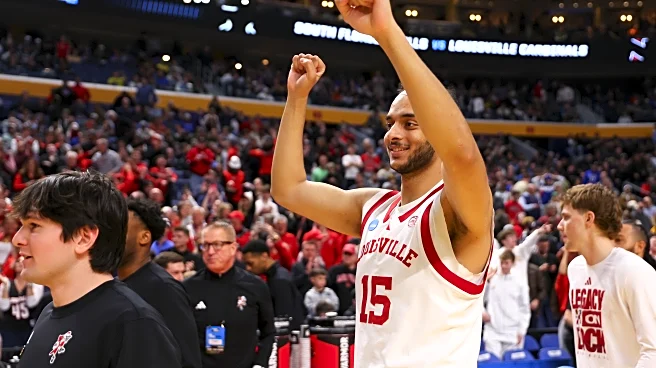




Despite someone (it doesn’t matter who) picking USF to advance and face the Spartans on Saturday, it will be MSU tipping off with the Louisville Cardinals in Buffalo, NY, at 2:45 PM on CBS.
Per FanDuel, Michigan State is a slight favorite at -4.5. The over/under is 150.5.
Louisville lead by as much as 23 in the second half in their opening round game and then had to withstand a furious rally from South Florida to hold off the Bulls, 83-79. Isaac McNeely with 23 points and Ryan Conwell with 18 against
USF led the Cardinals into the second round.
Join the conversation!
Sign up for a user account and get:
- Improved notifications system!
- Fewer ads
- Create community posts
- Comment on articles, community posts
- Rec comments, community posts
Let’s take a closer look at what the Spartans will be up against when they hit the floor on Saturday.
Louisville Overview
The Cardinals finished the regular season and ACC tournament schedule with a 23-10 record overall and 11-7 in conference – good for sixth place in their league. They defeated SMU in their opening game of the ACC tournament but then lost to Miami in the quarterfinals.
Louisville shared several common opponents with MSU this season:
- 11/11 – defeated Kentucky 96-88
- 12/3 – lost @ Arkansas 80-89
- 12/6 – defeated Indiana 87-78
- 1/6 – lost to Duke 73-84
- 1/26 – lost @ Duke 52-83
- 2/23 – lost to North Carolina 74-77
The Cardinals average almost 85 points per game on 47% shooting compared to the Spartans 79 points, also on 47% shooting. Louisville averages 17.1 assists on 28.7 made field goals per game while MSU assists on 18.5 of 27.6 baskets. Turnovers committed are also pretty even with 11.6 for Louisville and 11.5 for the Spartans.
One advantage for Louisville is in creating seven steals per game compared to just five for Michigan State.
One final comparison to look at is through Evan Miya’s offensive and defensive ratings. (An explanation of these ratings is at the end of this article.) MSU ranks 12th in the country with an O-Rate of 12.7 and a D-Rate of 11.9 for a total Relative Rating of 24.6. Louisville comes in a bit lower at 21st overall with an OR = 12.5, DR = 9.2 and Relative Rating of 21.8. OR, DR, and RR as shown on Miya’s site are defined at the end of the article.
Like so many teams now, Louisville, with five seniors in their rotation, is an experienced group primarily built through the transfer portal.
Louisville Starters
The lineup below is who first took the floor for the Cardinals in their round one win over USF. Louisville played without point guard Mikel Brown for the fifth game in a row due to a back injury.
Brown last played in the loss to North Carolina on February 23, where he scored 24 points on 9-25 shooting in 33 minutes. Despite the somewhat poor overall shooting, Brown did hit 6 of his 14 three point attempts in the UNC game. Prior to his injury, the 6-5 freshman was averaging 18.2 points, 3.3 rebounds, and 4.7 assists per game. He shot 41% overall and 34.4% on his threes and launched 7.6 three point attempts per game.

Going into Thursday’s game against South Florida, Louisville head coach Pat Kelsey expressed some hope that Brown could be ready for the second round but one recap of the USF-Louisville game indicated that he was unlikely to return.
If Brown’s absence continues, these are the likely starters against MSU:
- #53 6-8 JR F – Vangelis Zougris. 2.3 pts, 2.3 rebs, 53.8% FG, does not shoot the three – 0 attempts on the year. Zougris is from Greece and is listed as a Junior but this appears to be his first year in American collegiate basketball.
- #14 6-4 SO G – Adrian Wooley. 8.5 pts, 4 rebs, 1.8 assts, 48.9% FG, 39.1% 3FG. Kennesaw State transfer; first year at Louisville.
- #3 6-4 SR G – Ryan Conwell. 18.7 pts, 4.8 rebs, 2.5 assts, 40.7% FG, 34.2% 3FG. USF and Xavier transfer; first year at Louisville.
- #10 6-4 SR G – Isaac McKneely. 10.6 pts, 3 rebs, 1.4 assts, 40.7% FG, 38.1% 3FG. Virginia transfer; first year at Louisville.
- #1 6-7 SR G – J’Vonne Hadley. 11.8 pts, 5.2 rebs, 1.7 assts, 57.3% FG, 45.6% 3 FG. Northeastern and Colorado transfer; first year at Louisville.
Hadley is the top shooting threat, percentage-wise, but only puts up an average of 2.5 three pointers per game. He made his only deep attempt, and went 3-4 overall, against USF.

Despite starting, Zougris only plays about 10 minutes per game and Louisville starts a somewhat smaller lineup. However, they do have some more size coming off the bench.
Louisville Bench
- #13 6-11 JR F – Sananda Fru. 9.2 pts, 6 rebs, 1.3 assts, 75.9% FG, 4-8 on three point attempts for the year. Fru is from Berlin, Germany and is listed as a junior but this appears to be his first year in American collegiate basketball.
- #9 6-10 SO F – Khani Rooths. 5.5 pts, 4.4 rebs, 45.5% FG, 22.6% 3FG
- #15 7-0 SR C – Aly Khalifa. 3.2 pts, 1.9 rebs, 2.6 assts, 43.2% FG, 40.7% 3FG. Charlotte and BYU transfer; first year at Louisville.
- #11 6-3 SR G – Kobe Rogers. 3.3 pts, 2.4 rebs, 1.4 assts, 49.3% FG, 41.4% 3FG. Charleston transfer; first year at Louisville.

Fru and Rogers lead the way off the bench. Fru had a double-double with 10 points and 10 boards against USF in 25 minutes. Rogers played 20 minutes against the Bulls. He is another good three point shooter but he only averages one attempt per game, which is what he got off against USF on Thursday.
Louisville Coaching
Pat Kelsey is in his second year at Louisville and 13th overall as a head coach. In his first year with the Cardinals, they went 27-8 and 18-2 in the ACC. Kelsey was named ACC Coach of the Year a Naismith Coach of the Year semi-finalist in 2025.
Despite the overall success of last season for Louisville, the 2025 campaign didn’t end the way the Cardinals hoped. They dropped the ACC tournament championship game to Duke and then fell by 14 points to Creighton in the first round of the NCAA tournament. So, Thursday’s win against USF was Kelsey’s first NCAA tournament win at Louisville.
Prior to taking over at Louisville, Kelsey had very successful stints at Charleston and Winthrop.
Keys to the Game
Bench Contributions. The Spartans got to clear the bench Thursday against North Dakota State. That probably won’t happen against Louisville but a solid contribution from the bench sure couldn’t hurt. Cam Ward had a great game against NDSU and Trey Fort turned in another strong performance on Thursday. Denham Wojcik also helped Michigan State with four points in eight minutes against the Bison.
Fort is interesting in that, until the Spartans’ last couple of games, he hasn’t played much so he could be somewhat of an unknown to MSU’s opponents.
Defend the Three. Louisville shoots a lot of them. We’ve covered how the Spartans have struggled to defend them at times. MSU held NDSU to just 6-25 on their threes but Louisville should pose a bigger threat. Michigan State has to have their perimeter defense sorted out for this one.
Interior Presence. Carson Cooper led the way for the Spartans on Thursday. Ward was huge off the bench and Jaxon Kohler had a solid game with some timely threes. Another combined effort from this trio should give the Spartans the interior advantage against Louisville.
Take it to Them. Speaking of Cooper, he got the halftime interview on Thursday and mentioned that MSU wanted to be the aggressor from the beginning in the opening round game. The Spartans gave up a few easy baskets to the Bison in the early going but then got things rolling. It seemed like, after a brief lull at the start, the anger of losing early in the Big Ten tournament took over and the Spartans quickly built a double digit lead.
Despite the talk about the defensive lapses, MSU’s offense has been clicking more often than not recently. If that can continue, the Spartans may be able to survive a defensive breakdown or two against Louisville.
Jeremy Fears on his best behavior. I can’t believe I’m writing this in a game preview, but our starting point guard shouldn’t kick anyone in the groin. Fears picked up an early foul against North Dakota State but that ended up being his only personal, despite the refs perhaps keeping an extra close eye on him and the Bison trying to bait him.
Fears did what he needed against NDSU but the heat is going to turn up on Saturday and he needs to stay in control. Whether MSU is playing well and up by 6-12 points, or if they’re struggling and Louisville is hitting their threes, a flagrant foul could turn momentum, or make it worse.
What am I missing? What are your keys to the Spartans moving on to the Sweet 16?
Go Green.
_____________________________________________________________________________
- All stats referenced above are from before Thursday’s NCAA tournament games
- Relative Ranking: Each team is ranked based on how it would be expected to perform head-to-head against other similarly ranked teams. If a team is ranked 4th, it is predicted to lose against each of the top three teams, but predicted to beat teams ranked 5th, 6th, and so on. Each head-to-head prediction is based on both teams’ efficiency ratings, opponent adjustment, and pace adjustment.
- O-Rate: Team Offensive Efficiency Rating reflects a team’s expected offensive efficiency. This number can be interpreted as the points per 100 possessions better than average expected when playing against an average D1 team. However, each team’s O-Rate is actually based on how its offense would perform against other similarly ranked teams. A higher rating is better.
- D-Rate: Team Defensive Efficiency Rating reflects a team’s expected defensive efficiency. This number can be interpreted as the defensive points per 100 possessions better than average expected when playing against an average D1 team. However, each team’s D-Rate is actually based on how its defense would perform against other similarly ranked teams. A higher rating is better.
- Relative Rating: Team Net Relative Rating is the sum of a team’s O-Rate and D-Rate. This rating is the ultimate measure of a team’s expected overall strength, relative to other teams ranked similarly. The Relative Rating value can be interpreted as the number of points the team is expected to outscore an average D1 team by in an 100 possession game. However, each team’s Relative Rating is actually based on how it would be expected to perform against other similarly ranked teams. See the example at the bottom of the page.