
The NBA recently found itself arguing with a medical journal, and the league office doesn’t usually bother punching down at a sample size of nineteen unless something in the findings stings.
The paper, published late last month in the Orthopaedic Journal of Sports Medicine, examined nineteen NBA players who ruptured an Achilles tendon over the past decade and found that in the ten to fifteen games before the tendon gave, they were logging more minutes than their norm: twenty-nine a night against a season
baseline of twenty-seven and a half. The league’s director of sports medicine answered with methodological objections and an internal review that found no such relationship. The authors, to their credit, had listed their own limitations first. Nineteen players. No control group. No causal claims. Patterns “temporally associated” with injury, and nothing more.
The detail worth keeping is quieter than the fight. The injured players’ seasons were ordinary by the measures available: career-normal playing time and career-normal distance. The clearest pattern appeared in the short window before the rupture. Which raises a possibility the paper is careful not to promise: sudden changes in work may matter differently than season-long volume.
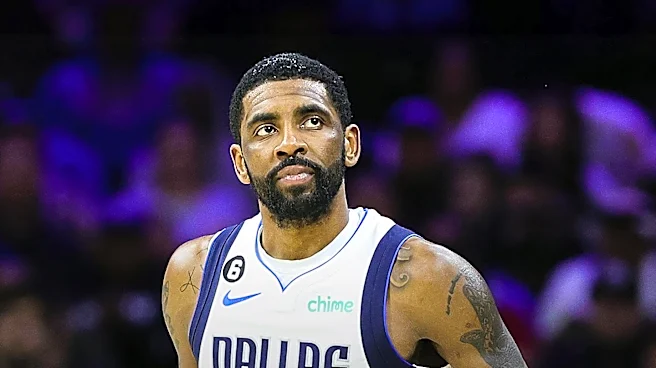
That pattern felt uncomfortably familiar in Dallas, where February has been writing Kyrie Irving’s story since the night it delivered him here, and where the story’s fifth chapter already has a time stamp.
What the minutes can prove
Before anyone reaches for a pitchfork, the honest part has to come first. Tearing the Achilles and the ACL are two very different injuries.
In 2017, researchers examined 83 NBA players who tore an ACL across three decades. The players had logged an average of 17.1 minutes in the games in which they were injured, compared with a season average of 23.5. That comparison carries an obvious limitation: a torn ACL tends to end the night. Even so, the narrow finding is worth respecting. Three decades of NBA knees do not support the simplest fatigue story, the one in which a ligament usually gives way only after an unusually heavy night.
Kyrie’s tear offers no cleaner version of that story. March 3, 2025, against Sacramento, nine minutes and twenty-five seconds into the game. First quarter. This was not a ligament failing at the end of forty hard minutes.
The tear itself resists a clean explanation. The research finds firmer ground on the other side of it, where the question becomes what shapes the player who comes back.
A 2025 study followed sixty-seven NBA players through twenty years of ACL tears. Eleven never made it back; those players skewed older and were more likely to have suffered injuries involving more than one ligament. Among the fifty-six who returned, age at the time of injury and greater minutes played before surgery were associated with a larger decline in player efficiency rating. The returners lost about three points of PER while matched healthy controls lost almost nothing, and lower post-return efficiency was associated with less favorable salary movement.
The minutes cannot convict Dallas of the tear. They still belong in the prognosis.
Dallas could not change Irving’s age. It did choose his minutes. But those minutes make sense only inside the relationship that preceded them, one in which Irving kept becoming whatever the franchise needed. By February 2025, as every other plan collapsed, Irving’s willingness to put on a cape and save the season had become a doomed season’s last bit of infrastructure.
February 2023: The discount
The Februarys started long before the tear. Dallas traded for Irving on February 6, 2023, sending Spencer Dinwiddie, Dorian Finney-Smith, an unprotected 2029 first-round pick and two seconds to Brooklyn, a price widely read at the time as below market for a player of his gifts. The discount was the risk. He arrived carrying everything the previous few years had attached to him, and that first partial season ended with no playoffs and a partnership still looking for its rhythm.
Sitting in the nosebleeds for Irving’s first Dallas home game, yours truly. Looking at the names in the Mavs box score for that game makes it feel like forever ago. Christian Wood; “people forget about Frank”; and two minutes of JaVale freakin’ McGee.
The incredible fourth-quarter comeback was a sight to behold. Irving spearheaded it with 24 of his team-high 36, only to see a backcourt miscommunication cost the Mavs a chance at a miracle win. The game of hot potato signified two stars, both willing to defer, and, in retrospect, may have been a sign of the great chemistry that was about to develop.
February 2024: The proof
The backcourt rhythm between Dončić and Irving began the 2023-2024 season at a solid level but kicked into high gear in February of 2024. Exactly one year after the trade became official, Irving returned to Brooklyn and scored 36. Dallas went 8-2 in the ten February games he played, with Irving averaging 27.7 points and shooting 55.4 percent from the field. That month offered the first sustained glimpse of the team that would reach the Finals.
2024 showed us how Irving has always been deployed best: as one of the finest championship-level second options the game has ever seen. The backbreaker against stretched-thin defenses. The secondary creator. The closer who entered the fourth quarter with his best fastballs saved for when the game was on the line. We saw all of it that year, and what felt like the beginning of several contending seasons became, tragically, a one-off memory sealed in amber by the inexplicable act that followed.
February 2025: What Dallas needed from him
The timeline of the tragedy matters because the infamous trade that ended an era just as it was getting started did not take a working Luka Dončić off the floor. His calf did that on Christmas Day, and he never wore the uniform again.
For the five weeks after Christmas, the carrying job was Irving’s. He missed five games of it himself in early January, first with an illness, then with what the team listed as a lumbar sprain, and returned on January 14 to the same assignment: holding the team together while the franchise player rehabbed and relief was supposedly coming. Then the first weekend of February, Nico Harrison traded the rehabbing franchise player for Anthony Davis, a thirty-one-year-old with an injury file, in a window Harrison insisted existed to win now. The reunion with his friend and backcourt mate, the one Irving had spent a month propping the season up for, never came. What arrived instead was three quarters of his replacement.
Davis debuted February 8, left late in the third quarter with what was later diagnosed as a left adductor strain, and the win-now roster was suddenly a thirty-two-year-old point guard and whatever was left standing.
In practical terms, Irving’s assignment became keeping the season afloat until Davis healed. From February 4 forward, his minutes jumped to 39.3 a night, and his usage climbed with them. His first five games after the trade, inside nine days: 41:51, 39:51, 41:36, 43:46, 39:59. The one night his usage rate eased came February 8, down to 20.7 percent, because for three quarters there was someone else to carry the offense. Two nights later Irving played 43 minutes and 46 seconds of an overtime loss to Sacramento.
You can watch the load climb every time the franchise lost a reason for restraint. Before Luka’s Christmas injury, Irving played about 35 minutes a night. From Luka’s injury to the trade: about 37 and a half. From the trade forward: 39.3. Across the first five games, as Davis arrived and vanished, more than 41. Two more minutes for every hope subtracted.
Sacramento, it turns out, was present at both ends of this.
Run his final ten healthy games through the Achilles paper’s method, borrowed here as vocabulary and nothing more, with the injury game removed from his season baseline just as the paper removed it. That cohort ran about a minute and a half over its norm before rupture. Irving’s baseline was 36.6 minutes; his final ten healthy games came in at 39.3. A jump of 2.7, at 32, with fourteen NBA seasons on the odometer.
His efficiency dipped as the minutes and the creation burden climbed: true shooting of .578 across that window, against .594 for the season.
The changing job showed even more clearly on February 12. Forty minutes, roughly a third of the team’s possessions, and not a single assist, the night a point guard completed his conversion into a scoring appliance.
Davis returned March 24, three weeks after Irving’s knee gave out while giving all he could to keep the season’s pulse.
February 2026: The accidental mercy of a lost season
One year later, February delivered the opposite order.
The early public timeline wandered from December to January to sometime after the All-Star break. No official date ever came. Harrison had already been fired. Davis became a Wizard at the February deadline. And on February 18, 2026, Dallas announced that Irving would not play at all that season.
Irving did not contest the shutdown publicly. He called the decision “the right one,” thanked the organization, and pointed toward the following season. He accepted the closed door even as his rehabilitation advanced.
So the franchise’s last two Februarys read as a matched set. On February 10, 2025, Dallas wrung 43 minutes and 46 seconds out of him in an overtime loss. On February 18, 2026, it announced that it would ask him for none. The man who spent him and the man he was spent for were both gone before he could possibly have suited up.
Hold the two Februarys next to each other. Desperation overclocked him. A lost season protected him. Neither posture began with the knee. Both began with what the franchise needed.
And by accident, the lost season may be the kindest thing this organization ever did for him. He had reconstruction surgery on March 26, 2025; by the time the regular season opens he will be nearly nineteen months removed from it, in his second postoperative season by the calendar. The research on NBA comebacks puts the average return at about a year, then half a season of availability, then something resembling the old self in year two. The second postoperative season is the point at which one NBA cohort’s average efficiency had recovered to its preinjury level. That is encouraging context, not a promise. His first season back will still be his first season back.
Two things about his time here can be true at once. When Dallas traded for him, the fear was what he would do to a locker room. That fear inverted so completely it became the best thing about him, and anyone who watched the 2024 Finals run knows it. It kept inverting through the lost season. Dallas Sports Journal reported watching him run footwork drills and post sessions with Cooper Flagg in practice while injured. Flagg told ESPN that Irving “stepped in as a great vet for me” during the stretches of a 26-56 rookie season that shook him. Irving’s review of the kid: “He’s chasing history.”
February 2027: The open question
And yet the question underneath this season is the one Dallas has twice answered for itself: will immediate need again determine how much of Kyrie Irving it spends? He is 34, and the offseason did not produce a proven conventional organizer of the offense. Dallas appears prepared to run more of the offense through Flagg, with Irving working more often off the ball. Naji Marshall is also expected to absorb some of the initiation. That plan protects Irving only if the young roster learns quickly enough to keep every wobble from landing back in his minutes. A developmental gamble, with his workload waiting to absorb the mistakes.
The 2027 trade deadline falls on Thursday, February 11, at 3 p.m. Eastern. Other teams have inquired, and Dallas has reportedly shut down those conversations. The organization has framed Irving as a long-term complement to Flagg; for now, the franchise wants to see him healthy, mentoring, rebuilding trust in the knee one clean landing at a time. If those interests eventually point outward, Dallas could convert what remains of the Luka era into a piece of the next one. The trade deadline looms, but a trade is only one possible answer.
The more immediate answer will be written in his minutes, his back-to-backs, and how often a young offense makes him the emergency exit. For the fifth February in a row, the month will force Dallas to declare what it needs from him. Whether Ujiri and Schmitz fill the blank with a trade, a protected role, or another emergency will tell you whether the new regime learned anything from the Februarys it inherited.
Irving is the last headliner from the last Dallas team anyone fully believed in.
Orthopedists use a questionnaire built around joint awareness after ACL reconstruction. Its ideal is a knee that recedes from consciousness. The feeling of being on autopilot. An afterthought, merely part of the intended athletic motion.
All season, the league will be noticing. The minutes. The back-to-backs. The first hard plant in traffic in a January game that does not matter.
Five seasons, five Februarys
There is a reason this calendar frame feels personal.
My first long-form piece asked readers to savor the season back in 2022, no matter how it unfolded. Kyrie Irving arrived less than four months later. Four Februarys into this role, every one has become a Kyrie chapter. The fifth is already waiting on the calendar.
And, if we are honest, the redemption arc setup was likely the only door through which he could have arrived in Dallas blue. Without the Brooklyn COVID-era drama, there is no trade, certainly not at that price. Dallas has rarely been the city top-tier stars choose in July. It became the city that answered the phone that February in 2023.
I do not know whether he will be a Maverick past February 11, and anything beyond speculation would be dishonest. What I know is what this season offers: a new front office, a new coach, a young roster worth being curious about, and the possibility that basketball in Dallas may feel exploratory, riveting, and fun again. Somewhere inside it is a thirty-four-year-old guard on a rebuilt knee, approaching the fifth February of a ballad that has given this franchise everything it asked for.
Four Februarys asked something different of Kyrie Irving: arrive under suspicion, prove the wager, carry the wreckage, accept the shutdown. He answered each one.
The fifth February will give Irving and the Dallas Mavericks the chance to decide how they can best help each other…one more time.