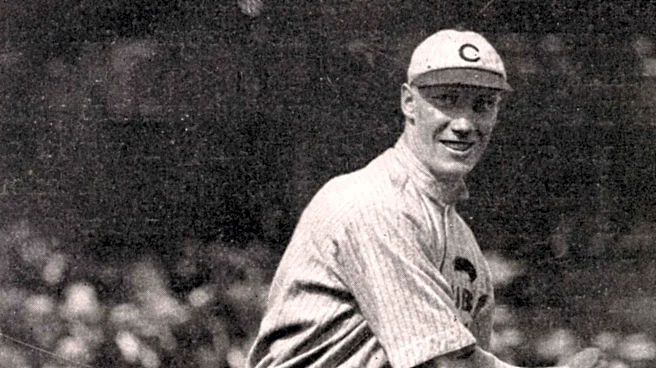




Long before the Yankees became the Yankees of Ruth, Gehrig, October mythology, and even Gerrit, Leonard Leslie “King” Cole (not to be confused with Nat) was one of the franchise’s most intriguing early arms. For a season, he looked like the kind of pitcher who could help stabilize a club still searching for its identity.
Instead, the ending was rushing toward him long before anyone realized it. Tragically the King’s New York chapter became one of the shortest, strangest, and saddest stories of the franchise’s
early years.
Leonard Leslie “King” Cole
Born: April 15, 1886 (Toledo, IA)
Died: January 6, 1916 (Bay City, MI)
Yankees Tenure: 1914-1915
Before he ever became “King,” Leonard Leslie Cole’s story began in much humbler surroundings. Born on April 15, 1886, in the rural Iowa town of Toledo, Cole’s early life carried a level of instability that would quietly mirror the unpredictability of his later baseball career. A troubled family situation led to his separation from home at a young age, and by 14 he had been sent to the Industrial School for Boys in nearby Eldora. In those difficult early years, the baseball diamond quickly became home.
By his late teens, Cole had already built a reputation as a talented pitcher for Toledo’s town team, the kind of local arm whose name traveled beyond county lines before organized baseball ever formally called. His path to the majors was anything but ordinary.
In 1907, Cole joined one of the era’s barnstorming “Bloomer Girls” teams, one of the traveling girls clubs that toured the country playing against town, semipro, and minor league men’s teams. To help draw crowds and raise the level of play, these clubs often employed male pitchers and catchers known as “toppers,” players who wore wigs to blend into the novelty of the traveling roster. For a brief stretch, Leonard Cole was one of them.
It is one of the strangest and most perfect details in his baseball story: before becoming King Cole, he sharpened his game as a pitcher for a Bloomer Girls club, barnstorming across the Midwest and learning the loose, restless rhythms of early baseball life. That journey helped carry him to Bay City, Michigan, a place that would become deeply important to both his personal and professional life.
By 1908, Cole was pitching for semipro clubs in Iowa and Michigan, continuing to sharpen the command and durability that would later define his major league peak. Then in 1909, Bay City gave him the kind of platform every talented regional arm needed. He thrived there.
Cole went 21-7 as Bay City’s ace, a dominant season that drew the full attention of the Chicago Cubs, still a powerhouse having won three pennants in a row from 1906–08 and the last two World Series in a row. Chicago signed Cole and gave him a chance late that season to make his professional debut, and he made sure no one forgot it, throwing a six-hit shutout in his major league debut against the Cardinals while also collecting three hits at the plate.
Just like that, the road from rural Iowa, reform school, and barnstorming Bloomer Girls clubs had delivered him to the major leagues. The Bay City chapter changed more than just his baseball life.
During the offseason, Cole stayed in Michigan, took up barbering as a trade, and earned yet another fitting nickname: “The Bay City Barber.” It was there that he also met Ada Seder, beginning the relationship that would soon lead to marriage just as his Cubs career was taking off. By the time 1910 arrived, Cole was no longer just a fascinating baseball story. He was on his way to becoming one of the National League’s best pitchers and be anointed King.

Cole won 20 games for the Cubs in 1910, leading the Senior Circuit with a 1.80 ERA and posting the kind of frontline production that made him one of the National League’s top arms. In the Deadball Era, where one run often felt decisive, pitchers who could control games deep into the afternoon carried enormous value, and Cole fit that mold perfectly. It was the season that truly made “King” feel like more than just a nickname, and if the NL Rookie of the Year Award existed back then, he probably would’ve won going away.
The Cubs romped to their fourth pennant in five years with 104 wins but fell to the similarly potent Philadelphia Athletics in the World Series. Cole got the start in Game 4, which ended up being the only playoff start of his career, and held the A’s to three runs in eight innings of work to help the Cubs stave off a sweep in their home park (West Side Grounds, Wrigley’s predecessor). Ace Mordecai “Three-Finger” Brown relieved him and held the A’s in check while the Cubs rallied a couple outs from elimination to tie it in the ninth on a leadoff double by Frank Schulte and a game-tying triple from player-manager Frank Chance. They ended it in the 10th on a Jimmy Archer and a walk-off single from left fielder Jimmy Sheckard. Alas, the A’s followed suit, beating up on a tiring Brown—starting on no rest, because hey it was 1910—to take the series with a 7-2 triumph.
Cole followed that with another strong year in 1911, winning 18 games and proving the previous season was no fluke. Even if he did not quite match the 1910 peak, Cole still looked like the kind of pitcher a manager could trust every time they put him on the rubber. At his best, he was not overpowering so much as dependable, the kind of arm managers leaned on because they knew exactly what they were getting. Then came the collapse.
The 1912 season started disastrously in Chicago. The sharpness that had defined his best years disappeared almost overnight, and what had once looked like steady command turned into something far less reliable. The King had become the Jester and was so famous for the excuses he gave that he inspired short story “Alibi Ike.”
The Cubs eventually sent him to Pittsburgh to finish the season, where he was better, but not remotely close to the pitcher he had been just a few seasons ago. The brilliance of 1910 had already started to feel far away. So far away that Cole was sold by the Pirates to Columbus of the minor league American Association.
After spending the winter barbering in Chicago and Bay City, Cole proved his career wasn’t over by reporting to Columbus and having a stellar year. He posted a 23-11 record and received offers from several major league clubs following the season. The New York Yankees, now managed by Cole’s former boss with the Cubs, Chance, had the winning bid.
When New York picked him up for the 1914 season, Cole was still chasing the heights of his Cubs peak as much as he was trying to prove he still belonged in the major leagues at all. And for a time, it looked like he did. In that comeback season Cole went 10-9 with a 3.30 ERA making 15 starts in 33 games.
One fun fact from Cole’s first season with the Yankees popped up on October 2, 1914 at Fenway Park. Cole entered in relief of Carroll Brown, who started the game opposite of a rookie left-hander named George Herman Ruth in Boston. In the Babe’s third big-league game, the 19-year-old would limit his future team to six hits on the mound and lead off the seventh inning with a double off Cole — Ruth’s first MLB hit. Little did the 1,500 or so in attendance at the still-nascent ballpark know that they were witnessing history.
Cole’s first season with the Yankees gave the club exactly what early-era teams valued most from a pitcher: dependable innings and a calming presence on a still-developing staff. He was no longer the 20-game winner from his Cubs peak, but the command and poise that had once made him so valuable were still visible.

Across the 1914 and 1915 seasons, Cole would go 12-12 with a 3.27 ERA over 192.2 innings in pinstripes. Those numbers tell the story of a pitcher who still knew how to survive, compete, and help a club even as the overpowering version of his earlier career had faded.
That makes 1914 feel especially important in hindsight. It would be the final season in which Cole still looked like a veteran pitcher writing a respectable second act rather than a player unknowingly entering the final chapter of his life. That is what makes the turn into 1915 feel so much heavier.
In spring training, Yankees manager Bill Donovan noticed something was wrong. Cole had developed a growth on his leg, something he had apparently ignored for years because it had not yet caused him any pain. That detail says so much about the era and perhaps about Cole himself. Players then often pitched through discomfort, lived hard, and treated warning signs as inconveniences instead of alarms.
Cole’s instinct was simply to keep going until someone physically stopped him. That refusal to stop becomes the emotional center of the story. Even after surgery to try to address the tumors, Cole pushed to return quickly, insisting he would be back within weeks. And he did come back, pitching for the Yankees that summer despite diminished stuff and erratic command. The performances were uneven, and the club’s patience wore thin, but there is something deeply human in the image of a pitcher trying to outrun what his body was already telling him.
The quirks of his life off the mound only deepen that feeling. Cole’s 1915 season included missed trains, an indefinite suspension, and even an automobile accident in Yonkers that briefly put him in legal trouble, all while his health continued to deteriorate. It creates the portrait of a talented early ballplayer living with the loose structure and restless unpredictability of the pre-modern game, where routines were fragile and careers could tilt off course in an instant.
Then came the cruelest turn. By December, the cancer had returned aggressively. What had once seemed like a manageable operation became terminal illness, and on January 6, 1916, Cole died at just 29 years old. For a pitcher talented enough to win 54 major league games before turning 30, the loss feels especially haunting.
His Yankees chapter lasted only two seasons, but it remains one of the organization’s earliest reminders of how quickly baseball promise can vanish. What makes King Cole such a compelling birthday subject is not simply the tragedy. It is the strange mix of brilliance, stubbornness, unpredictability, and vulnerability that defined his final baseball years. In another era, maybe the diagnosis comes earlier. Maybe the recovery plan is stricter. Maybe the life lasts another few decades.
Instead, King Cole’s Yankees legacy became a snapshot of baseball’s rougher early century. A time where even “Kings” were still barbers in the offseason. A time when people and players alike ignored warning signs of their health. A time when the storylines the games and its players was able to create mattered almost as much as the games themselves.
Happy birthday, King Cole.
See more of the “Yankees Birthday of the Day” series here