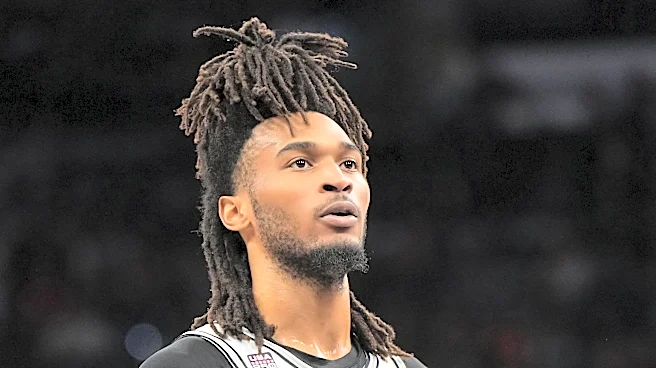


Shaedon Sharpe deactivated his instagram account and it’s hard not to know why. Internet commentary is the unfiltered id of society and he had the audacity to commit a professional athlete’s one unforgivable sin: he got injured.
In the grand scheme of things, a young man in his twenties tearing his meniscus isn’t some great tragedy. He’ll eventually heal, be able to walk again, and live a normal life, but Shaedon Sharpe is anything but normal. He’s a superhuman able to defy the laws of physics each
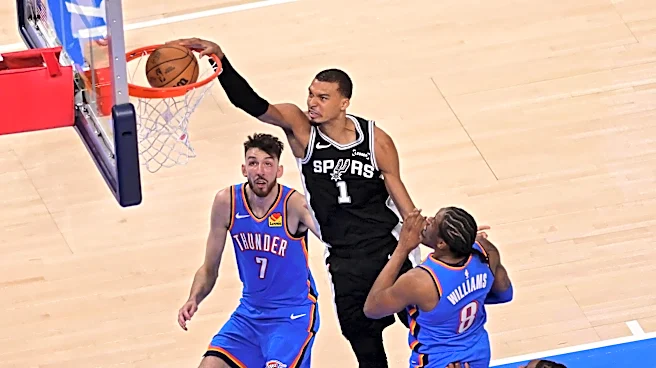
time his feet leave the ground, hanging in the air for an impossible amount of time before he crams the ball through the rim, just as gravity reasserts its tenuous hold on him.
I’ve watched and re-watched enough Shaedon Sharpe slams that it seems like the novelty should’ve worn off, but it hasn’t. At this point, I don’t think it ever will. Witnessing a Shaedon Sharpe dunk is to experience every synapse in your brain firing, creating more synapses, those firing, bringing you to the verge of awareness so transcendent that you can almost see and understand the area that exists between dimensions.
Now, an injury has robbed us of that sensation for at least six months, probably longer. Adding an obstacle to a season that hasn’t yet begun. For the second year in a row, a young Trail Blazers guard had his body betray him in the offseason, inching a career already off-track a little further off the rails.
For a fanbase following a franchise snakebit by injuries, in general, and meniscus tears, specifically, the Shaedon Sharpe news was a re-opening of wounds barely scarred over. As raw as the hurt is on those exposed nerves, I know it’s much worse for him. The pain isn’t just figurative, the trauma isn’t just emotional.
I can only imagine what Sharpe is going through during his recovery, but what I don’t have to imagine is how mean and self-centered fans can be in that moment. Unfortunately, I know that cruelty firsthand.
A Bittersweet Memory Soured
I was at Moda Center for what turned out to be Greg Oden’s last game in a Blazer uniform.
Two years after Portland made him the first overall pick, the investment was starting to pay off. The big man’s skills were still very unrefined, but his impact on the court was undeniable. He was a physical specimen whose very presence warped play around him on both sides of the court, but especially when he was acting as the defensive anchor.
In an early season game against the Spurs, I remember watching Oden make Tim Duncan look overmatched, old, and irrelevant. The same Tim Duncan who was an All-star that year and a starter for an NBA champion five years later couldn’t keep up with Oden’s physicality or athleticism. At the time, I thought that the potential of both the promising center and the young Blazers would be finally realized.
Fast forward to yours truly attending a Saturday evening tilt against the Rockets; a rematch against the team who had knocked the Blazers out in the first round the year prior and whose own former first overall pick center phenom was having injury issues.
The game had barely started when Oden went to provide weakside help on an Aaron Brooks drive. He planted his feet and rose up to contest the floater in one explosive motion that produced so much force that it ripped his kneecap completely in half. It was gruesome. A giant, powerful exemplar of a man immediately crumpled to the floor, fragile and helpless.
The arena fell quiet as a library. Brandon Roy put his hands to the sides of his head, pantomiming the silent scream held within all of us. As the team captain watched his junior writhe in agony, he slowly collected himself, walked over, reached out and held Oden’s hand in a beautiful poignant moment of comfort.
It was right then that I heard someone a few rows behind me say, “Pfft, what a bust.”
It was something so shocking in an arena already experiencing a state of shock, that the shock on top of shock somehow became a cold splash of reality that sobered me up enough to turn and glare at the offender. Our eyes met briefly before he turned his attention to the floor in shame. That’s when I realized I wasn’t alone in the staredown, dozens of us were sharing the quiet dismay he galvanized.
I couldn’t tell you anything about the people who sat near me who were my allies in that encounter, but I could pick the guy who ruined that moment for us out of a police lineup all these sixteen plus years later. I can recall every scatalogical detail of the turd in the punch bowl, but don’t remember the color of beverage it swam in.
With no eye contact to fence them in, unpopular and impolite opinions run rampant in the free range of internet discourse. Engagement is king; anger, outrage, and shock its loyal subjects. The further away communication gets from human-to-human contact, the more emboldened it is to become inhumane.
Who seems further removed from the general public than professional athletes? They’re more gifted than us and richer than us, breathing the rarefied air of the elite. It’s easy to objectify idols and treat athletes as totems for our entertainment when you only see them on a screen or witness them from a hundred feet away. They’re untouchable.
Out of the spotlight, they’re just as human as we are. Flesh and blood, full of thoughts and feelings that more than likely mirror our own. They’re just as likely to experience a sense of loss.
Professional sports don’t shield its participants from tragedy. Sometimes professional sports expose them to it.
A New Study, an Old Truth
In case you missed it, a new peer-reviewed study of CTE in NFL athletes was released recently and the results are damning. Of the 338 former players who donated their brains for study post-mortem, 315 of them were diagnosed with CTE. To give you an idea of the scale, CTE is diagnosed in less than one percent of the general public.
For those of you who don’t know, CTE stands for chronic traumatic encephalopathy, a brain disease caused by multiple blows to the head killing nerve cells. The symptoms read like a horror novel: memory loss, dementia, mood swings, substance abuse, emotional instability, impulsive behavior, aggression, depression, suicidal thoughts and behavior, shaking, and gradual loss of control of movements, such as walking, speaking, swallowing and breathing.
Yikes.
I first became aware of CTE in 2007, when my favorite professional wrestler, Chris Benoit, was diagnosed with it after committing the tragic murder-sucide that took his life and the lives of his wife and young son.
The loss hit me hard. In my twenties, my wrestling fandom had become too sophisticated to appreciate cheap gimmicks or quick bouts that predictably ended with a finishing move on some no-name jobber. I needed the match to tell me a story. I needed a tactician who knew how to work the ring in the mold of Ricky Steamboat, Randy Savage, Curt Hennig, Arn Anderson, and Brett Hart.
For me, nobody embodied that style more than Benoit. He combined the perfect technique and ring positioning of a tactician with the reckless daring of a high-flyer. He was equal parts old school and innovator, a student reverent enough of the craft to know just how and when to push its boundaries. And I loved him for it.
When I got tickets to see him live in the Tacoma Dome at Spring Stampede ‘99, I was beyond pumped. I couldn’t even get any rest the night before, I was like a kid on Christmas Eve. On the day of the event, the forties my buddies and I chugged in the parking lot before entering the arena only further stoked my fervor.
The match lived up to the hype. A tag-team bout full of double moves, a broken table, a negligent referee, and a touch of outside interference already had me worked up in a froth. When Chris Benoit finished it with a flying headbutt off the top rope onto a steel chair placed on the head of his opponent, I absolutely lost my mind.
As he raised his hand victorious, brow covered in blood, I was sent into sleep deprived, malt liquor induced euphoria. Chris Benoit was him.
Looking back, the joy of that moment is long gone, tainted by the knowledge that it no-doubt contributed to the condition that led to the horrible incident that took three innocent lives. A minor footnote to the tragedy is that I haven’t watched a professional wrestling match since.
Five years later, another hero of mine who played an entirely different sport was diagnosed with CTE after committing suicide. Junior Seau was just able-minded enough to know the source of his issues, which were memory loss, mood swings, emotional instability, impulsive behavior, aggression, depression and suicidal thoughts, so he pointed the gun at his heart to preserve his brain for study.
Now I don’t watch football, either.
Get Well Soon, Shae
I say none of this to be sanctimonious, nor to be smug about my own personal choices. I just know where I draw the line for myself. I’m not here to judge where others draw that line for themselves.
People are going to watch and play professional football and wrestling for as long as it exists. I’m sure of that. It won’t matter how much we highlight the checkered history full of retirees who are cursed to live in the aftermath. For many, the call of glory and controlled, competitive violence is impossible to ignore; its hot, brutal embrace encouraged.
I just can’t anymore. I’m too sensitive now that I’m aware of the harm done. Maybe I’m overly sensitive, but that’s fine. I’d rather my heart bleed than be calloused. I think the world is all stocked up on the latter as it is.
I know this is a basketball site and I’m here to provide armchair basketball analysis. Eventually, I have to tackle the topic of the basketball implications of Shaedon Sharpe’s injury. I just didn’t want to do it before I acknowledged the human element of all this first. A young man whose livelihood depends on athleticism suffered an injury that put it at risk.
Get well soon Shaedon Sharpe, but don’t do it for your teammates, the organization, or the fans. Get well for yourself. Get well not just for us, but for the people who are going to care about you when the spotlight moves on.