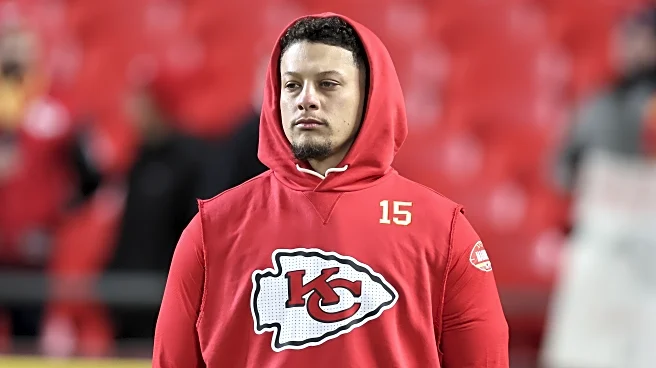

The torn ACL and LCL suffered by the Kansas City Chiefs’ quarterback Patrick Mahomes on Sunday afternoon are not the first injuries he’s sustained during his career — but they are the most severe. For
these injuries, the only path forward is surgery and rehabilitation. That’s unfamiliar territory for an organization (and fan base) that has grown accustomed to watching the team’s two-time MVP defy medical expectations after gut-wrenching scares.
So Mahomes wasted little time shifting his focus toward 2026 and beyond.
On Wednesday, Rick Burkholder — the team’s vice president of sports medicine and performance — explained how the quarterback quickly moved from a postgame MRI to seeking the opinion and surgical expertise of Dr. Dan Cooper, who is the head team physician of the Dallas Cowboys.
“Dr. Cooper set up an appointment for him Monday afternoon,” said Burkholder, “and then operated on him Monday night.”
This was unusual, because ACL surgery is typically delayed until swelling around the knee subsides — but the full extent of Mahomes’ injury demanded an accelerated timeline.
“The reason he wanted to operate on him quickly — where we usually wait on the ACLs — is because [of] the LCL,” explained Burkholder. “We wanted to reattach the avulsion injury there.”
According to Dr. Cooper and the Chiefs’ team physician, however, everything involved with this injury was fully correctable; Burkholder noted they had found no artery, nerve, joint-surface or meniscal damage.
And Burkholder revealed that Mahomes is already doing just what we would expect: taking the injury head-on.
“He has already started rehab down in Dallas,” he said. “He was there first thing Tuesday morning. He’ll do that through tomorrow — and then he’ll be back here Friday.
“In the past, with Patrick and his injuries, he attacks them and does very well. I’ve talked to him every day — and I know Coach [Andy Reid] has, too — and he’s already on it. He’ll return here Friday. For the majority of the rehab, he will do it with my staff — and in particular, [assistant athletic trainer] Julie Frymyer, who’s done his dislocated patella, his toe injury and his ankle injuries.”
Burkholder said the “ballpark” estimate for Mahomes’ return is nine months — although it could be “a month or two” or a “month or two” less. Some of that will depend on more specific details about the injury that are still being gathered.
“We’re doing a lot to get his muscles firing and get his swelling down,” Burkholder said. “He’s in a protective brace right now.”
With rehabilitation underway, Mahomes’ season may be over — but the work continues. The routine will look different than his usual preparation — but will be just as demanding.
“As a player, his mindset is a little different than most,” observed Burkholder. “He is so regimented in what he does; he’s in here at 6:00 a.m., he’s the last guy out at night, he’ll take the rehab like that… When you add up all the little things, that allows the player to get back faster. They don’t heal up any faster; they just get back to performance faster.”
At 30 years old, Mahomes still has a significant amount of football ahead of him. That reality must guide every step of the recovery process. And Burkholder’s remarks make it clear: there may not be another NFL player who can be trusted more to give an all-out effort towards the recovery process.