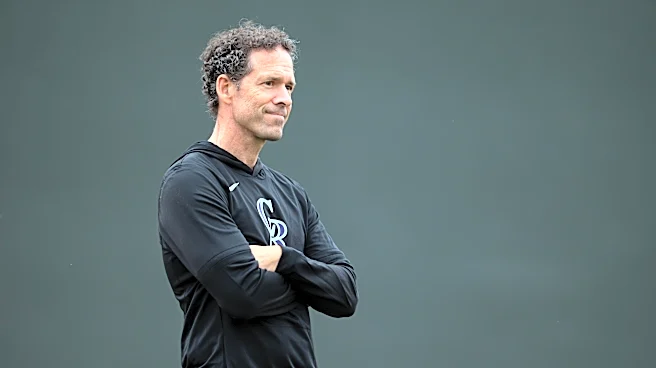





On Saturday, Colorado Rockies president of baseball operations Paul DePodesta spoke with media and provided an update on how the Rockies are approaching the MLB draft, promoting prospects, and the trade deadline in addition to a variety of other topics.
Below are highlights from that conversation that have been lightly edited for clarity.
On the MLB Draft
DePodesta made clear he and his staff are focused on the coming MLB Draft.
When asked about whether the Rockies were developing a “type of player” and what the Rockies are
looking for in potential draftees, DePodesta answered as follows.
I think we even tried to do that through the course of this off season. It was really starting to try to create a shared vision for the organization about what we wanted our guys to look like, both pitchers and position players. I think we’ve communicated that throughout the course of the spring with our scouts, our player development people, even with our major league team, and I think as we go into the draft process, my guess is a lot of our selections will reflect that. It’s hard to find 21 players for 20 rounds that are going to fit that precisely, so that’s not necessarily what we’re trying to do. It won’t be cookie cutter, but I think there will be elements of each of those players that absolutely fit our philosophies.
DePodesta described his thinking about how the baseball environment of Coors Field will affect the organization’s decision making.
There are some things about this ballpark certainly that make a difference, and we’ve got more acreage to cover than anybody else, so we haven’t been shy about saying how important we think outfield defense is. We also think we need to put the ball and play more. We’ve talked about that all year, so those are, I think, at least a couple things, high level, that are certainly important to us. On the pitching side, we need to throw strikes, and we know that we can’t afford to walk people, really. In general, you certainly can’t afford to walk them here because that ends up being crooked numbers a lot of times on the scoreboard. So we want to have an aggressive mentality on the mound.

I think the bottom line is usually good players. Now there are certain players that will probably take more advantage of being here than others, and vice versa, but I think (the) bottom line is that talent matters. So we’re still going to look for the most talented players and find ways that we can maximize their potential in this venue,
I think there are probably guys that we would say would be able to take better advantage of either being here or not, both position players and pitchers, but I don’t think there’s anyone where we’ve said, ‘Oh, he’s really talented, but that wouldn’t be a fit for us.’ I don’t think that’s the case at all.
We want guys who are hard to hit, and we want them to throw strikes, so ideally you want them in that quadrant, if you were thinking about a sort of a four-square matrix. But those guys are hard to find, and there aren’t that many of them in the game, so we have to make certain trade-offs. Then it’s how much contact you’re willing to give up to throw enough strikes, or how much strike throwing are you willing to give up to get less contact, and I really think it’s on an individual-by-individual basis. So, as I mentioned earlier, I don’t think our roster is going to be cookie cutter, where every single guy is going to look the same. I think we’re probably going to look for elements of each of those things to make sure that as a staff we cover all the bases.
On playing baseball at elevation
According to DePodesta, the Rockies continue to learn more about how elevation affects players and the game of baseball.
There’s the physics of playing here. There’s also the physiology of playing here, and doing that — having to go in and out of that constantly through the course of a six-month season — presents unusual challenges, but (it’s) certainly something that we’re trying to conquer. I think we made some real headway so far this year, just in terms of how we’ve played on the road, and even how we’ve adjusted during some of the longer home stands.

I think I got a lot of really good advice before coming here, and a lot of good insights from people who had been here for a long time, so I think I was at least somewhat mentally prepared for it. But I think so far, the realities of having to go in and out (of elevation) all the time is something that’s hard to really appreciate until you do it, until you see your players have to go through it. And I think the other piece is probably the just the length that’s necessary in your bullpen on a daily basis, just the amount of pitching we have to use to get through games, especially when you have seven-game stretches or 13-game stretches, or like our current 17-game stretch. Just knowing going into that, that it’s virtually impossible to get through a 17-game stretch and not make player moves. You’re just going to have to be moving players on the roster here and there to get through those kind of stretches. So we need to be prepared for that, both in terms of the players we have available, but also in terms of how we sort of maneuver the roster, and it’s not necessarily about always optimizing for a single day. It’s how are you optimizing for this 17-game stretch, for instance.
On a crowded outfield
When DePodesta was asked about the bounty of outfielders currently in the Rockies system, he saw it as a good problem.
We want more problems just like this one. We talked a lot in the off season and even throughout spring about the importance of competition and young guys earning their spot, and I think we’ve really benefited as a team just from that philosophy and not just in the outfield, but in other places, too. Now we have a lot of guys who who’ve earned it, and now it’s a matter of opportunity for some of these guys. There was an opportunity for Cole (Carrigg) to come up, and he’s absolutely taken advantage of it. There was an opportunity for Sterlin (Thompson) to come up, (and) he took advantage of it. So I think some of these things are just about timing. I would imagine that the guys who aren’t here now will be here again at some point soon because other opportunities will arise. They just will. So we have yet to get to the point where we feel like we have too many good players. Does it give us opportunities to potentially make moves? Sure. But we’re not anxious to do that. I think we feel we feel good about the depth that we have right now,
On the trade deadline
Even though the Rockies’ current focus is on the MLB draft, DePodesta also described their approach to the trade deadline on August 3.
We’ve already started having exploratory conversations with some other clubs. We’ve also been doing our homework on a lot of other teams, so we have a good sense of their prospect depth and whether or not there might be matches for us in different situations. (We’re also) just trying to understand what it is they’re looking to do at the deadline, so that when the time comes, probably post-draft, we’ll really be ready to hit the ground running at that point.
On their changing use of pitch suggesting
DePodesta indicated their pitch suggestion process is evolving.
I think we just continue to evolve it, to be honest. We always talked about it really being a collaborative process from the beginning, and some of it’s about sequencing. It’s like, ‘Well, who’s offering the first suggestion, and how exactly are we doing that?’ So, some of that has changed with certain pitchers — not with all of them — and part of it has really, I think, been experimental on our part, trying to figure out what might work best, and even what might work best with different combinations of pitcher and catcher. So it’s very much still a work in progress. But I think our game prep hasn’t changed all that much in terms of the collaborative process that’s involved in that. So even if it’s the catcher making the first suggestion or the pitcher making the first suggestion instead of the pitching coach, all the information that was feeding that original suggestion has been very much the same.
Closing thoughts
Clearly, DePodesta was never going to divulge any secrets, but he did give a sense of the factors they were taking into account in developing their strategy for the MLB draft. In addition, I take his comments about the outfielders to mean that changes are coming, depending on the situation. But right now, his focus is on the draft.
This week on the internet
I thought this was pretty terrific.
There’s one other thing that stood out to me.
Did you notice how fellow catcher Brett Sullivan does the presenting and not manager Warren Schaeffer? That suggests to me that Schaeffer is decentering himself in the clubhouse. In other words, it’s another way in which he’s telling players this is their space, not something he controls.
On the Farm
Triple-A: Albuquerque Isotopes 7, Round Rock Express 3
Zac Veen got the party started with a first-inning home run, his 15th of 2026. However, the lead was short lived with the Express answering back with a homer in the bottom of the first and then a two-run homer in the bottom of the fourth from John Taylor. But Veen was not yet done. He tied the game with a second home run in the sixth, which preceded a series of Isotopes scores that saw them take a 5-3 lead before their half of the sixth had ended. They tacked on another run in the seventh off a Kyle McCann RBI single that brought home Jordan Beck and added one more run in the ninth. On the pitching side, starter Valente Bellozo lasted just 4.2 innings, allowing three runs (all earned) on six hits.
Double-A: Hartford Yard Goats 5, Somerset Patriots 3
This one was all Yard Goats off the strength of a dominant Jackson Cox start that saw him going six innings and allowing no hits. He struck out three and walked four but did not allow a run. On the offensive side, the Yard Gots got off to a quick start in the first with a two-run Roc Reggio homer, his 12th. In the second inning, Andy Perez hit a sacrifice fly to bring home Brayden Wimmer and make the score 3-0. Adding to that, Dyan Jorge and GJ Hill also had scores. It was a good day at the ballpark for the Yard Goats.
High-A: Spokane Indians 9, Hillsboro Hops 3
It was a day of steady offense for the Indians. Leading the way was Robert Calaz with three hits and four RBI. Tevin Tucker and Kevin Fitzner contributed two more. Each player on the Indians roster had a least one hit on the day. Yujanyer Herrera took the mound and went 5.0 IP, allowing one run (earned) on one hit. He struck out three, walked one, and allowed one home run.
Single-A: Tower Buzzers 13, Fresno Grizzlies 0
It just wasn’t the Grizzlies’ day. Sarter Riley Kelly lasted just 3.1 innings. During that time, he allowed seven runs (all earned) on eight hits. In addition, he walked three, struck out four, and surrendered two home runs. Reliever Grif Hughes struggles as well. In 3.2 IP, he gave up three runs on five hits. The Grizzlies had eight hits, but were never able to bring runners home to score with Roldy Brito notching three hits. Cam Nelson, Derek Bernard (as a PH), Carlos Renzullo, Jeremy Ciriaco and Cruzmel Arias each had one hit to make up the other five.
Rockies trade deadline needs, June standouts, winning at Coors Field | Mile High Territory (podcast)
Ryan Spilborghs and Troy Renck have embarked on a new podcast project. Check it out!
Astros Targeting OF, SP at Deadline: Moniak, McCarthy, Skubal, Gray | The Crawford Boxes
Yesterday, Bob Nightengale reported on some possible Astros trade interests. Here’s the ‘Stros take on the situation from our sister SB Nation site, The Crawford Boxes.
Join the conversation!
Sign up for a user account and get:
- Fewer ads
- Create community posts
- Comment on articles, community posts
- Rec comments, community posts
- New, improved notifications system!
Please keep in mind our Purple Row Community Guidelines when you’re commenting. Thanks!